The Olympic Rings and Flag
The Olympic rings are one of the most recognized symbols worldwide. They are much more than a simple logo; they are a powerful symbol of unity, diversity, and the enduring spirit of the Olympic Games. Representing the interconnectedness of continents and the inclusive nature of the Olympics, the rings stand as a testament to the values of international cooperation, cultural diversity, and the pursuit of excellence.
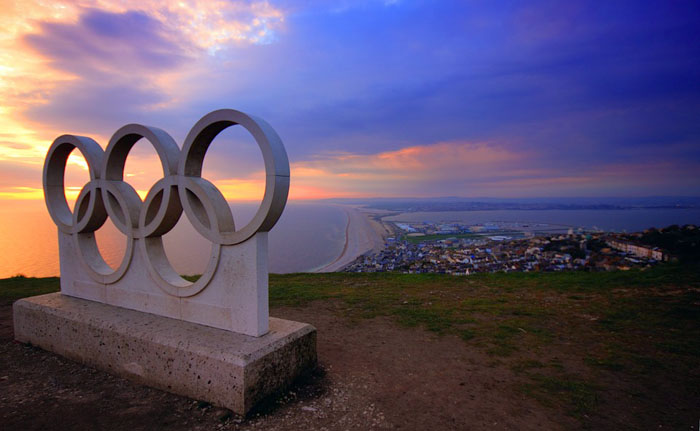 Olympic rings at sunset
 Design
The design of the official Olympic flag, which is five interconnected rings on a white background, was created Pierre de Coubertin in 1914. The colors are (from left to right) blue, yellow, black, green, and red. It was first flown at the Antwerp Olympic stadium in 1920.
Representation
The five Olympic rings represent the five major regions of the world – Africa, the Americas, Asia, Europe and Oceania, and are interconnected to symbolize the friendship to be gained from these international competitions. The colors were chosen because at least one of them appeared on the flag of every country in the world.
History
At the closing ceremony of the Games, the mayor of the current host city presents the flag to the mayor of the next host city. The original Olympic Flag that was first unveiled at Antwerp in 1920 was finally retired after the 1984 Games at Los Angeles, and a new flag was flown at the 1988 Seoul Games.
Educational Values
In 2006, IOC identified five educational values of Olympism.
- Pursuit of excellence (blue)
- Joy of effort (black)
- Fair play (red)
- Respect for others (yellow)
- Balance between body, will and mind (green)
Trivia
- There is one country's flag that has every color that is represented on the Olympic flag - South Africa
Related Pages
- Other Olympic Traditions
- Olympic Oath
- Olympic Creed & Motto
- Olympic Pictograms
 Any comments, suggestions, or corrections? Please let us know.
Old Comments
- I think you could you put the Olympic values like friendship as an example so it would catch peoples eyes a bit more. (from alicia, Aug 2012)
- I have an idea - why doesn't the black ring stand for Africa, the yellow for Asia, the red for the Americas, and the blue for Oceania? (from joe, Aug 2012)
- In respect to the 5 rings of the Olympic Games and their colors. The colors add up to 33 on the ancient temple value of colors and also represent the 5 spheres which show over earth 6 times in groups of 5 = 30 and depart on the 18th March, 18th August and 18th November first letters of each of those months spelling MAN. The colors are fixed into power values and can be matched against other objects which are also color valued against the same values such as the MAGER DISC ALSO CALLED THE Rosetta whos value is 42 used all over the world in dowsing and sensing, the Round Table painted up by Henry 8th and value 33 in colors. I can also direct to you the mind to mind chart now being extracted from the form which provides the colors and the message it is sending over for the time between 13/7 and the 18th August which you will fine very interesting, if you want to know more. My research has been going on since 2003 and the colors have been tested by a London leading Museum under their test conditions, but one thing is certain the true meaning of the rings is very different from that being expounded as the basis is of a very great worry just to provide a little more info the last letter over the UK is an I by a line across the UK at 18.00 hours GMT on the 31/7 and this area will be in use until 18th August thus also 18 days but its the other letters which show something is interlocking by colors to symbols and this is what the biolocation forensic scientists are looking into with my help by use of a new magnetic radio telescope . (from p.e.vincent, June 2012)