Cycling VO2max Calculator
Quick Answer
This calculator estimates your cycling VO2max using the validated Storer-Davis formula (1990), which predicts maximal oxygen uptake from cycle ergometer peak power output. Results help you benchmark aerobic fitness and track training progress.
- Uses the Storer-Davis equation with ~2.8 ml/kg/min accuracy
- Provides results in both L/min and ml/kg/min formats
- Includes fitness category classification and percentile ranking
What is Cycling VO2max?
VO2max (maximal oxygen consumption) is the gold standard measure of aerobic capacity in athletes. It represents the maximum rate at which your body can consume oxygen during intense exercise. For cyclists, this metric is particularly important as it directly correlates with endurance performance potential.
The cycling VO2max test uses a cycle ergometer to progressively increase workload until the athlete reaches exhaustion. This calculator uses the Storer-Davis formula to predict your VO2max based on peak power output, body weight, age, and gender—without requiring expensive gas analysis equipment.
How to Conduct a Cycling VO2max Test
Ergometer Required: A cycle ergometer capable of measuring and adjusting power output is essential. The Monark bike is commonly used in laboratory settings. Some athletes may use their own bicycle mounted on a smart trainer or power-measuring rollers.
Other Equipment Required: For direct measurement, you need oxygen consumption measuring equipment (e.g., oxygen and carbon dioxide analyzers, Douglas bags, or metabolic cart). For prediction using this calculator, you only need accurate power measurement, a stopwatch, heart rate monitor, and optionally an RPE scale.
Pre-test Procedures: Explain the test procedures to the subject. Perform health risk screening and obtain informed consent. Record basic information (age, height, body weight, gender). Check and calibrate equipment. Adjust seat and handlebar heights appropriately. Perform a 5-10 minute warm-up. See more details of pre-test procedures.
Test Procedure: Exercise is performed on a cycle ergometer with workloads progressively increasing from moderate to maximal intensity. Common protocols include 25-30 watt increases every 2-3 minutes. The test continues until volitional exhaustion or the athlete can no longer maintain the required cadence (typically 60-90 RPM).
Measurement: Record the peak power output achieved at or near test completion. For direct VO2max measurement, oxygen uptake is calculated from ventilation and expired gas analysis. Heart rate should be measured every minute, along with optional ratings of perceived exertion (RPE).
Understanding the Storer-Davis Formula
Our calculator uses the Storer-Davis prediction equation, published in Medicine & Science in Sports & Exercise (1990). The formulas differ by gender:
Males:
VO2max (ml/min) = (10.51 × Watts) + (6.35 × body mass in kg) − (10.49 × age) + 519.3
Females:
VO2max (ml/min) = (9.39 × Watts) + (7.7 × body mass in kg) − (5.88 × age) + 136.7
This formula was validated against direct gas analysis and has a standard error of estimate of approximately 212 ml/min, making it one of the most accurate prediction equations available for cycling VO2max.
VO2max Scoring and Interpretation
Results are presented as either L/min (liters per minute) for absolute values or ml/kg/min (milliliters of oxygen per kilogram of body weight per minute) for relative values. The relative measure is more useful for comparing athletes of different sizes.
Signs of achieving true VO2max include:
- A plateau or 'peaking over' in oxygen uptake despite increased workload
- Maximal heart rate reached (approximately 220 minus age)
- Attainment of a respiratory exchange ratio of 1.15 or greater
- Volitional exhaustion (unable to continue)
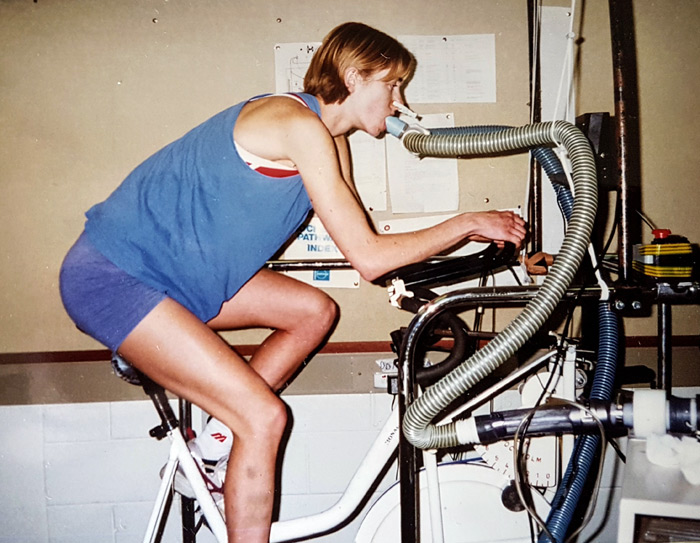
VO2max cycling test in progress
Sport-Specific VO2max Standards
Cycling-Specific Benchmarks
VO2max values vary significantly across cycling disciplines:
| Category | Male (ml/kg/min) | Female (ml/kg/min) |
|---|---|---|
| World-Class Road Cyclist | 75-85+ | 65-75+ |
| Elite/Professional | 65-75 | 55-65 |
| Competitive Amateur | 55-65 | 45-55 |
| Recreational/Club Level | 45-55 | 38-45 |
| Beginner/Untrained | 35-45 | 30-38 |
Professional Cyclist Examples
- Chris Froome: 84.6 ml/kg/min (Tour de France winner)
- Miguel Indurain: 88 ml/kg/min (reported highest ever for a cyclist)
- Greg LeMond: 92.5 ml/kg/min (disputed, but frequently cited)
- Average Tour de France Rider: 70-80 ml/kg/min
Advantages of Cycling VO2max Testing
- Stability: Cycling is a stable exercise mode suitable for participants with balance issues or joint injuries
- Heart Rate Accuracy: The stable position provides more reliable heart rate measurement compared to running's abrupt movements
- Workload Control: Cycle ergometers allow easy monitoring and precise workload adjustments
- Sport Specificity: Ideal for cyclists, triathletes, and sports with cycling components
Limitations to Consider
- Local Muscle Fatigue: Participants unaccustomed to cycling may experience quadriceps fatigue before achieving true VO2max
- Lower Values: Cycling VO2max is typically 5-15% lower than running VO2max in the same individual
- Prediction Accuracy: Calculator results are estimates; direct measurement provides greater accuracy
- Population Validity: The Storer-Davis formula was validated primarily on healthy adults aged 20-70
⚠️ Important Note: The cycling VO2max test is a maximal exercise test requiring a reasonable level of fitness. It is not recommended for recreational athletes or people with health problems, injuries, or low fitness levels. Complete a PAR-Q before testing.
How to Improve Your Cycling VO2max
Based on your calculated VO2max, here are evidence-based training recommendations:
High-Intensity Interval Training (HIIT)
Intervals at 90-100% of VO2max are highly effective. Try 4-6 × 4-minute intervals at maximum sustainable pace with 3-4 minutes recovery between efforts.
Threshold Training
Sustained efforts at 85-90% of maximum heart rate for 20-40 minutes improve both VO2max and lactate threshold.
Long Aerobic Base Rides
2-4 hour rides at moderate intensity (60-75% max HR) build mitochondrial density and capillary networks.
Progressive Overload
Gradually increase training volume by 5-10% weekly, with recovery weeks every 3-4 weeks to allow adaptation.
Medical Disclaimer
Important: This calculator provides estimates for educational and athletic training purposes only. Results should not replace professional medical advice. Always consult with a qualified healthcare provider or sports medicine professional before making health or training decisions. Maximal exercise testing carries inherent risks and should be supervised by qualified personnel.
Frequently Asked Questions
How accurate is the Storer-Davis cycling VO2max formula?
The Storer-Davis formula has a standard error of estimate of approximately 212 ml/min (about 2.8 ml/kg/min), making it one of the most validated prediction equations for cycling. However, for elite athletes or research purposes, direct gas analysis measurement is recommended.
What is a good VO2max for cyclists?
For recreational cyclists, 35-45 ml/kg/min is typical. Competitive amateur cyclists often achieve 50-60 ml/kg/min, while elite professional cyclists may reach 70-85 ml/kg/min. Tour de France winners typically have values exceeding 80 ml/kg/min.
Is cycling VO2max different from running VO2max?
Yes, cycling VO2max is typically 5-15% lower than running VO2max in the same individual. This is due to the smaller active muscle mass engaged during cycling and the seated position. Sport-specific testing is recommended for accurate assessment.
What power output should I use for the calculator?
Use the peak power output achieved during a maximal or near-maximal cycling test. This is typically the power at which you can no longer maintain the required cadence (usually 60-90 RPM), lasting 1-2 minutes at maximum sustainable effort.
How often should I test my cycling VO2max?
For athletes in structured training, testing every 8-12 weeks allows tracking of aerobic fitness changes. During base building phases, consider testing every 4-6 weeks. Avoid testing during recovery weeks or when significantly fatigued.
Can I improve my VO2max through training?
Yes, VO2max can improve 15-20% in untrained individuals through consistent aerobic training. Well-trained athletes may see smaller improvements of 3-5%. High-intensity interval training (HIIT) has been shown to be particularly effective for VO2max development.
Why is relative VO2max (ml/kg/min) more useful than absolute (L/min)?
Relative VO2max accounts for body weight, making it more useful for comparing athletes of different sizes and for predicting performance in weight-bearing activities like climbing. A heavier cyclist may have higher absolute VO2max but lower relative values.
References
- Storer TW, Davis JA, Caiozzo VJ. (1990). "Accurate prediction of VO2max in cycle ergometry." Medicine & Science in Sports & Exercise, 22(5):704-12.
- Andersen LB. (1995). "A maximal cycle exercise protocol to predict maximal oxygen uptake." Scandinavian Journal of Medicine & Science in Sports, 5(3):143-6.
- American College of Sports Medicine. (2018). "ACSM's Guidelines for Exercise Testing and Prescription." 10th Edition, Wolters Kluwer.
- Bassett DR, Howley ET. (2000). "Limiting factors for maximum oxygen uptake and determinants of endurance performance." Medicine & Science in Sports & Exercise, 32(1):70-84.
- Faria EW, Parker DL, Faria IE. (2005). "The science of cycling: Factors affecting performance." Sports Medicine, 35(4):313-337.
- Mujika I, Padilla S. (2001). "Physiological and performance characteristics of male professional road cyclists." Sports Medicine, 31(7):479-487.
- Jeukendrup AE, Craig NP, Hawley JA. (2000). "The bioenergetics of world class cycling." Journal of Science and Medicine in Sport, 3(4):414-433.
Similar Tests
- VO2max Swimming Test
- Treadmill VO2max Test
- Astrand-Rhyming Bicycle Ergometer Test
- YMCA Cycle Ergometer Submaximal Test
- PWC170 Test
- Tri-level Aerobic Test
Related Pages
- See the general protocol method for measuring VO2max.
- Adult VO2max norm values.
- Videos of VO2max Tests being performed.
- Fitness tests for cyclists
- Comparison of Cycle Ergometers
- Cycling Fitness Tests, assessments involving cycling exercise.
- Measuring Oxygen Consumption by Indirect Calorimetry
- Methods for heart rate measurement.
- Ratings of Perceived Exertion Scale if you want to quantify effort during the test.
- VO2max test scores from different sports.
- VO2max test world bests.
 Any comments, suggestions, or corrections? Please let us know.