Agility Cone Drill Calculator
Quick Answer
This calculator analyzes your Agility Cone Drill (Compass Drill) performance by averaging your clockwise and counterclockwise times. Enter both trial times to receive instant performance ratings, asymmetry analysis, and sport-specific recommendations.
- Calculates: Average time, best time, and directional asymmetry
- Based on: SPARQ protocol with 3-meter cone spacing
- Target Sports: Basketball, soccer, rugby, tennis, and team sports
The Agility Cone Drill (also called the Compass Drill) is a lateral movement test that measures the agility of the athlete, especially body control and change of direction. The test involves running to four cones arranged in a diamond pattern around a center cone, covering all directions like points on a compass.
How to Use This Calculator
Follow these steps to calculate your Agility Cone Drill score:
- Complete the Test: Set up 5 cones in a diamond pattern with 3 meters between the center cone and each outer cone. Run the test twice - once clockwise and once counterclockwise with 3 minutes rest between trials.
- Record Your Times: Use a stopwatch or timing gates to measure your time to the nearest hundredth of a second (e.g., 9.45 seconds).
- Enter Your Data: Input your clockwise time (running cones 1→2→3→4→5) and counterclockwise time (running cones 1→4→3→2→5).
- Get Your Results: Click "Calculate" to see your average time, performance rating, asymmetry analysis, and training recommendations.
Pro Tip: For the most accurate results, complete both trials on the same day under similar conditions. Ensure adequate rest (3 minutes) between trials and maintain consistent effort throughout.
Test Purpose and Protocol
Test Purpose: This is a test of speed, explosion, body control and the ability to change direction (agility).
Equipment Required: Stopwatch or timing gates, measuring tape or chalk, 5 marker cones, a flat non-slip surface.
Pre-Test: Explain the test procedures to the subject. Perform screening of health risks and obtain informed consent. Prepare forms and record basic information such as age, height, body weight, gender, test conditions. Measure and mark out the course. Ensure that the participants are adequately warmed-up. See more details of pre-test procedures.
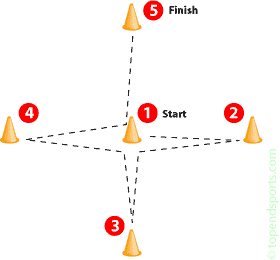 Procedure: The cones are laid out as per the diagram, with four marker cones placed in a diamond shape, and one in the middle. The outer cones are each placed 3 meters from the center. The player crouches behind and with their left hand on the middle cone, facing forwards (towards cone 5). The player then turns and runs to the right and touches the cone (2) with their hand. They then turn back and run to the center cone, out to the next cone (3), back to the center, out to the next cone (4), back to the center and then finally turn and finish by running through the finish line at cone 5. The player is required to touch the cone with their hand at each turn. Timing starts when the hand comes off the center cone, and stops when the chest passes through the line of the final cone. Rest for three minutes, then repeat the drill, moving in the opposite direction (counterclockwise, cones in order 1-4-3-2-5).
Scoring: Record the time to complete the test in seconds to the nearest two decimal places for each direction. The score is the average time of two trials.
Performance Standards and Normative Data
The following table provides performance standards for the Agility Cone Drill based on SPARQ protocols and sports science research. Standards are provided for adult male athletes aged 16-35.
| Rating | Male Time (seconds) | Female Time (seconds) | Description |
|---|---|---|---|
| Elite | < 8.5 | < 9.0 | Professional/National level athletes |
| Advanced | 8.5 - 9.5 | 9.0 - 10.0 | Competitive club and collegiate athletes |
| Intermediate | 9.5 - 10.5 | 10.0 - 11.0 | Recreational competitive players |
| Developing | 10.5 - 12.0 | 11.0 - 12.5 | Youth and beginning athletes |
| Below Average | > 12.0 | > 12.5 | Needs improvement |
Research with youth basketball players (ages 10-12) showed average times of 9.11-10.27 seconds, demonstrating that younger athletes can achieve competitive times with proper training (Ovidius University Study, 2016).
Understanding Bilateral Asymmetry
A key advantage of the Agility Cone Drill is its ability to assess bilateral (left-right) differences in change of direction ability. Asymmetry greater than 5% between clockwise and counterclockwise times may indicate:
- Leg dominance: Most athletes have a preferred turning direction
- Previous injury: Compensation patterns from past injuries
- Training imbalance: Overemphasis on one-sided movements
- Technical inefficiency: Poor technique in one direction
Addressing asymmetry through targeted training can improve overall performance and reduce injury risk. Research by Stojanović et al. (2019) found that bilateral differences in agility performance are common among basketball players and should be monitored regularly.
Sport-Specific Applications
Basketball
Guards who excel at lateral movement can better defend ball handlers and navigate screens. The diamond pattern mimics defensive slides and cutting movements common in basketball.
Basketball SPARQ Testing →Soccer
Midfielders and forwards benefit from improved change of direction when evading defenders, making quick cuts, and transitioning between attack and defense.
Soccer SPARQ Testing →Rugby & Hockey
The multi-directional nature of the test simulates game situations requiring rapid direction changes while maintaining body control and balance.
More Agility Tests →How to Improve Your Agility Cone Drill Time
Improving your Agility Cone Drill performance requires a combination of technique work, strength training, and consistent practice:
- Master Deceleration: Practice rapid stopping and direction changes. The ability to decelerate quickly is often more important than top speed in agility tests.
- Improve Turning Technique: Drop your hips, plant the outside foot firmly, and drive explosively off the planted leg. Keep your center of gravity low during turns.
- Strengthen Key Muscles: Focus on hip flexors, glutes, quadriceps, hamstrings, and ankle stabilizers through exercises like lateral lunges, Bulgarian split squats, and single-leg hops.
- Practice Both Directions Equally: Train clockwise and counterclockwise patterns with equal volume to address any bilateral asymmetry.
- Use Cone-Specific Drills: Incorporate the test setup into your regular training 2-3 times per week. Video analysis can help identify technique flaws.
Athletes typically improve 0.3-0.6 seconds over 8-12 weeks with dedicated agility training.
Frequently Asked Questions
What is a good Agility Cone Drill time?
A good Agility Cone Drill time for adult male athletes is under 9.5 seconds, with elite performers achieving under 8.5 seconds. Female athletes typically score 0.5-1.0 seconds slower. Youth athletes (ages 10-14) may have times between 9-12 seconds depending on training level.
How accurate is this test for measuring agility?
Research shows the Compass Drill has acceptable reliability (ICC: 0.50-0.88) and correlates well with other change of direction tests. However, it measures pre-planned change of direction rather than true reactive agility. For comprehensive assessment, combine with reactive agility tests.
Why is the test called the Compass Drill?
The test is called the Compass Drill because the cone layout resembles compass points - with cones placed in four directions (north, south, east, west) around a center cone, requiring the athlete to run to all directions like navigating compass points.
How much rest should I take between trials?
Rest for three minutes between the clockwise and counterclockwise trials. This allows adequate recovery while maintaining neuromuscular readiness. Shorter rest may result in fatigue affecting your second trial.
What should I do if I have significant asymmetry?
If your asymmetry exceeds 5%, focus on training your weaker direction more frequently. Include unilateral exercises like single-leg bounds and lateral cone hops on the weaker side. Consider consulting a sports physiotherapist if asymmetry persists or is related to pain.
Is this test part of the SPARQ assessment?
Yes, the Agility Cone Drill was part of the original SPARQ basketball and soccer assessment batteries. While SPARQ is no longer active, the test protocol remains valuable for measuring change of direction ability in athletes.
Can I use this test for team assessments?
Yes, the test is efficient for team settings as it only requires basic equipment and can be completed in 2-3 minutes per athlete. For large groups, set up multiple stations and rotate athletes through. Record all times and use the calculator to analyze team-wide trends.
References
- Stojanović, E., et al. (2019). "Reliability, usefulness, and factorial validity of change-of-direction speed tests in adolescent basketball players." Journal of Strength and Conditioning Research, 33(11): 3162-3173.
- Sheppard, J.M., & Young, W.B. (2006). "Agility literature review: Classifications, training and testing." Journal of Sports Sciences, 24(9): 919-932.
- SPARQ Training Protocol. "SPARQ Basketball and Soccer Testing Batteries." Nike SPARQ Assessment System.
- Nimphius, S., et al. (2018). "Change of direction and agility tests: Challenging our current measures of performance." Strength & Conditioning Journal, 40(1): 26-38.
- Ovidius University Annals. (2016). "Testing Agility Skill at a Basketball Team (10-12 Years Old)." Series Physical Education and Sport, XVI(1).
- Haff, G.G., & Triplett, N.T. (2015). Essentials of Strength Training and Conditioning (4th ed.). Human Kinetics.
- Semenick, D. (1990). "Tests and measurements: The T-test." Strength and Conditioning Journal, 12: 36-37.
Similar Tests
- Lane Agility Drill (basketball)
- AFL Agility Test
- Zig-Zag Test
- Illinois Agility Test
- Balsam Agility Run (soccer)
- Arrowhead Agility Drill
Related Pages
Agility Tests
Explore our complete collection of agility and change of direction tests for athletes.
View All Agility Tests →SPARQ Rating System
Learn about the SPARQ assessment battery and how agility testing fits into overall athletic evaluation.
SPARQ Overview →Fitness Testing Guide
Complete guide to conducting, recording, and interpreting fitness tests for athletes.
Testing Guide → Any comments, suggestions, or corrections? Please let us know.