Chester Treadmill Test (CTT) Calculator
Quick Answer
This calculator estimates your VO2max based on the Chester Treadmill Walk Test protocol used by UK Fire & Rescue Services. Complete all 12 minutes at the required gradients to meet the 42 ml/kg/min firefighter fitness standard.
- Calculates estimated VO2max from test level completed
- Based on Professor Kevin Sykes' validated protocol
- Shows pass/fail status against the 42 ml/kg/min standard
The Chester Treadmill Walk Fitness Test is a progressive treadmill test of aerobic capacity, developed by Professor Kevin Sykes from the University of Chester, specifically designed for use by the UK Fire Service as an alternative to the 20m Shuttle Run and Chester Step Test. The Chester Treadmill Police Walk Test (CTPWT) is an adaptation of this test for the Police Service.
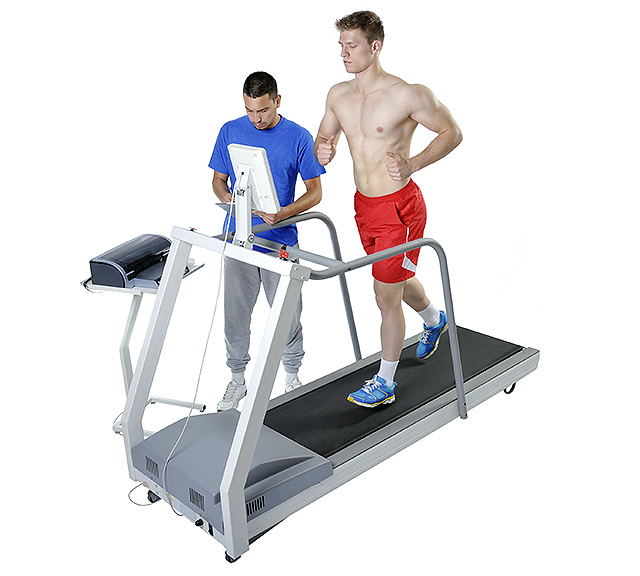
Treadmill testing for firefighter fitness assessment
How to Conduct the Chester Treadmill Test
Equipment Required: Treadmill with adjustable gradient, stopwatch, heart rate monitor, RPE chart.
Pre-test Procedures: Explain the test procedures to the subject. Perform screening of health risks and obtain informed consent. Prepare forms and record basic information such as age, height, body weight, gender, test conditions. Calibrate the treadmill speed and gradient. See more details of pre-test procedures.
Test Protocol
The treadmill is set at 6.2 km/hr (3.9 mph) for the entire test. The gradient starts at 0% for the first two minutes, then increases by 3% every two minutes unless the participant reaches 80% of their maximum heart rate or an RPE of 14. The test ends after 12 minutes, at which point the gradient is returned to 0% and the speed reduced to enable the subject to cool down.
| Level | Time (min) | Gradient (%) | VO2 (ml/kg/min) |
|---|---|---|---|
| 1 | 0-2 | 0 | 14 |
| 2 | 2-4 | 3 | 19 |
| 3 | 4-6 | 6 | 25 |
| 4 | 6-8 | 9 | 31 |
| 5 | 8-10 | 12 | 36 |
| 6 | 10-12 | 15 | 42 |
Understanding Your Results
Scoring: UK Fire & Rescue personnel must complete all 12 minutes to achieve the fitness standard of 42 ml/kg/min VO2max. This is the minimum recommended aerobic capacity for operational firefighting duties.
Result Categories
✓ Pass (42+ ml/kg/min): Meets the national firefighter fitness standard. You have demonstrated adequate aerobic capacity for operational firefighting duties.
⚠ Remedial Range (35-41 ml/kg/min): Below the standard but may continue with a structured fitness programme. Most fire services provide remedial training and retest opportunities.
✗ Below Standard (<35 ml/kg/min): Significant fitness improvement required. May result in temporary removal from operational duties until fitness improves.
The Science Behind the Chester Treadmill Test
The Chester Treadmill Test uses a linear relationship between treadmill gradient and oxygen consumption to estimate VO2max. Walking at a constant speed of 6.2 km/hr while progressively increasing the gradient creates a predictable workload that corresponds to specific oxygen costs.
Why 42 ml/kg/min?
Research by Stevenson, Wilsher, and Sykes (2009) in the Fitness for Fire and Rescue: Standards, Protocols and Policy guide established that firefighters require a minimum VO2max of 42 ml/kg/min to safely perform firefighting tasks while wearing personal protective equipment (PPE) and self-contained breathing apparatus (SCBA).
Firefighting activities can demand up to 82% of VO2max during intense operations. Tasks such as carrying equipment, climbing stairs, and dragging charged hoses require sustained high levels of aerobic effort. The 42 ml/kg/min standard provides an appropriate safety margin for these demanding activities.
Important Considerations
Test Validity: This test could be a maximal test for some individuals. Care should be taken to ensure the test is stopped if the subject is unable to keep up with the workrate or becomes overly distressed.
Handrail Use: Candidates must NOT hold onto the treadmill handrails at any point during the test. Holding rails reduces the workload and invalidates results.
How to Prepare for the Chester Treadmill Test
Training Programme
Royal Berkshire Fire and Rescue Service recommends the following progressive training programmes:
Programme 1 (Beginner)
Speed: 6.2 km/hr (3.9 mph)
- 3 minutes at 0% gradient
- 3 minutes at 3% gradient
- 3 minutes at 6% gradient
- 3 minutes at 9% gradient
- 3 minutes at 12% gradient
- 3 minutes at 15% gradient
Total: 18 minutes
Progression: Increase duration at each gradient
General Fitness Tips
- Cardiovascular Training: Include running, cycling, swimming, or rowing 3-5 times per week
- Hill Training: Walk or run on inclines to build gradient tolerance
- Interval Training: Alternate high and moderate intensity periods
- Consistency: Allow 8-12 weeks of progressive training before testing
- Recovery: Include rest days and adequate sleep for adaptation
Chester Treadmill Test vs Other Fitness Tests
The Chester Treadmill Test provides an alternative to other aerobic capacity assessments used by UK emergency services:
| Test | Protocol | Pass Standard |
|---|---|---|
| Chester Treadmill Walk | 6.2 km/hr, gradient increases 3%/2 min | Complete 12 minutes (42 ml/kg/min) |
| Bleep Test (MSFT) | 20m shuttles, increasing pace | Level 8.8 (42.3 ml/kg/min) |
| Chester Step Test | Step up/down at increasing cadence | Predicted VO2max ≥ 42 ml/kg/min |
| Cooper 12-min Run | Maximum distance in 12 minutes | ~2.4 km for 42 ml/kg/min |
The Chester Treadmill Test is particularly useful for individuals who have difficulty with:
- Running (due to injury or joint problems)
- The twists and turns of shuttle running
- Step tests (balance or coordination issues)
Frequently Asked Questions
What is the pass mark for the Chester Treadmill Test?
UK Fire & Rescue personnel must complete all 12 minutes of the Chester Treadmill Test to achieve the fitness standard. This corresponds to a VO2max of 42 ml/kg/min, which is the national standard for operational firefighters regardless of age, gender, or duty system.
How accurate is the Chester Treadmill Test for predicting VO2max?
The Chester Treadmill Test provides a validated estimate of aerobic capacity based on the relationship between gradient and oxygen cost at walking speed. While not as precise as laboratory VO2max testing, it offers a practical, standardised assessment suitable for occupational fitness screening.
Can I hold the handrails during the test?
No, holding the treadmill handrails at any point during the Chester Treadmill Test is not permitted. Gripping the rails reduces the workload and would invalidate your results. You must walk unaided for the entire 12-minute duration.
What happens if I fail the Chester Treadmill Test?
If you don't complete the full 12 minutes, you'll typically be offered a structured fitness programme with retest opportunities. The 'amber zone' between 35-42 ml/kg/min allows continued work with remedial training. Below 35 ml/kg/min may result in temporary removal from operational duties.
How long should I train before attempting the test?
Allow at least 8-12 weeks of progressive cardiovascular training before your test. Focus on building aerobic base fitness through walking, running, cycling, and specific treadmill gradient training. Most fire services provide preparation guidance and may offer familiarisation sessions.
What's the difference between the Chester Treadmill Walk and Run tests?
The Chester Treadmill Walk Test (for Fire Service) uses 6.2 km/hr speed with gradients up to 15%. The Chester Treadmill Run Test (for Police) uses 10.4 km/hr with lower maximum gradients. Both achieve similar aerobic demands through different protocols.
Can the Chester Treadmill Test be used for general fitness assessment?
Yes, while designed for UK emergency services, the Chester Treadmill Test can assess aerobic capacity for anyone who prefers walking over running. The graded protocol provides useful benchmarks for general fitness, though interpretation should consider the firefighter-specific standards.
References
- Sykes K. Fitness for Fire and Rescue. Standards, Protocols and Policy. In: Stevenson R, Wilsher P, eds. United Kingdom: Firefit Steering Group, 2009.
- Sykes K. The Chester Treadmill Police Walk Test. United Kingdom: Cartwright Fitness, 2015.
- Morris M, Deery E, Sykes K. Chester treadmill police tests as alternatives to 15-m shuttle running. Occup Med (Lond). 2019 Apr 13;69(2):133-138.
- National Fire Chiefs Council. Firefighter Fitness Best Practice Guide. 2016.
- Bilzon JL, Scarpello EG, Smith CV, Ravenhill NA, Rayson MP. Characterization of the metabolic demands of simulated shipboard Royal Navy fire-fighting tasks. Ergonomics. 2001;44(8):766-780.
- International Association of Fire Fighters. IAFF/IAFC Fire Service Joint Labor Management Wellness-Fitness Initiative. 2008.
- Elsner KL, Kolkhorst FW. Metabolic demands of simulated firefighting tasks. Ergonomics. 2008;51(9):1418-1425.
The Test in Action
- The Chester Treadmill Walk Fitness Test is specifically designed for use by the UK Fire Service.
- Many UK fire brigades including London, Essex, Avon, and Lancashire use this test for recruitment and annual fitness assessments.
- The test is also available as an alternative to the bleep test for candidates with medical conditions affecting running ability.
Similar Tests
- Chester Treadmill Police Walk Test — walking at 6km/hr on a treadmill, increasing gradient by 3% every 2 minutes.
- Chester Treadmill Police Run Test — run at 10.4 km/hr on a treadmill, increasing the gradient every 2 minutes.
- Astrand Treadmill Test — running at 5mph with a 2.5% increase in gradient every two minutes, until exhaustion.
Related Pages
Treadmill Gradient Calibration
How to measure and calibrate treadmill gradient for accurate testing
Learn More →UK Fire Service Fitness Testing
Complete guide to fitness requirements for UK firefighters
Learn More → Any comments, suggestions, or corrections? Please let us know.