Deadlift Rep Max Calculator
Quick Answer
This calculator estimates your deadlift one-rep maximum (1RM) using validated strength formulas. Enter a weight and rep count from a recent set to instantly calculate your maximum strength potential.
- Uses Epley, Brzycki, and Lombardi formulas for accuracy
- Provides training percentages for programming
- Shows relative strength compared to bodyweight
This is a specific repetition maximum (RM) fitness test, assessing maximum strength for the lower body (see the general description of 1RM fitness tests), using the deadlift exercise. The calculator above uses proven sports science formulas to estimate your one-rep maximum from submaximal lifts, eliminating the need for risky maximal testing.
How to Use This Calculator
Follow these steps to accurately estimate your deadlift one-rep maximum:
- Select Your Units - Toggle between metric (kg) or imperial (lbs) using the switch at the top of the calculator.
- Enter Weight Lifted - Input the weight you successfully lifted for your set. Use a recent training weight where you achieved good form throughout all repetitions.
- Enter Repetitions - Input the number of complete reps performed. For best accuracy, use sets of 1-10 reps. Higher rep ranges (10+) decrease prediction accuracy.
- Optional: Add Bodyweight - Enter your bodyweight to see your relative strength ratio and strength classification.
- Calculate - Click the button to see your estimated 1RM and training percentages.
Pro Tip: For most accurate results, use a weight you can lift for 3-5 reps with proper form. This sweet spot balances heavy loading with enough repetitions for reliable estimation.
Understanding Your Results
The calculator provides several valuable outputs for your training:
Estimated 1RM: Your predicted maximum for a single repetition. This number helps you program training loads and track strength progress over time without the injury risk of actual maximal attempts.
Formula Comparison: Different formulas have slightly different predictions. The Epley formula tends to work better for lower rep ranges (1-6), while Brzycki may be more accurate for moderate rep ranges (6-10). Viewing all three helps you understand the range of your likely maximum.
Bodyweight Ratio: This relative strength metric allows comparison across different body sizes. A 100kg athlete deadlifting 200kg (2.0x ratio) demonstrates similar relative strength to a 70kg athlete lifting 140kg.
Training Percentages: The table shows recommended weights for different training goals. Use 85-95% for strength work, 70-85% for hypertrophy, and 50-70% for power and technique training.
Deadlift 1RM Test Protocol
Test Purpose: To measure lower body maximum strength using the deadlift exercise.
Equipment Required: Various free weights and a deadlift "hex-bar" bar (the bar splits around the subject so they can stand in the middle).
Pre-Test: Explain the test procedures to the subject. Perform screening of health risks and obtain informed consent. Prepare forms and record basic information such as age, height, body weight, gender and test conditions. See more details of pre-test procedures.
Procedure: After an adequate warm up, the subject stands inside the open space of the bar, with feet shoulder-width apart. The knees should be in line with the toes. Bend at the hips to lower the body and grasp the bar. Ensure the head and neck are in a neutral position with eyes facing forward (avoid rounding of the spine). To perform the deadlift, pull the bar straight up by extending the knees and hips in a slow, smooth and continuous movement, until the legs are straight and the body upright. During the lifting motion, the subject must not allow the knees to collapse inward, and the shoulders must remain above the hips at all times. The heels must also maintain contact with the ground throughout the lift.
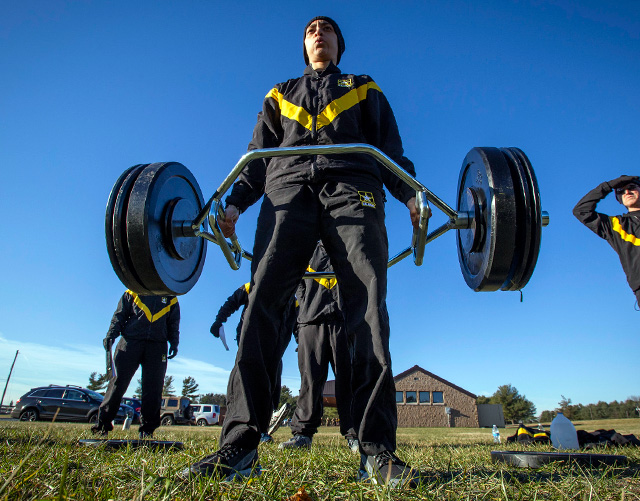
Deadlift max-lift using a Hex Bar
The Test: Start with a 'check' 3-rep test with the weight of 40lbs or less, to check for correct technique. Then one repetition (new recruits) or three repetitions (annual assessments) is performed for each weight in sequence. For the new recruits, the weights used are 120 lbs, 140 lbs, 160 lbs, 180 lbs, 190 lbs, 200 lbs, 210 lbs, and 220 lbs. Less than 1 minute rest is allowed between reps. If a weight is failed, another attempt may be made.
Scoring: The maximum weight lifted is recorded. To standardize the score it may be useful to calculate a score proportional to the person's bodyweight using the calculator above.
Advantages: The required equipment is readily available in most gymnasiums, and the test is simple to perform.
Disadvantages: This test should only be performed by those with a good deadlift technique. If the subject is not able to show the correct technique during the warmup, the test should not proceed.
⚠️ Safety Warning: Always use a spotter or safety equipment when testing near maximal loads. Stop immediately if you experience pain or form breakdown. The submaximal calculation method using this calculator is safer than true 1RM testing.
Comments: The results of this test may be specific to the equipment used (height of bench, variations in weights), so is best to use the same equipment for test-retest measures. The warm-up procedure should also be recorded and repeated with further testing. If any variation in technique was allowed, this should be recorded on the results sheet for referral when the test is repeated.
Variations / Modifications: The US Army uses this test with either 1 or 3 maximum repetitions, depending on the level of the soldier.
The Science Behind the Calculation
The calculator uses three validated formulas developed through sports science research:
Epley Formula (1985):
1RM = weight × (1 + reps/30)
This formula was developed by Boyd Epley and is widely used in strength and conditioning. It tends to be most accurate for rep ranges of 1-10.
Brzycki Formula (1993):
1RM = weight × (36 / (37 - reps))
Matt Brzycki's equation provides slightly lower estimates than Epley for higher rep ranges and is preferred by many powerlifting coaches.
Lombardi Formula:
1RM = weight × reps^0.1
This formula uses an exponential approach and often provides estimates between Epley and Brzycki.
Sport-Specific Applications
The deadlift is a foundational movement across many sports and training programs:
Powerlifting: The deadlift is one of three competition lifts. Elite male powerlifters in the 83kg class typically deadlift 280-320kg (617-705 lbs), while female athletes in the 63kg class achieve 180-220kg (397-485 lbs).
Football (American): NFL combine participants are often evaluated on deadlift strength. Offensive linemen commonly achieve 2.0-2.5x bodyweight, contributing to their blocking power.
Rugby: Forward players benefit from high deadlift strength for scrummaging and tackling. Professional players typically maintain 1.8-2.2x bodyweight deadlifts.
Track and Field: Throwers (shot put, discus, hammer) use heavy deadlifts to develop hip and back power. Elite throwers often deadlift 2.5x+ bodyweight.
CrossFit: Deadlifts appear frequently in workouts and competitions. Competitive athletes maintain strong deadlifts while balancing endurance capacity.
Strength Standards by Experience Level
Use these guidelines to assess your deadlift relative to training experience:
- Beginner (Less than 1 year): 1.0x bodyweight
- Novice (1-2 years): 1.25x bodyweight
- Intermediate (2-5 years): 1.5x bodyweight
- Advanced (5+ years): 2.0x bodyweight
- Elite/Competitive: 2.5x+ bodyweight
Note that these standards vary by age, gender, and specific sport. Female athletes typically achieve approximately 70-80% of male standards at equivalent training levels.
Frequently Asked Questions
How accurate is the deadlift rep max calculator?
The calculator uses validated formulas that are typically accurate within ±5% for trained athletes when using 1-10 repetitions. Accuracy decreases with rep ranges above 10. For best results, use a weight you can lift for 3-5 challenging reps with good form.
What is a good deadlift for my bodyweight?
Strength standards vary by training experience. Beginners typically deadlift around 1x bodyweight, intermediates reach 1.5x, advanced lifters achieve 2x, and elite powerlifters can exceed 2.5x their bodyweight. These benchmarks help you set realistic long-term goals.
How often should I test my deadlift max?
True 1RM testing is physically demanding and should be limited to every 8-12 weeks during peaking phases. Use submaximal testing with this calculator for regular progress monitoring without the injury risk and recovery demands of maximal lifts.
What formula does this calculator use?
This calculator uses the Epley formula (1RM = weight × (1 + reps/30)), which is the most widely validated and commonly used equation in strength and conditioning. It was developed by Boyd Epley and provides reliable estimates for rep ranges of 1-10. The results panel also shows comparative values from Brzycki and Lombardi formulas for reference.
Can I use this calculator for conventional and sumo deadlifts?
Yes, the formulas work for both styles. However, maintain consistency in testing - if you train primarily with conventional stance, test with conventional. Most athletes can lift similar weights with either style once proficient.
Why does my calculated 1RM differ from my actual max?
Individual differences in muscle fiber composition, technique efficiency, and mental factors affect maximal performance. The calculator provides an estimate based on population averages. Some athletes consistently exceed calculated values while others fall slightly short.
Should I test my deadlift 1RM before or after other exercises?
Always test deadlift 1RM when fully rested - ideally as the first exercise of a session after a thorough warm-up. Fatigue from prior exercises significantly reduces maximal strength output and increases injury risk.
References
- Epley, B. (1985). "Poundage Chart." Boyd Epley Workout. University of Nebraska.
- Brzycki, M. (1993). "Strength Testing—Predicting a One-Rep Max from Reps-to-Fatigue." Journal of Physical Education, Recreation & Dance, 64(1), 88-90.
- LeSuer, D.A., McCormick, J.H., Mayhew, J.L., Wasserstein, R.L., & Arnold, M.D. (1997). "The accuracy of prediction equations for estimating 1-RM performance in the bench press, squat, and deadlift." Journal of Strength and Conditioning Research, 11(4), 211-213.
- Reynolds, J.M., Gordon, T.J., & Robergs, R.A. (2006). "Prediction of one repetition maximum strength from multiple repetition maximum testing and anthropometry." Journal of Strength and Conditioning Research, 20(3), 584-592.
- Ritti-Dias, R.M., Avelar, A., Salvador, E.P., & Cyrino, E.S. (2011). "Influence of previous experience on resistance training on reliability of one-repetition maximum test." Journal of Strength and Conditioning Research, 25(5), 1418-1422.
- U.S. Army (2020). "Army Combat Fitness Test (ACFT) Field Testing Manual." Department of the Army.
The Test in Action
- This test forms part of the fitness testing for the US Army.
Similar Tests
- 1RM Squat — maximum lift for one squat repetition.
- 1RM bench press test — measure of the maximal weight you can bench press with one repetition.
- Lat Pulldown 1-Rep Max Test — one-repetition max test using the lat pulldown exercise.
Related Pages
- General description of 1RM fitness tests
- A calculator to estimate 1RM
- The Sport of Power Lifting Deadlift
- US Army testing discussion and scoring
- About the equipment: Trap (Hex) Bar
- Powerlifting Deadlift Sport
- Deadlift exercise technique
 Any comments, suggestions, or corrections? Please let us know.