Footeval Test Calculator
Quick Answer
This calculator converts your Footeval test results into estimated VO2max, Maximal Aerobic Specific Speed (MASS), and provides fitness ratings specifically for soccer players.
- Calculates MASS and estimated VO2max from final level achieved
- Based on validated research by Manouvrier et al. (2016)
- Provides position-specific interpretations for football players
What is the Footeval Test?
The Footeval Test is an incremental and intermittent football (soccer) specific test designed by Manouvrier et al. (2016). The test is based on the 20m shuttle test, though it incorporates dribbling of a soccer ball and 30-second rest periods after every minute. This makes it one of the most sport-specific aerobic tests available for evaluating football players' fitness in conditions that closely resemble actual match demands.
Unlike traditional beep tests that only measure running ability, the Footeval test evaluates the combination of aerobic capacity and technical skill under fatigue, providing coaches and sports scientists with a more complete picture of a player's football-specific fitness level.
How Does the Footeval Test Work?
Test Purpose: To measure aerobic fitness and skill in soccer players simultaneously.
Equipment Required:
- 30m x 10m grassed field area
- Measuring tape and marker cones
- Soccer balls and soccer goal
- Portable barrier for reflecting the kicked ball
- Audio track and audio player
Pre-Test Procedures: Explain the test procedures to the subject. Perform screening of health risks and obtain informed consent. Prepare forms and record basic information such as age, height, body weight, gender, and test conditions. Measure and mark out the course. Ensure that the participants are adequately warmed-up. See more details of pre-test procedures.
Course Setup
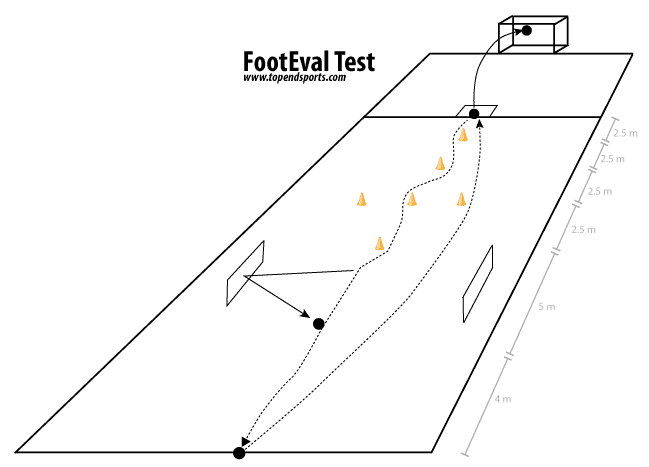
Mark out the testing area as illustrated below. There is a shooting area (2m x 0.5m), which is 10 meters from a goal. From this point in the other direction are four cones 2.5m apart. Barriers are placed to either side after that, leading to the turning point 19 meters from the start.
Test Levels and Protocol
The first level is designed as a warm-up and lasts two minutes. All following levels last for one minute and are followed by a recovery phase of thirty seconds. The first level begins at 6.5 km/h and the speed required is increased by 0.5 km/h each level.
| Level | Speed (km/h) | Duration | Rest Period | Est. VO2max* |
|---|---|---|---|---|
| 1 (Warm-up) | 6.5 | 2 minutes | 30 seconds | ~35 |
| 2 | 7.0 | 1 minute | 30 seconds | ~38 |
| 3 | 7.5 | 1 minute | 30 seconds | ~41 |
| 4 | 8.0 | 1 minute | 30 seconds | ~44 |
| 5 | 8.5 | 1 minute | 30 seconds | ~47 |
| 6 | 9.0 | 1 minute | 30 seconds | ~50 |
| 7 | 9.5 | 1 minute | 30 seconds | ~52 |
| 8 | 10.0 | 1 minute | 30 seconds | ~54 |
| 9 | 10.5 | 1 minute | 30 seconds | ~56 |
| 10 | 11.0 | 1 minute | 30 seconds | ~57 |
| 11 | 11.5 | 1 minute | 30 seconds | ~58 |
| 12 | 12.0 | 1 minute | 30 seconds | ~60 |
| 13 | 12.5 | 1 minute | 30 seconds | ~62 |
| 14 | 13.0 | 1 minute | 30 seconds | ~64 |
| 15 | 13.5 | 1 minute | 30 seconds | ~66 |
*Estimated VO2max values are approximations based on the relationship between running speed and oxygen consumption in football-specific conditions.
Test Procedure
The participant begins at the goal end, dribbling the ball around the cones. After the last cone, the player plays the ball against a barrier to the side, traps the ball after the rebound, and continues dribbling the ball to the end line. The player stops the ball at the line and waits for the audio cue to start back the other way. This time the player dribbles the ball straight back to the shooting area and kicks towards the goal. The test continues until they are unable to keep up with the audio track.
Test Termination Criteria:
- Player is more than 3 meters from the line and unable to reduce the gap
- Player cannot restart after the recovery phase
- Player makes more than two technical errors within a level (bad passes, bad shots, or bad ball control)
The Science Behind the Footeval Calculator
The Footeval test was validated by Manouvrier and colleagues in a 2016 study published in the Journal of Sports Science & Medicine. Twenty-four highly trained subjects from an elite football academy (average age 17.8 years) performed two Footeval sessions separated by 7 days.
Key Research Findings
The study demonstrated that the Footeval test produces reliable and valid results:
- VO2max correlation: r = 0.79-0.82 between Footeval performance and directly measured VO2max
- Test-retest reliability: ICC = 0.93 for final level achieved
- Mean VO2max: 58.1 ± 5.6 ml/kg/min for elite academy players
- Mean final level: 10.71 ± 1.2 for elite academy players
Calculation Methodology
Our calculator estimates VO2max using the Maximal Aerobic Specific Speed (MASS) achieved during the test. The formula incorporates:
MASS (km/h) = 6.0 + (Level × 0.5)
The estimated VO2max is then calculated using a modified version of equations validated for intermittent shuttle tests, accounting for the increased oxygen cost of ball dribbling (approximately 8% higher than running without a ball, according to Reilly et al.).
Understanding Your Footeval Results
Fitness Rating Categories for Soccer Players
| Rating | Level Achieved | Est. VO2max Range |
|---|---|---|
| 11+ | 58+ ml/kg/min | |
| 9-10 | 52-57 ml/kg/min | |
| 7-8 | 46-51 ml/kg/min | |
| 5-6 | 40-45 ml/kg/min | |
| <5 | <40 ml/kg/min |
Position-Specific Standards
Different playing positions have varying aerobic demands:
- Midfielders: Typically require the highest aerobic capacity (target level 10+) due to extensive pitch coverage
- Wingbacks/Fullbacks: High demands for repeated sprints with recovery (target level 9+)
- Forwards: Moderate-high requirements (target level 8+) with emphasis on repeat sprint ability
- Central Defenders: Moderate requirements (target level 7+) with focus on power and heading
- Goalkeepers: Lower aerobic demands (target level 6+) but specific agility requirements
How to Improve Your Footeval Score
Research by Manouvrier et al. (2017) on the sensitivity of the Footeval test to different training modes found that:
- Small-sided games (SSG): Produced the highest improvement in Footeval scores (15% increase)
- Technical training: Improved both running economy with ball and technical execution
- Generic aerobic training: Improved overall VO2max but less specific transfer to Footeval
For optimal improvement in your Footeval performance, combine regular small-sided games with ball-specific conditioning drills that mimic the test's demands.
Advantages and Limitations
Advantages
- Sport-specific assessment combining fitness and technical skill
- Validated and reliable (ICC = 0.93)
- Intermittent protocol mirrors match demands
- Sensitive to football-specific training adaptations
- Can differentiate between players with similar generic fitness but different technical abilities
Limitations
- Usually only a single player can do the test at once
- Requires specific equipment setup including goal and barriers
- Relatively new test and not as widely used as standard beep tests
- Audio track may need to be specially created or obtained
Frequently Asked Questions
What is a good Footeval test score for soccer players?
For elite youth academy players (ages 17-18), reaching level 10-11 is considered excellent, corresponding to MASS of 11-11.5 km/h and estimated VO2max around 57-58 ml/kg/min. Professional senior players may achieve higher levels. Recreational players typically reach levels 6-8.
How accurate is the Footeval VO2max estimate?
The Footeval test shows strong correlations (r = 0.79-0.82) with directly measured VO2max. However, estimates should be considered approximations, typically within ±5 ml/kg/min of laboratory values. For precise measurements, direct VO2max testing is recommended.
How does Footeval compare to the Yo-Yo test?
Both are intermittent tests, but Footeval adds technical skill components (dribbling, passing, shooting) that the Yo-Yo test lacks. This makes Footeval more specific to football but also more complex to administer. Yo-Yo tests are better for testing large groups simultaneously.
Can the Footeval test be used for all soccer players?
Yes, the Footeval test is suitable for all soccer players regardless of level. The test evaluates the combination of aerobic fitness and technical skill, making it applicable from youth academy to professional levels. Younger players (under 16) may have slightly adjusted expectations due to developmental factors.
How often should I perform the Footeval test?
For monitoring training adaptations, testing every 4-6 weeks during pre-season and monthly during the competitive season is recommended. Allow at least 48 hours recovery after intense training before testing. Consistent testing conditions (time of day, surface, equipment) improve reliability.
What causes technical errors in the Footeval test?
Technical errors include missed passes against the barrier, poor ball control after rebounds, shots missing the goal, and losing control while dribbling around cones. More than two errors in a single level ends the test, making technical proficiency as important as aerobic fitness.
Where can I get the Footeval audio track?
The official Footeval audio track may be available through sports science departments or can be created using audio software based on the published protocol. You may be able to use the Team BeepTest software to create a custom audio track matching Footeval specifications.
References
- Manouvrier, C., Cassirame, J., & Ahmaidi, S. (2016). "Proposal for a Specific Aerobic Test for Football Players: The Footeval." Journal of Sports Science & Medicine, 15(4), 670–677.
- Manouvrier, C., Cassirame, J., Julien, H. (2013). "Proposition d'un test d'évaluation des qualités du joueur de Football." XVème Congrès ACAPS.
- Manouvrier, C., Cassirame, J., Levitre, J., & Ahmaidi, S. (2016). "Footeval test, what are the determinants of performance?" Medicina dello Sport, 69(4).
- Manouvrier, C., Cassirame, J., & Ahmaidi, S. (2017). "The Sensitivity of the Footeval Test To Different Training Modes." Journal of Strength and Conditioning Research.
- Reilly, T., Williams, A.M., Nevill, A., & Franks, A. (2000). "A multidisciplinary approach to talent identification in soccer." Journal of Sports Sciences, 18(9), 695-702.
- Stolen, T., Chamari, K., Castagna, C., & Wisloff, U. (2005). "Physiology of soccer: an update." Sports Medicine, 35(6), 501-536.
- Léger, L.A., & Lambert, J. (1982). "A maximal multistage 20-m shuttle run test to predict VO2max." European Journal of Applied Physiology, 49(1), 1-12.
Similar Tests
- Loughborough Intermittent Shuttle Test — intermittent and variable shuttle test designed to replicate the demands of a football match.
- Soccer FIT Interval Test — this test was developed initially to mimic the demands of soccer players, involves running 10 and 25 yards circuits in diminishing times, with 30 seconds rest between sets.
- Futsal Intermittent Endurance Test — consists of 45m (3x15m) shuttles performed at progressive speeds until exhaustion.
- Gacon Test — an intermittent test with 45 seconds of running and 15 seconds rest, with the running distance incrementally increasing.
- 30-15 Intermittent Fitness Test (30-15 IFT) — with a 30/15 second work/rest ratio
- Interval Shuttle Run Test (ISRT) — with a 30/15 second work/rest ratio
- Yo-Yo Intermittent Tests
Related Pages
- About Testing for Intermittent Sports
- Beep Test Modifications
- About fitness testing for soccer
- About Skill Testing for Soccer
- You may be able to use the Team BeepTest software to create the audio for this test.
- Beep Test Calculator — convert standard beep test results to VO2max
 Any comments, suggestions, or corrections? Please let us know.