Hand Grip Strength Calculator
Quick Answer
This calculator analyzes your hand grip strength measurements and compares them to age and gender-specific norms based on NIH and ACSM validated data. Enter your dynamometer readings to instantly see your percentile ranking and athletic performance category.
- Compares your grip to population norms by age and gender
- Calculates percentile ranking using validated scientific data
- Analyzes hand asymmetry for injury risk assessment
- Provides sport-specific interpretation for athletes
The purpose of the handgrip strength test is to measure the maximum isometric strength of the hand and forearm muscles. Handgrip strength is important for any sport in which the hands are used for catching, throwing or lifting. Also, as a general rule people with strong hands tend to be strong elsewhere, so this test is often used as a general test of strength. See also the finger pinch strength test.
How to Use This Calculator
Follow these steps to accurately measure and assess your grip strength:
- Measure Your Grip Strength - Use a hand dynamometer (such as a Jamar or Camry device). Hold the device with your arm at your side, elbow bent at 90 degrees, and squeeze as hard as possible for 3-5 seconds.
- Record Multiple Trials - Take 3 measurements for each hand with 15-30 seconds rest between trials. Use the best (highest) score for each hand.
- Enter Your Results - Input your best right and left hand scores into the calculator above, along with your age group and gender.
- Review Your Analysis - The calculator will provide your combined average, percentile ranking, hand asymmetry analysis, and athletic interpretation.
What Equipment Do I Need?
Equipment required: handgrip dynamometer
The most commonly used and recommended dynamometer is the Jamar hydraulic hand dynamometer, which is considered the gold standard for grip strength testing. More affordable options like the Camry electronic dynamometer also provide reliable measurements when used consistently.
Standard Testing Procedure
Pre-test preparation: Explain the test procedures to the subject. Prepare forms and record basic information such as age, height, body weight, gender, hand dominance. Calibrate dynamometer, adjust to suit the subject. See more details of pre-test procedures.
Procedure: The subject holds the dynamometer in the hand to be tested, with the arm at right angles and the elbow by the side of the body. The handle of the dynamometer is adjusted if required - the base should rest on the first metacarpal (heel of palm), while the handle should rest on middle of the four fingers. When ready the subject squeezes the dynamometer with maximum isometric effort, which is maintained for about 5 seconds. No other body movement is allowed. The subject should be strongly encouraged to give a maximum effort.
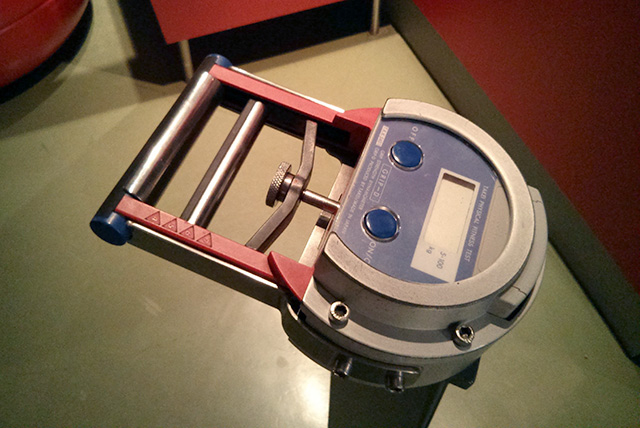
Handgrip dynamometer in use for strength testing
Grip Strength Norms by Age and Gender
The following table provides normative data for grip strength (combined average of both hands) based on validated research from NIH Toolbox and ACSM guidelines:
| Rating | Males | Females | ||
|---|---|---|---|---|
| (lbs) | (kg) | (lbs) | (kg) | |
| Excellent | > 141 | > 64 | > 84 | > 38 |
| Very Good | 123-141 | 56-64 | 75-84 | 34-38 |
| Above Average | 114-122 | 52-55 | 66-74 | 30-33 |
| Average | 105-113 | 48-51 | 57-65 | 26-29 |
| Below Average | 96-104 | 44-47 | 49-56 | 23-25 |
| Poor | 88-95 | 40-43 | 44-48 | 20-22 |
| Very Poor | < 88 | < 40 | < 44 | < 20 |
Norms for adults aged 25-29. Values represent combined average of both hands. See more Hand Grip Strength Norms by age. Also see examples of some actual athlete results.
Sport-Specific Applications
Hand grip strength is particularly important in these sports and activities:
Grappling Sports (Wrestling, Judo, BJJ): Athletes in combat sports require exceptional grip strength to control opponents. Elite wrestlers typically demonstrate grip strength 20-30% above population norms.
Racquet Sports (Tennis, Badminton, Squash): Strong grip is essential for racquet control and power generation during serves and volleys. Professional tennis players show correlation between grip strength and serve velocity.
Climbing Sports (Rock Climbing, Bouldering): Climbers develop exceptional grip endurance alongside peak strength. Elite climbers often train grip specifically 2-3 times per week.
Throwing Sports (Baseball, Cricket, Javelin): Grip strength contributes to ball control and release mechanics. Studies show correlation between grip strength and throwing velocity in baseball pitchers.
Strength Sports (Powerlifting, Weightlifting, Strongman): Grip often becomes the limiting factor in deadlifts and carries. Elite powerlifters typically exceed 70+ kg grip strength.
Professional Athlete Benchmarks
For context, here are grip strength benchmarks from professional sports:
- NHL Draft Combine Average: 128 lbs (58 kg) - The best score at the 2015 NHL Combine was 180 lbs (81.6 kg)
- NFL Players: Elite pass rushers typically exceed 150 lbs (68 kg), with some reaching 200+ lbs
- Senior Athletes: Active athletes aged 80-85 demonstrate grip strength similar to sedentary adults aged 60-64
How to Improve Your Grip Strength
If your grip strength falls below average for your age and gender, these exercises can help improve it:
- Dead Hangs: Hang from a pull-up bar for 20-60 seconds, 3-4 sets
- Farmer's Walks: Carry heavy dumbbells or kettlebells while walking
- Plate Pinches: Pinch weight plates between thumb and fingers
- Wrist Curls: Curl a barbell or dumbbell focusing on forearm flexion
- Grip Trainers: Use adjustable hand grippers for progressive resistance
- Towel Training: Perform exercises like pull-ups or rows using a towel for grip
Research suggests that grip strength can improve by 10-25% within 8-16 weeks of consistent, progressive training.
Test Variations
Variations: The position of the arm and hand can vary in different grip strength protocols. Various positions include the elbow being held at right angles as per the above procedure, the arm hanging by the side, and the extended arm being swung from above the head to by the side during the squeezing motion. The Eurofit Test Manual recommends squeezing for 3 seconds. The procedure for the Groningen Elderly Tests has the subject hang their hand by their side, one practice trial, best of three attempts with 30 seconds rest between.
Validity and Reliability
Validity: The validity of this test as a measure of general strength has been questioned, as the strength of the forearm muscles does not necessarily represent the strength of other muscle groups. However, research consistently shows strong correlations between grip strength and overall health outcomes, including cardiovascular health, bone density, and mortality risk. If you wish to measure the strength of a particular muscle group, there are other specific tests that can be performed.
Reliability: The dynamometer may need to be calibrated regularly to ensure consistent results. The Jamar dynamometer has shown excellent inter-rater reliability (r=0.98) and test-retest reliability (r>0.80). Having consistent technique and adequate rest is required to ensure reliability.
Advantages: This is a simple and commonly used test of general strength level, well researched and many norms are available.
Disadvantages: The dynamometer must be adjusted for hand size, how successfully this is done will affect the accuracy of the measurement.
Important Considerations
- It is also useful to record whether the athlete is left or right handed, as this may help in the interpretation of results. The non-dominant hand usually scores about 10% lower.
- The forearm muscles are easily fatigued, so the best scores are usually achieved in the first or second trial.
- Results are expected to differ between males and females, between left and right (dominant and non-dominant) hands, and with age.
- The results can also be affected by the position of the wrist, elbow and shoulder, so these should be standardized.
- Factors such as hand size, body weight, training status, and health conditions can all affect grip strength measurements.
Frequently Asked Questions
What is a good grip strength for my age?
Good grip strength varies significantly by age and gender. For adult males aged 25-29, an average grip strength is 48-51 kg (105-113 lbs), while excellent is above 64 kg (141 lbs). For females in the same age group, average is 26-29 kg (57-65 lbs) and excellent is above 38 kg (84 lbs). Grip strength typically peaks around ages 25-39 and gradually declines thereafter.
How accurate is this grip strength calculator?
This calculator uses normative data from validated scientific sources including the NIH Toolbox and ACSM guidelines. The accuracy depends primarily on the quality of your dynamometer and adherence to standardized testing protocols. For clinical precision, use a calibrated Jamar hydraulic dynamometer with the standardized ASHT protocol.
Why is my non-dominant hand weaker?
It's normal for the non-dominant hand to be approximately 10% weaker than the dominant hand. This asymmetry is due to differences in daily use and neural recruitment patterns. A difference greater than 10-15% may warrant evaluation, particularly if you're an athlete or have experienced an injury.
Can grip strength predict overall health?
Yes, research consistently shows that grip strength is a powerful biomarker for health. Studies have found correlations between grip strength and cardiovascular health, bone density, cognitive function, and mortality risk. Low grip strength has been associated with higher risk of heart disease, diabetes, and functional decline in older adults.
How often should I test my grip strength?
For general fitness monitoring, testing every 3-6 months is sufficient. During rehabilitation or specific training programs, testing every 2-4 weeks helps track progress. Avoid testing too frequently as day-to-day variations can be misleading, and allow adequate recovery between maximum effort tests.
What factors affect grip strength measurements?
Several factors influence grip strength including: hand and arm position during testing, time of day (strength typically peaks in afternoon), fatigue status, hand size, body weight, training status, age, gender, health conditions (arthritis, carpal tunnel), and the type and calibration of dynamometer used.
How can athletes improve grip strength for sports?
Athletes can improve grip strength through targeted exercises including dead hangs, farmer's walks, plate pinches, wrist curls, and specific grip trainers. Training 2-3 times per week with progressive overload can yield 10-25% improvements in 8-16 weeks. Sport-specific grip training should mimic the demands of your activity.
References
- Wang, Y.C., et al. (2018). "Hand-Grip Strength: Normative Reference Values and Equations for Individuals 18 to 85 Years of Age Residing in the United States." Journal of Orthopaedic & Sports Physical Therapy, 48(9), 685-693.
- Bohannon, R.W. (2019). "Grip Strength: An Indispensable Biomarker For Older Adults." Clinical Interventions in Aging, 14, 1681-1691.
- Roberts, H.C., et al. (2011). "A review of the measurement of grip strength in clinical and epidemiological studies: towards a standardised approach." Age and Ageing, 40(4), 423-429.
- Mathiowetz, V., et al. (1985). "Grip and pinch strength: normative data for adults." Archives of Physical Medicine and Rehabilitation, 66(2), 69-74.
- Massy-Westropp, N.M., et al. (2011). "Hand Grip Strength: age and gender stratified normative data in a population-based study." BMC Research Notes, 4, 127.
- Steiber, N. (2016). "Strong or Weak Handgrip? Normative Reference Values for the German Population across the Life Course Stratified by Sex, Age, and Body Height." PLoS ONE, 11(10), e0163917.
- Jordre, B., et al. (2020). "Hand Grip Strength in Senior Athletes: Normative Data and Community-Dwelling Comparisons." International Journal of Sports Physical Therapy, 15(4), 536-546.
- Leong, D.P., et al. (2015). "Prognostic value of grip strength: findings from the Prospective Urban Rural Epidemiology (PURE) study." The Lancet, 386(9990), 266-273.
Similar Tests
- See the similar finger pinch strength test
- Grip endurance is also measured using the Extended-Arm Hang Test
Related Pages
- Hand Grip Strength Testing FAQs
- This test is part of the Ice Hockey SPARQ rating, Eurofit Test Manual, Groningen Elderly Tests plus many others.
- More Hand Grip Strength Norms
- There are some grip strength test results of athletes.
- List of other strength tests.
- Calibrating Handgrip Dynamometers
Related Products
- Camry Hand Dynamometer
- Grip Strength Dynamometers on Amazon
- Grip strength trainers for sale online.
 Any comments, suggestions, or corrections? Please let us know.