Hexagonal Obstacle Test Calculator
Quick Answer
This calculator determines your hexagonal obstacle test score by combining your best clockwise and anti-clockwise trial times. Results are compared against Alpine Canada norms for junior elite alpine skiers.
- Calculates combined score from both directional trials
- Based on Alpine Canada Fitness Testing Protocols (2016)
- Identifies directional imbalances in agility performance
The Hexagonal Obstacle Test, also called the Hex Jump, is a test of agility developed specifically for alpine skiers. The test involves quickly jumping over obstacles arranged in a hexagon shape. It is similar to the hexagon test, except that in this test the participants jump over an obstacle when they move in and out of the hexagon, rather than just over a line.
How to Use This Calculator
Follow these steps to calculate your hexagonal obstacle test score and compare to normative data:
- Select Your Demographics - Choose your age group and gender to compare against appropriate norms
- Enter Clockwise Time - Record your best time from two clockwise trial attempts
- Enter Anti-clockwise Time - Record your best time from two anti-clockwise trial attempts
- Calculate Score - Click the button to see your combined score and performance rating
- Review Results - Check your interpretation and directional balance analysis
Pro Tip: A difference greater than 1.5 seconds between clockwise and anti-clockwise times may indicate a directional imbalance that could benefit from targeted training.
What is the Hexagonal Obstacle Test?
Aim: This is a test of the ability to move quickly while maintaining balance. The hexagonal obstacle test measures agility, coordination, and lateral movement speed using progressive hurdle heights.
Equipment required: obstacles ranging in height from 20cm to 35cm, stopwatch, recording sheets.
Pre-test: Explain the test procedures to the subject. Perform screening of health risks and obtain informed consent. Prepare forms and record basic information such as age, height, body weight, gender and test conditions. Measure out the jump area and place the obstacles as per the procedure. Perform a standard warm-up, including practice going over the hurdles. See more details of pre-test procedures.
Test Setup and Layout
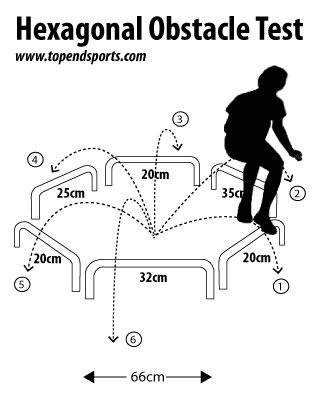 Test layout: Place the six obstacles in a hexagon. The length of each side of the hexagon should be 66 cm (26 inches). The obstacles are arranged with varying heights from 20cm to 35cm around the hexagon.
Hexagon Dimensions
Each side: 66 cm (26 inches)
Interior angle: 120 degrees
Total perimeter: 396 cm
Obstacle Heights
Range: 20cm to 35cm
Progressive difficulty
Consistent spacing
Equipment Needed
6 hurdles/obstacles
Measuring tape
Stopwatch
Test Procedure
Procedure: The participant starts with both feet together in the middle of the hexagon, side-on to the 20 cm hurdle. On the command 'go', they jump off two feet laterally over the obstacle, then back over the same obstacle, returning to the middle of the hexagon. Then turn a little and jump laterally over the adjacent obstacle and back into the hexagon, continuing around the hexagon, completing two complete circuits. Two trials are performed in the clockwise direction, and two trials in the anti-clockwise direction.
Scoring and Norms
Scoring: The participant's score is the time taken to complete two full revolutions. The stopwatch starts on the command go, and finishes after completing two circuits and when landing back in the middle after jumping the 32 or 35cm hurdle (depending on the direction of travel). If you hit one of the obstacles the trial needs to be repeated. The score is the combined best time for each direction.
Alpine Canada Target Scores
These are target scores for junior elite alpine skiers from the Alpine Canada Fitness Testing Protocols.
| Age Group | Male Target (seconds) | Female Target (seconds) |
|---|---|---|
| 14-16 years | 23.0 - 20.1 | 23.0 - 20.5 |
| 17-18 years | 22.0 - 19.7 | 22.0 - 19.7 |
| 19-20 years | 21.0 - 19.0 | 21.0 - 19.3 |
source: Alpine Canada Fitness Testing Protocols, published Fall 2016
Understanding Your Results
Your hexagonal obstacle test score is evaluated based on several factors:
Combined Time
Lower times indicate better agility. Elite alpine skiers typically achieve combined times under 20 seconds.
Directional Balance
Comparing clockwise vs anti-clockwise reveals potential imbalances. A difference over 1.5 seconds may warrant attention.
Age-Appropriate Norms
Performance expectations vary by age. Younger athletes have slightly more lenient targets.
Sport-Specific Applications
The hexagonal obstacle test has applications beyond alpine skiing:
Alpine Skiing
The test was specifically developed for alpine skiers as part of the Ironman Test Battery. It assesses the lateral movement and rapid direction changes essential for navigating slalom gates and managing terrain variations. Elite alpine racers use this test as a key indicator of on-snow performance potential.
Other Sports Using Hex Jump Testing
- Volleyball - Assesses lateral agility for court coverage and defensive positioning
- Tennis - Evaluates quick directional changes needed for court movement
- Basketball - Tests defensive agility and lateral quickness
- Ice Hockey - Measures off-ice agility that transfers to skating performance
- Soccer - Assesses quick feet and agility for dribbling and defending
How to Improve Your Score
If your hexagonal obstacle test results indicate room for improvement, consider these training strategies:
Plyometric Training
Box jumps, lateral bounds, and hurdle hops directly improve the explosive jumping power needed for the test. Research shows plyometric training can improve agility by an average of 7.7% in athletes.
Lateral Movement Drills
Practice lateral shuffles, carioca drills, and side-to-side cone drills to improve the directional movement patterns used in the test.
Balance Training
Single-leg exercises, BOSU ball work, and stability training improve the balance component essential for quick direction changes over obstacles.
Address Directional Imbalances
If one direction is significantly slower, focus extra training on that weaker side. This might indicate a strength or coordination imbalance that targeted exercises can correct.
Test Advantages and Limitations
Advantages: The hexagonal obstacle test provides a sport-specific assessment of agility that closely mimics the demands of alpine skiing. The obstacles add complexity beyond the standard hexagon test, making it more challenging and discriminating for trained athletes.
Disadvantages: Only one person can perform the test at a time, and specific hurdles of a range of heights are required. The equipment setup is more complex than simpler agility tests.
Variations: The test can be conducted using cones (which are all the same height). There is also a Hexagon Test, a version with no obstacles that is simpler to set up and administer.
Target population: This test was created to assess alpine skiers, though it has been adapted for use in various sports requiring lateral agility and quick direction changes.
Frequently Asked Questions
What is a good hexagonal obstacle test time?
For junior elite alpine skiers aged 14-16, target combined times are 20.1-23.0 seconds for males and 20.5-23.0 seconds for females. More experienced athletes aged 19-20 should aim for 19.0-21.0 seconds. Lower times indicate better agility performance.
How do you set up the hexagonal obstacle test?
Place six obstacles in a hexagon shape with each side measuring 66cm (26 inches). Obstacles should range from 20cm to 35cm in height, arranged progressively around the hexagon. The athlete starts in the center facing a 20cm hurdle.
How many circuits are in the hexagonal obstacle test?
The athlete completes two full circuits (revolutions) around the hexagon per trial. Two trials are performed in the clockwise direction and two in the anti-clockwise direction. The best time from each direction is combined for the final score.
What happens if you hit an obstacle during the test?
If you hit or knock over an obstacle during the hexagonal obstacle test, that trial must be restarted from the beginning. Only clean trials without touching obstacles count toward your score.
What is the difference between the hexagonal obstacle test and hexagon agility test?
The hexagonal obstacle test requires jumping over hurdles (20-35cm high) when moving in and out of the hexagon, making it more challenging. The standard hexagon agility test only requires jumping over taped lines on the floor with no physical obstacles.
Why test both clockwise and anti-clockwise directions?
Testing both directions reveals potential asymmetries in agility performance. A significant difference (greater than 1.5 seconds) between directions may indicate muscle imbalances, coordination issues, or injury-related limitations that could affect sport performance.
How often should I perform the hexagonal obstacle test?
For training monitoring, conduct the test every 4-6 weeks during pre-season and monthly during in-season. This frequency allows enough time to see meaningful improvements while tracking progress throughout the training year.
References
- Alpine Canada. (2016). "Alpine Canada Fitness Testing Protocols." Fall 2016.
- Ironman Testbatteriene. (2013). "Attacking Vikings." Norges Skiforbund Olympiatoppen, Versjon 4.2, 15. aug 2013.
- Beekhuizen, K.S., et al. (2009). "Test-retest reliability and minimal detectable change of the hexagon agility test." Journal of Strength and Conditioning Research, 23(7), 2167-2171.
- Farlinger, C.M., et al. (2007). "Relationships to skating performance in competitive hockey players." Journal of Strength and Conditioning Research, 21(3), 915-922.
- Hydren, J.R., et al. (2013). "Review of Strength and Conditioning for Alpine Ski Racing." Strength and Conditioning Journal, 35(1), 10-28.
- Pauole, K., et al. (2000). "Reliability and validity of the T-test as a measure of agility, leg power, and leg speed." Journal of Strength and Conditioning Research, 14(4), 443-450.
- Fernandez-Fernandez, J., et al. (2021). "Relationship between Sprint, Change of Direction, Jump, and Hexagon Test Performance in Young Tennis Players." International Journal of Environmental Research and Public Health, 18(3), 1291.
Similar Tests
- Hexagon agility test — involves jumping in and out of a hexagon shape as fast as possible.
- Quadrant Jump Test — involves two-legged jumping around a cross shape on the floor, as fast as possible.
- Multistage Hurdle Jump Test — count the number of jumps over a hurdle in two 20-second periods.
- 30 Second Endurance Jump — jump across a hurdle as many times as possible in 30 seconds.
Related Pages
 Any comments, suggestions, or corrections? Please let us know.