Vertical Jump Test Calculator
Quick Answer
The vertical jump test measures your explosive leg power by calculating the difference between your standing reach and maximum jump height. Simply enter your measurements above to instantly see your rating and how you compare.
- Excellent: Males >70cm (28"), Females >60cm (24")
- Average: Males 41-50cm (16-20"), Females 31-40cm (12-16")
- Method: Counter-movement jump with arm swing
Push-Up | Sit-Up | Squat | Step | Vertical Jump | Sit & Reach
How to Perform the Vertical Jump Test at Home
This test is designed to measure your explosive leg lower body power. All you need is a high wall, such as the outside of a building, and a bit of room so you can jump and land safely.
Start by standing side on to a wall and reach up as high as you can with the hand closest to the wall. Make note of how high you can reach. This is called the standing reach height. Then stand a little away from the wall, and jump high as possible using both arms and legs to assist in projecting the body upwards.
Attempt to touch the wall at the highest point of the jump. Make note of where you touched the wall at the height of the jump. Measure the distance between the standing reach height and the maximum jump height, and that is your result.
You can assist in recording your score by holding a piece of chalk in your hand and using it to mark the wall. If the wall already has horizontal lines, such as a brick wall, it will be easier to mark your jump height. Have as many attempts as you need to get the best possible score. Practice your technique, as the jump height can be affected by how much you bend your knees before jumping, and the effective use of the arms.
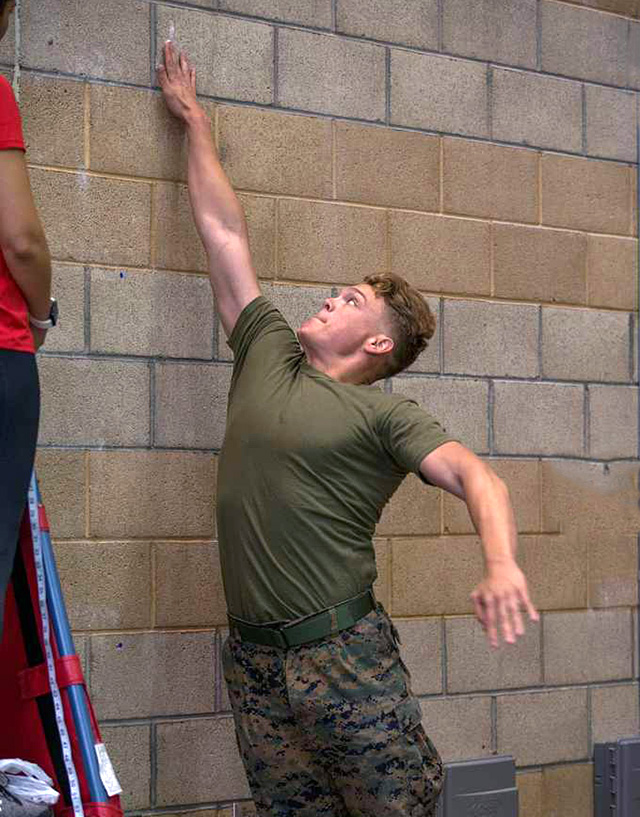 vertical jump test against a brick wall
For a demonstration, there is a video example of using the wall technique in the Vertical Jump Videos. This method uses the counter movement technique. For discussion of other ways to perform this test, see vertical jump techniques.
Vertical Jump Rating Table
Compare your results to the table below. Remember, these scores are based on doing the tests as described, and may not be accurate if the test is modified at all. Don't worry too much about how you rate - just try and improve your own score.
| Rating | Males (inches) | Males (cm) | Females (inches) | Females (cm) |
|---|---|---|---|---|
| Excellent | > 28 | > 70 | > 24 | > 60 |
| Very Good | 24 - 28 | 61-70 | 20 - 24 | 51-60 |
| Above Average | 20 - 24 | 51-60 | 16 - 20 | 41-50 |
| Average | 16 - 20 | 41-50 | 12 - 16 | 31-40 |
| Below Average | 12 - 16 | 31-40 | 8 - 12 | 21-30 |
| Poor | < 12 | < 30 | < 8 | < 20 |
Understanding Your Vertical Jump Results
Your vertical jump score provides valuable insight into your explosive lower body power, which is critical for sports performance. The counter-movement jump technique used in this test allows you to utilize the stretch-shortening cycle, where your muscles store elastic energy during the downward phase and release it during the jump.
Athletes with higher vertical jumps typically excel in sports requiring explosive movements like basketball, volleyball, football, and track and field. NBA players average around 28-30 inches, while elite volleyball players often exceed 35 inches. For recreational athletes, achieving an "above average" rating indicates good lower body power development.
Sport-Specific Applications
Basketball
Vertical jump is crucial for rebounding, blocking shots, and dunking. NBA combine tests vertical jump as a key athletic metric.
Volleyball
Attack height and blocking ability directly correlate with vertical jump. Elite players may jump over 40 inches.
Football
NFL Combine measures vertical jump for wide receivers, defensive backs, and linebackers. Key indicator of explosiveness.
Track & Field
High jumpers and long jumpers rely heavily on vertical power. Training often includes plyometrics to improve jump height.
How to Improve Your Vertical Jump
Improving your vertical jump requires a combination of strength training, plyometric exercises, and technique refinement. Here are evidence-based strategies used by elite athletes:
Strength Training: Focus on compound movements like squats, deadlifts, and lunges. Research shows that athletes who can squat 1.5-2x their body weight have significantly higher vertical jumps. Bulgarian split squats and single-leg exercises also improve unilateral power.
Plyometric Training: Box jumps, depth jumps, and bounding exercises develop the stretch-shortening cycle. Start with low-intensity plyometrics and progress to more advanced exercises. Allow 48-72 hours between plyometric sessions for recovery.
Technique Optimization: Proper arm swing can add 10-15% to your jump height. Practice the countermovement by quickly dropping into a quarter squat before exploding upward. Time your arm swing to peak at takeoff.
Flexibility and Mobility: Adequate hip flexor, ankle, and calf flexibility allows for optimal force production. Include dynamic stretching before training and static stretching for recovery.
Frequently Asked Questions
What is a good vertical jump height?
For males, a good vertical jump is 20-24 inches (51-60 cm), which is classified as "above average." Elite athletes typically exceed 28 inches (70 cm). For females, a good jump is 16-20 inches (41-50 cm), with elite performers exceeding 24 inches (60 cm). These standards are based on general athletic populations.
How do I measure my vertical jump at home?
Stand sideways next to a wall and reach up with your closest hand to mark your standing reach height. Then jump as high as possible using countermovement technique and touch the wall at your peak. The difference between your standing reach and jump height is your vertical jump. Using chalk helps mark both heights accurately.
How can I improve my vertical jump quickly?
While significant gains take 8-12 weeks, you can optimize your current jump through technique improvements like proper arm swing and countermovement timing. Plyometric exercises like box jumps and depth jumps, combined with strength training for squats and deadlifts, provide the most reliable long-term improvements.
What is the average vertical jump by age?
Vertical jump typically peaks in the early to mid-20s. Average males aged 18-25 jump 16-20 inches, while females average 12-16 inches. Performance naturally declines with age, but regular training can maintain and even improve vertical jump ability well into the 30s and 40s.
Does height affect vertical jump?
Height itself doesn't directly determine vertical jump ability. Factors like leg power-to-weight ratio, muscle fiber composition, technique, and training history are more important. Both tall and short athletes can develop impressive vertical jumps. Taller athletes may have longer limbs to generate force, while shorter athletes often have better power-to-weight ratios.
What equipment do I need for the vertical jump test?
For a basic home test, you need a high wall, chalk or a marking tool, a measuring tape, and enough clear space to jump safely. A brick wall with horizontal lines makes marking easier. For more accurate testing, consider using a Vertec device or jump mat, though the wall method provides reliable results for training purposes.
How often should I test my vertical jump?
Test your vertical jump every 4-6 weeks when following a training program. This allows enough time to see meaningful improvements while tracking progress. Always test under similar conditions (same time of day, same warm-up, same surface) for accurate comparisons. Testing too frequently can lead to overreaching and inconsistent results.
References
- Markovic, G. (2007). "Does plyometric training improve vertical jump height? A meta-analytical review." British Journal of Sports Medicine, 41(6), 349-355.
- Bosco, C., Luhtanen, P., & Komi, P. V. (1983). "A simple method for measurement of mechanical power in jumping." European Journal of Applied Physiology, 50(2), 273-282.
- Lees, A., Vanrenterghem, J., & De Clercq, D. (2004). "Understanding how an arm swing enhances performance in the vertical jump." Journal of Biomechanics, 37(12), 1929-1940.
- Patterson, D. D., & Peterson, D. F. (2004). "Vertical jump and leg power norms for young adults." Measurement in Physical Education and Exercise Science, 8(1), 33-41.
- Carlock, J. M., et al. (2004). "The relationship between vertical jump power estimates and weightlifting ability: a field-test approach." Journal of Strength and Conditioning Research, 18(3), 534-539.
- McBride, J. M., et al. (2009). "Relationship between maximal squat strength and five, ten, and forty yard sprint times." Journal of Strength and Conditioning Research, 23(6), 1633-1636.
- National Strength and Conditioning Association. (2016). Essentials of Strength Training and Conditioning (4th ed.). Human Kinetics.
Home Fitness Testing Manual
Download your free copy of the Home Fitness Testing Manual — a guide for you to plan, conduct, analyze and interpret fitness testing at home.
Related Pages
- See other home fitness tests
- A Home Fitness Testing Kit — the basics required for you to test yourself at home
- Procedure for Vertical Jump Testing using the Vertec® or just a wall.
- Vertical Jump Videos, which includes an example of using the wall technique.
- About vertical jump techniques
- Vertical Jump test results and World Records for the Vertical Jump
- A discussion about the various vertical jump equipment available
- Apparatus for sale in the vertical jump store
 Any comments, suggestions, or corrections? Please let us know.