Shorter Illinois Agility Test Calculator
Quick Answer
This calculator scores your Shorter Illinois Agility Test time against athletic populations, providing instant performance ratings and sport-specific comparisons.
- Good times: 6.5-7.5 seconds (males), 7.0-8.0 seconds (females)
- Based on Hachana et al. (2014) research methodology
- Includes sport-specific context for soccer, basketball, and more
What is the Shorter Illinois Agility Test?
The Shorter Illinois Agility Test is a modified version of the classic Illinois Agility Test designed to provide a purer measure of change-of-direction ability. Developed by Hachana et al. (2014), this variation covers half the distance of the original (5 meters x 5 meters) while maintaining the same fundamental movement patterns including forward sprints, 180-degree turns, and slalom weaving through cones.
The key advantage of this shorter version is that it minimizes the influence of straight-line sprinting speed and reduces fatigue effects that can compromise agility assessment in the original 10-meter course. This makes it particularly valuable for sports scientists and coaches who want to isolate true change-of-direction ability from aerobic capacity and sprint speed.
"The modified Illinois test provides a more specific assessment of change-of-direction ability by reducing the contribution of linear sprint capacity."— Hachana et al. (2014), PLOS ONE
How to Perform the Shorter Illinois Agility Test
Equipment required: flat non-slip surface, 7 marking cones, stopwatch, measuring tape, timing gates (optional for improved accuracy)
Pre-test preparation: Explain the test procedures to the athlete. Perform health screening and obtain informed consent. Record basic information including age, height, body weight, gender, and test conditions. Measure and mark out the test area using cones. If using timing gates, check equipment and calibrate as required. See more details of pre-test procedures.
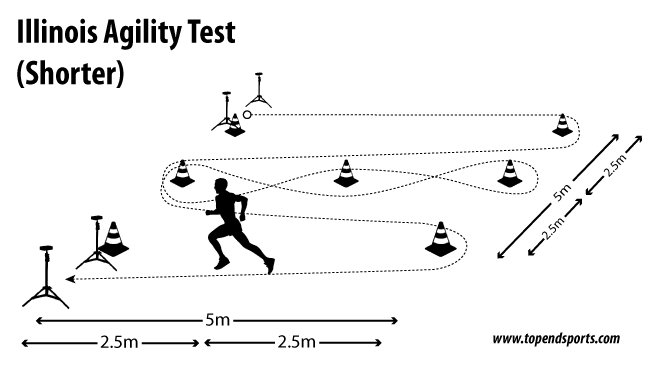
Course layout: The test area measures 5 meters by 5 meters. Four cones mark the corners of the square (start, finish, and two turning points). Three additional cones are placed down the center, spaced 2.5 meters apart for the slalom section.
Test procedure: Athletes begin in a standing position at the start line. Unlike the original Illinois test where athletes start lying prone, the standing start enables accurate use of timing gates. On the "Go" command, the athlete:
- Sprints forward 5 meters to the first corner cone
- Turns 180 degrees and sprints back 5 meters to the start line
- Weaves through the three center cones in a slalom pattern
- Turns and weaves back through the cones
- Sprints 5 meters forward to the far corner
- Turns 180 degrees and sprints back through the finish line
Multiple trials should be completed with adequate rest between attempts. The best time is typically recorded as the official result.
Understanding Your Results
Performance on the Shorter Illinois Agility Test is influenced by multiple factors including change-of-direction speed, body control, coordination, and sport-specific movement experience. Since this modified version has limited published normative data, the calculator above provides estimated performance categories based on the research of Hachana et al. (2014) and proportional scaling from established original Illinois test standards.
Excellent (Elite)
Under 6.8 seconds (males) or 7.2 seconds (females). Indicates superior change-of-direction ability typically seen in professional athletes.
Good (Above Average)
6.8-7.2 seconds (males) or 7.2-7.7 seconds (females). Strong agility performance for competitive athletes.
Average
7.2-7.6 seconds (males) or 7.7-8.2 seconds (females). Typical performance for recreational athletes and fitness enthusiasts.
Sport-Specific Applications
The Shorter Illinois Agility Test has particular relevance for sports requiring rapid direction changes in confined spaces. The research by Hachana et al. (2014) validated the test specifically on elite and sub-elite under-14 soccer players, making it especially appropriate for youth football assessment.
Soccer/Football
Midfielders and wingers benefit most from high agility scores, as their positions require constant direction changes when receiving and distributing the ball. Elite youth soccer players typically complete the test in under 7.0 seconds, with exceptional performers achieving times below 6.5 seconds.
Basketball
Point guards and defensive specialists rely heavily on change-of-direction ability for both offensive creation and defensive positioning. The compact test area closely mimics the movement demands within the key and during defensive transitions.
Tennis
Court coverage requires explosive lateral movements and rapid direction changes similar to the slalom portion of this test. Tennis players often show excellent performance due to their sport's emphasis on multi-directional footwork training.
Team Sports General
Rugby, hockey, volleyball, and American football all include phases of play where athletes must rapidly change direction in confined spaces. This test provides a standardized assessment applicable across these sports.
Advantages of the Shorter Version
- Reduced fatigue influence: The shorter course can be completed well under 10 seconds, minimizing anaerobic fatigue effects
- Purer agility measure: Less straight-line sprinting means better isolation of change-of-direction ability
- Timing gate compatible: Standing start position enables electronic timing for improved accuracy and reliability
- Space efficient: Requires only a 5m x 5m area versus 10m x 5m for the original
- Youth appropriate: Validated specifically on under-14 soccer players
Limitations and Considerations
Footwear and surface effects: Test times can vary significantly based on footwear type and running surface. Athletes should perform the test in their sport-specific footwear on a consistent surface for valid comparisons.
Limited normative data: Unlike the original Illinois test which has extensive published norms, this modified version has limited reference data. The performance standards in this calculator are estimates based on the original research and proportional scaling.
Timing consistency: Results can be subject to timing inconsistencies when using manual stopwatches. Electronic timing gates are recommended for research purposes and accurate monitoring of performance changes over time.
Asymmetry considerations: Research by Rouissi et al. (2016) found that directional asymmetries in this test can impact young soccer players' performance and may indicate injury risk factors worth addressing through targeted training.
Frequently Asked Questions
What is a good time for the Shorter Illinois Agility Test?
Good times typically range from 6.5-7.5 seconds for adult males and 7.0-8.0 seconds for adult females. Elite athletes may complete the test in under 6.5 seconds (males) or 7.0 seconds (females). Youth athletes generally have slightly longer times due to ongoing physical development.
How is this test different from the original Illinois Agility Test?
The Shorter Illinois Agility Test covers half the distance (5m x 5m vs 10m x 5m) while maintaining the same movement patterns. This reduces the influence of straight-line sprinting speed and minimizes fatigue, providing a more focused assessment of change-of-direction ability. Athletes also start standing rather than lying prone.
How many cones do I need for the Shorter Illinois Test?
You need 7 cones total: four to mark the corners of the 5m x 5m square, and three placed down the center spaced 2.5 meters apart for the slalom section.
Can I use this test for team assessments?
Yes, the Shorter Illinois Test is well-suited for team testing due to its quick completion time and space efficiency. Athletes can be tested individually with adequate rest between trials, and the standing start makes timing more consistent across multiple athletes.
How often should I retest to track improvement?
For tracking agility development, retest every 4-6 weeks during focused training periods. This allows sufficient time for training adaptations while providing regular feedback on progress. Always use consistent testing conditions including surface, footwear, and timing method.
Why does my calculator result differ from the original Illinois test norms?
The Shorter Illinois Test has different performance expectations than the original due to the reduced course length. Times are approximately 50% faster because the course covers half the distance. The calculator uses estimated standards based on the Hachana et al. (2014) research specifically for this modified version.
Should I warm up before taking this test?
Yes, always perform a thorough warm-up before any agility testing. Include 5-10 minutes of light jogging, dynamic stretching, and several practice runs at increasing intensity. This optimizes performance and reduces injury risk. Allow full recovery between practice runs and official test attempts.
About Our Calculations
This calculator uses estimated performance standards based on the Hachana et al. (2014) research methodology. As formal normative tables have not been published for the Shorter Illinois Agility Test, results should be interpreted as guidelines rather than definitive classifications. Individual performance varies based on training background, sport experience, and testing conditions. Last formula update: January 2026.
References
- Hachana, Y., Chaabène, H., Ben Rajeb, G., Khlifa, R., Aouadi, R., Chamari, K., & Gabbett, T.J. (2014). "Validity and Reliability of New Agility Test among Elite and Subelite under 14-Soccer Players." PLOS ONE, 9(4), e95773.
- Rouissi, M., Chtara, M., Berriri, A., Owen, A., & Chamari, K. (2016). "Asymmetry of the Modified Illinois Change of Direction Test Impacts Young Elite Soccer Players' Performance." Asian Journal of Sports Medicine, 7(2), e33598.
- Gabbett, T.J., Kelly, J.N., & Sheppard, J.M. (2008). "Speed, change of direction speed, and reactive agility of rugby league players." Journal of Strength and Conditioning Research, 22(1), 174-181.
- Sheppard, J.M., & Young, W.B. (2006). "Agility literature review: Classifications, training and testing." Journal of Sports Sciences, 24(9), 919-932.
- Young, W.B., Dawson, B., & Henry, G.J. (2015). "Agility and Change-of-Direction Speed are Independent Skills: Implications for Training for Agility in Invasion Sports." International Journal of Sports Science & Coaching, 10(1), 159-169.
- Chaouachi, A., Manzi, V., Chaalali, A., Wong, D.P., Chamari, K., & Castagna, C. (2012). "Determinants analysis of change-of-direction ability in elite soccer players." Journal of Strength and Conditioning Research, 26(10), 2667-2676.
- Nimphius, S., Callaghan, S.J., Spiteri, T., & Lockie, R.G. (2016). "Change of Direction Deficit: A More Isolated Measure of Change of Direction Performance Than Total 505 Time." Journal of Strength and Conditioning Research, 30(11), 3024-3032.
Similar Tests
- Illinois Agility Test (Modified) — a modification of the standard Illinois test which reduces some straight sprinting while maintaining the 10m course length
- Illinois Agility Test — the original agility run involving 180 degree turns and slalom running over a 10m x 5m course
- T-Test — running a T-shape course involving forward, lateral, and backwards running
- Zig-Zag Test — tests agility through rapid direction changes without slalom weaving
- Figure-of-Eight Agility Run Test — continuous figure-8 pattern for assessing curved running ability
Related Pages
Video Examples
Watch Illinois test demonstrations and proper technique.
 Any comments, suggestions, or corrections? Please let us know.