Isokinetic Strength Test Calculator
Quick Answer
This calculator analyzes isokinetic dynamometer test results to determine hamstring-to-quadriceps (H:Q) ratios and bilateral strength deficits. Results help identify muscle imbalances that may increase injury risk.
- Calculates H:Q ratio for both limbs instantly
- Identifies bilateral deficits between dominant and non-dominant legs
- Provides body weight-normalized values for cross-athlete comparison
What is Isokinetic Strength Testing?
Isokinetic strength testing involves exercise at a constant angular velocity using specialized dynamometer equipment. Unlike free weights where speed varies with effort, isokinetic machines provide variable resistance that matches the force applied, allowing maximal effort throughout the entire range of motion. This methodology provides the most accurate assessment of muscular strength and power available in sports science.
The term "isokinetic" comes from Greek roots meaning "equal motion." During testing, the dynamometer arm moves at a pre-set speed regardless of how much force the athlete applies. If the athlete pushes harder, the machine increases resistance to maintain constant velocity. This allows precise measurement of peak torque, total work, and power at specific points throughout the movement.
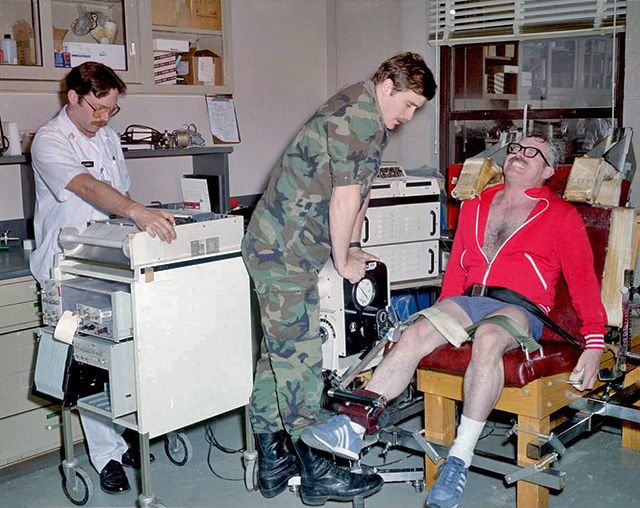
Cybex isokinetic dynamometer used for strength testing
Understanding the H:Q Ratio
The hamstring-to-quadriceps (H:Q) ratio is one of the most important metrics from isokinetic testing. This ratio compares the peak torque generated by the hamstrings to that generated by the quadriceps on the same limb. Research has consistently shown that inadequate hamstring strength relative to quadriceps strength significantly increases the risk of hamstring strains, particularly in sports involving sprinting, kicking, and rapid deceleration.
According to sports science expert Robert Wood, who has analyzed sports performance data for over 25 years, the conventional H:Q ratio typically ranges from 50-80% at slow testing velocities (60°/s). This means healthy hamstrings should produce 50-80% of the force that the quadriceps can generate. At higher velocities, this ratio increases as hamstring performance becomes relatively better compared to quadriceps.
Normal H:Q Range
50-80% at 60°/s is considered normal for most athletic populations. Elite sprinters may have ratios approaching 80%.
Risk Threshold
H:Q ratios below 50% indicate significant hamstring weakness and elevated injury risk requiring intervention.
Velocity Effect
H:Q ratio increases with testing velocity, typically reaching 80-100% at 300°/s due to hamstring fiber composition.
Bilateral Deficit Analysis
Comparing strength between limbs reveals important information about asymmetry. A bilateral deficit greater than 10-15% between the dominant and non-dominant leg is considered clinically significant. Such asymmetries may result from previous injury, sport-specific adaptations, or underlying dysfunction that could predispose to future injury.
Athletes with bilateral deficits exceeding 15% have significantly higher rates of lower extremity injury. Return-to-sport protocols following ACL reconstruction or hamstring strain typically require bilateral deficits to be reduced below 10% before clearing athletes for competition.
Testing Velocities and Their Significance
Isokinetic testing at multiple angular velocities provides a comprehensive picture of muscular performance across the force-velocity spectrum:
- 60°/s - Assesses maximum strength capacity; closest to isometric conditions
- 120°/s - Evaluates strength-speed qualities important for power production
- 180°/s - Tests power endurance; commonly used for repeated effort analysis
- 240°/s - Assesses high-speed strength relevant to running mechanics
- 300°/s - Evaluates explosive power; mimics sprint-speed muscle actions
Sport-Specific Applications
Different sports have varying isokinetic strength requirements based on the demands of competition:
Soccer/Football
Kicking athletes require strong H:Q ratios (>65%) due to eccentric hamstring loading during kick follow-through. Bilateral symmetry is critical for two-footed players.
Track & Field - Sprinting
Sprinters need exceptional hamstring strength with H:Q ratios often exceeding 70%. High-velocity testing (300°/s) is particularly relevant.
Basketball/Volleyball
Jumping athletes benefit from balanced quadriceps strength bilaterally. Testing at multiple velocities assesses jump-specific power output.
Ice Hockey
Skating mechanics load the hip and knee extensors uniquely. Isokinetic testing helps identify stride-limiting weaknesses.
Equipment for Isokinetic Testing
Equipment required: Isokinetic testing equipment such as Biodex System 4, Cybex HUMAC NORM, or Con-Trex systems. These dynamometers range in cost from $30,000 to over $100,000 and are typically found in sports medicine clinics, university research labs, and professional sports team facilities.
Pre-test procedures: Explain test protocols to the subject. Perform health risk screening and obtain informed consent. Record basic information including age, height, body weight, gender, sport, position, and injury history. Calibrate equipment according to manufacturer specifications. Allow adequate warm-up including 5-10 minutes of cycling and dynamic stretching. See more details of pre-test procedures.
Test procedure: The subject is positioned with the joint axis aligned to the dynamometer axis, typically tested in seated position for knee extension/flexion. Stabilization straps secure the trunk and thigh to isolate the target muscles. Following familiarization repetitions, the athlete performs 3-5 maximal efforts at each velocity, with adequate rest between sets. Peak torque, average power, and total work are recorded for analysis.
Interpreting Your Results
Results from isokinetic testing should be interpreted in context of the athlete's sport, position, training history, and injury status. Key metrics include:
- Peak Torque (Nm) - Maximum force generated during the movement; primary measure of strength
- Body Weight Normalized Values (Nm/kg) - Allows comparison across athletes of different sizes
- Time to Peak Torque - Rate of force development; important for explosive sports
- Total Work (J) - Cumulative force through range of motion; indicates work capacity
- Fatigue Index (%) - Decline in performance across repetitions; reflects muscular endurance
Normative values vary by sport, sex, age, and testing velocity. Male athletes typically generate peak knee extension torque of 2.5-3.5 Nm/kg at 60°/s, while female athletes typically achieve 2.0-2.8 Nm/kg. Elite athletes in power sports often exceed these values significantly.
Using Results for Training
Based on isokinetic test findings, specific training interventions can address identified weaknesses:
Low H:Q Ratio (<55%):
- Prioritize Nordic hamstring exercises and Romanian deadlifts
- Include eccentric-emphasized hamstring training
- Reduce quadriceps isolation work until ratio improves
- Retest after 6-8 weeks of targeted training
Significant Bilateral Deficit (>15%):
- Emphasize unilateral training on the weaker limb
- Single-leg squats, step-ups, and lunges targeting deficit
- Consider underlying causes (previous injury, motor control issues)
- Monitor progress with regular reassessment
Frequently Asked Questions
What is a normal H:Q ratio?
A normal conventional H:Q ratio is typically 50-80% at slow speeds (60°/s), meaning hamstring strength should be 50-80% of quadriceps strength. The optimal range for most athletes is 60-70%, with elite sprinters often achieving ratios above 70%.
What bilateral deficit is considered problematic?
A bilateral deficit greater than 10-15% between limbs is generally considered clinically significant and may indicate increased injury risk. Deficits greater than 15% typically require targeted training intervention before return to sport.
What angular velocity should I test at?
Most comprehensive protocols test at multiple velocities. 60°/s assesses maximum strength, 180°/s evaluates power endurance, and 300°/s measures high-speed performance. The choice depends on sport demands and assessment goals.
How do I interpret body weight-normalized values?
Dividing peak torque by body weight allows comparison across athletes of different sizes. Male athletes typically achieve 2.5-3.5 Nm/kg for knee extension at 60°/s. Values below 2.0 Nm/kg may indicate relative weakness requiring attention.
Why is the H:Q ratio important for athletes?
The H:Q ratio is crucial because hamstring weakness relative to quadriceps strength is a significant risk factor for hamstring strains, particularly in sprinting and kicking sports. Maintaining optimal ratios helps prevent injury and optimize performance.
How often should athletes undergo isokinetic testing?
Elite athletes typically undergo testing during pre-season screening, mid-season monitoring, and post-injury rehabilitation. Testing every 3-6 months during training phases helps track strength development and identify emerging imbalances early.
What equipment is used for isokinetic testing?
Common isokinetic dynamometers include Biodex System 4, Cybex HUMAC NORM, and Con-Trex systems. These specialized machines cost $30,000-$100,000+ and are found in sports medicine clinics, university labs, and professional sports facilities.
References
- Croisier, J.L., et al. (2008). "Strength imbalances and prevention of hamstring injury in professional soccer players." American Journal of Sports Medicine, 36(8), 1469-1475.
- Aagaard, P., et al. (1998). "Isokinetic hamstring/quadriceps strength ratio: influence from joint angular velocity, gravity correction and contraction mode." Acta Physiologica Scandinavica, 163(1), 75-83.
- Heiser, T.M., et al. (1984). "Prophylaxis and management of hamstring muscle injuries in intercollegiate football players." American Journal of Sports Medicine, 12(5), 368-370.
- Kannus, P. (1994). "Isokinetic evaluation of muscular performance: implications for muscle testing and rehabilitation." International Journal of Sports Medicine, 15(S1), S11-S18.
- Dauty, M., et al. (2016). "Identifying the risk factors of hamstring injury occurrence in professional soccer players." Annals of Physical and Rehabilitation Medicine, 59, e84-e85.
- Orchard, J., et al. (1997). "Intrinsic and extrinsic risk factors for anterior cruciate ligament injury in Australian footballers." American Journal of Sports Medicine, 25(6), 781-789.
- Zvijac, J.E., et al. (2013). "Isokinetic concentric quadriceps and hamstring strength variables from the NFL Scouting Combine are not predictive of hamstring injury in first-year professional football players." American Journal of Sports Medicine, 41(7), 1511-1518.
Similar Tests
- Mid-Thigh Pull Test (IMTP) — an isometric leg strength test, the participant pulls against a static object
Related Pages
- Other strength tests
 Any comments, suggestions, or corrections? Please let us know.