Kneeling Power Ball Chest Launch Calculator
Quick Answer
This calculator rates your kneeling power ball chest launch throw distance against athletic performance standards from SPARQ testing. Enter your distance to see your percentile ranking and sport-specific comparisons.
- Calculates percentile ranking based on Nike SPARQ combine data
- Compares results to football, hockey, and athletic standards
- Provides sport-specific training recommendations
The Kneeling Chest Launch Test involves throwing a Power Ball for maximum distance from a kneeling position, as a measure of upper body strength and power. This test is one of the tests of the SPARQ rating system for ice hockey and newly added to the football SPARQ testing (it replaced the maximum bench press), and their protocol is listed here.
What Does This Calculator Measure?
The kneeling power ball chest launch is a validated test of upper body coordination, strength, and explosive power. Unlike the seated medicine ball throw which isolates arm strength, the kneeling position allows athletes to utilize their trunk and hip drive, making it a more functional assessment of total upper body power that transfers to sports performance.
Purpose: This test measures upper body coordination, strength and power.
Equipment required: 2 or 3 kg power ball, tape measure, foam pad for kneeling, clear open area for testing.
Pre-test: Explain the test procedures to the subject. Perform screening of health risks and obtain informed consent. Prepare forms and record basic information such as age, height, body weight, gender and test conditions. Check the weight of the ball. The start line should be clearly marked. Perform a standard warm-up. See more details of pre-test procedures.
Weights: Males use 3 kg, females 2 kg, and all youth the 2 kg power ball.
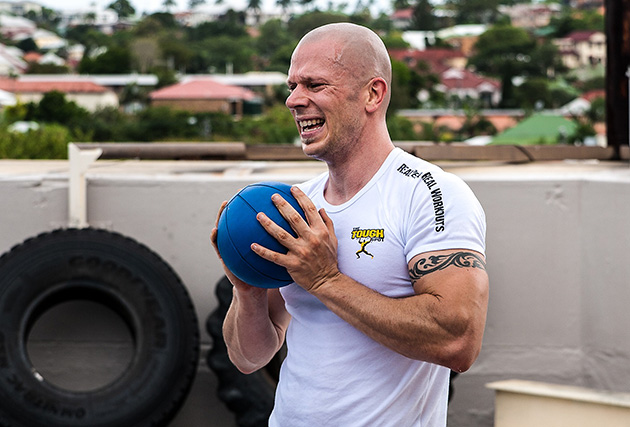
Powerball throw test demonstration
How to Perform the Test
Procedure: The athlete starts in a kneeling position with the back erect and facing the direction they are going to throw. The thighs should be parallel and the knees at the start line. Ensure that the toes are pointed backwards, as curled up toes can be used for greater traction. Starting with the ball grasped with both hands at the sides, and held out and above the head. The ball is brought down to the chest as their hips are brought back to the heels, then in one motion the ball is pushed forward and up (optimally between 30-45 degrees). A practice trial is allowed to learn the correct movements and get the best trajectory for maximum distance. They must not throw favoring one arm or rotate about the spine. The athlete is permitted to fall forwards over the line after the ball is released. The knees are not to leave the ground. Two attempts are allowed, with at least 45 seconds recovery between each throw.
Scoring: The measurement is recorded in feet and inches to the nearest inch, measuring from the outer edge of the launch line to the central point where the Power Ball first lands. The best result of two throws is recorded.
Understanding Your Results
Your power ball throw distance reflects multiple athletic qualities including chest and shoulder strength, core stability, hip power, and neuromuscular coordination. The kneeling position eliminates leg drive contribution while still allowing trunk involvement, making it an excellent functional upper body power assessment.
Results Reference: US Decathlete Bryan Clay achieved 38 ft 9 in in this test during a SPARQ testing exercise (published in SPARQ Magazine, Summer 2008). At Nike SPARQ Combines, top high school football prospects have recorded throws exceeding 45 feet, with the record standing at 49 feet.
Pro Tip: The angle of ball release is critical for maximum distance. The optimal release angle is between 30-45 degrees. Allow practice throws to find your best trajectory before official attempts.
Sport-Specific Applications
Target population: Football, ice hockey, rugby, wrestling, and other sports in which upper body power is important.
The pushing motion closely correlates with blocking power in football, checking ability in hockey, and grappling strength in combat sports. Coaches use this test to:
- Assess offensive and defensive lineman explosiveness
- Evaluate hockey players' checking potential
- Monitor upper body power development over training cycles
- Compare athletes within position groups
How to Improve Your Power Ball Throw
To improve your kneeling power ball chest launch distance, focus on these evidence-based training strategies:
- Explosive Push Exercises: Plyometric push-ups, bench press throws, explosive dumbbell presses
- Strength Foundation: Build base strength with bench press, overhead press, and rows
- Core Stability: Strong core transfers force efficiently from hips to arms
- Hip Power: Practice the hip-loading motion that generates initial force
- Technique Refinement: Focus on optimal 30-45 degree release angle
Research shows that 8-12 weeks of combined strength and plyometric training can improve medicine ball throw distance by 10-15% in trained individuals.
Advantages: This test is easy and quick to perform for an individual, with the equipment required relatively cheap.
Disadvantages: Several people are needed to conduct this test smoothly: one to mark results, another to check technique and another to collect and return the balls. If testing a large group of participants, it can be time consuming to put all of them through this test.
Comments: The angle the ball is thrown is important. You may want to explain to the subject about the optimal angle for maximal distance, and to allow some practice attempts.
The Test in Action
- This test is one of the tests of the SPARQ rating system for ice hockey and newly added to the football SPARQ testing protocol.
- Nike SPARQ Combines used this test to evaluate thousands of high school athletes annually
- The test replaced the bench press in Football SPARQ as a safer, more functional power assessment
Frequently Asked Questions
What is a good kneeling power ball throw distance?
For adult males using a 3kg power ball, a good throw is 35-39 feet (10.7-11.9 meters), placing you in the 60th-79th percentile. Excellent throws reach 40-44 feet, and elite athletes achieve 45+ feet. Bryan Clay's 38 ft 9 in represents upper-tier performance for trained athletes.
What weight power ball should I use?
Males use a 3kg power ball, females use a 2kg power ball, and all youth athletes use the 2kg power ball regardless of gender. The ball weight significantly affects distance, so always compare results using the same weight category.
How does this test differ from the seated medicine ball throw?
The kneeling chest launch allows torso utilization and hip drive, making it a more functional whole-body power test. The seated throw isolates arm and chest strength by keeping the back against a wall. Expect 15-25% greater distances in the kneeling position.
What is the optimal throwing angle?
The optimal release angle is between 30-45 degrees for maximum distance. Too low an angle limits hang time; too high wastes horizontal force. Practice throws help athletes find their personal optimal trajectory.
Is this test used in professional sports combines?
Yes, the kneeling power ball throw was a key component of the SPARQ rating system used at Nike Combines for football and ice hockey. It replaced the bench press in Football SPARQ as a safer, more functional test that doesn't require spotters or heavy weights.
How can I improve my power ball throw distance?
Focus on explosive push exercises (plyometric push-ups, bench throws), build foundational strength (bench press, overhead press), develop core stability, and refine your technique with the hip-loading motion. Consistent training typically yields 3-5 feet improvement per month.
How many attempts are allowed in official testing?
The standard SPARQ protocol allows two attempts with at least 45 seconds recovery between throws. One practice trial is permitted to learn correct movements and find the best trajectory. The best of two official throws is recorded.
References
- SPARQ Magazine. (2008). "Bryan Clay SPARQ Testing Results." Summer 2008 Edition.
- Stockbrugger, B.A., & Haennel, R.G. (2003). "Contributing factors to performance of a medicine ball explosive power test." Journal of Strength and Conditioning Research, 17(4), 768-774.
- Cronin, J.B., & Owen, G.J. (2004). "Upper-body strength and power assessment in women using a chest pass." Journal of Strength and Conditioning Research, 18(3), 401-404.
- Debeliso, M., et al. (2022). "Establishing Normative Reference Values for the Utah Seated Medicine Ball Throw Protocol in Adolescents." The Sport Journal.
- National Strength and Conditioning Association. (2016). Essentials of Strength Training and Conditioning (4th ed.). Human Kinetics.
- ESPN. (2011). "Anthony Smith's record power ball toss highlights Houston Nike combine." ESPN College Sports Recruiting.
- Hackett, D.A., et al. (2018). "Predictive ability of the medicine ball chest throw and vertical jump tests for determining muscular strength and power in adolescents." Measurement in Physical Education and Exercise Science, 22(1), 79-87.
Similar Tests
- Seated Medicine Ball Throw
- Kneeling basketball throw test — a one-handed throw for distance from the kneeling position.
- Basketball Throw — two-handed push power with the back against a wall
- The "Seated Power Throw" test, part of the US Army Occupational Physical Assessment Test, uses a 4.4 pound (2 kg) medicine ball.
- Bench Press Max Power
Related Pages
- Medicine and Power Ball Fitness Tests
- About Medicine/Power Balls
- The SPARQ rating system for football and ice hockey
- SPARQ fitness rating system
- Other speed and power tests
- Medicine balls for sale
 Any comments, suggestions, or corrections? Please let us know.