Isometric Push-Up Hold Test Calculator
Quick Answer
This calculator measures your isometric push-up hold time to assess chest, arm, and core muscular endurance. Results help you track strength gains and compare against athletic norms.
- Average hold time for trained adults: 45-90 seconds
- Tests pectoralis major, deltoids, triceps, and core stability
- Validated for athletes across strength and endurance sports
The Isometric Push-Up Hold Test requires the participants to hold a lowered 'down' push-up position for as long as possible. This is different from the Brockport assessment Isometric Push-Up Test in which the 'up' position is held. See the similar fitness tests the Plank Fitness Test and Side Ramp Tests. There are also several other push-up tests.
How to Use This Calculator
Follow these simple steps to assess your isometric push-up hold strength:
- Enter Time Manually: If you've already completed the test, enter your hold time in seconds directly into the input field.
- Add Your Details: Enter your body weight and select your gender for more accurate assessment and percentile ranking.
- Get Your Results: Click "Calculate Results" to see your performance category, percentile ranking, and training recommendations.
Pro Tip: For the most accurate results, perform the test after a proper warm-up but when you're well-rested. Avoid testing immediately after upper body training sessions.
Test Purpose and Benefits
The isometric push-up hold test measures maximum strength endurance of the chest and arm muscles, as well as core body strength. Unlike dynamic push-up tests that count repetitions, this static assessment evaluates your ability to maintain muscular tension over time—a critical component of functional fitness.
Key benefits of isometric push-up testing include:
- Muscular Endurance Assessment: Measures how long muscles can sustain a contracted position
- Core Stability Evaluation: Tests the ability to maintain proper body alignment under sustained load
- Joint-Friendly Testing: Lower impact on joints compared to repetitive movements
- Progress Tracking: Easy to measure improvements over training cycles
- Sport-Specific Application: Relevant for wrestling, martial arts, gymnastics, and tactical fitness
Equipment Required
Minimal equipment is needed for this assessment:
- Flat and clean surface (mat or floor)
- Stopwatch or timer (or use the calculator above)
- Recording sheets and pen
Pre-Test Procedures
Explain the test procedures to the subject and demonstrate the correct technique. Perform screening of health risks and obtain informed consent. Prepare forms and record basic information such as age, height, body weight, gender and test conditions. Perform a standard warm-up including light cardio and dynamic stretching. See more details of pre-test procedures.
Test Procedure
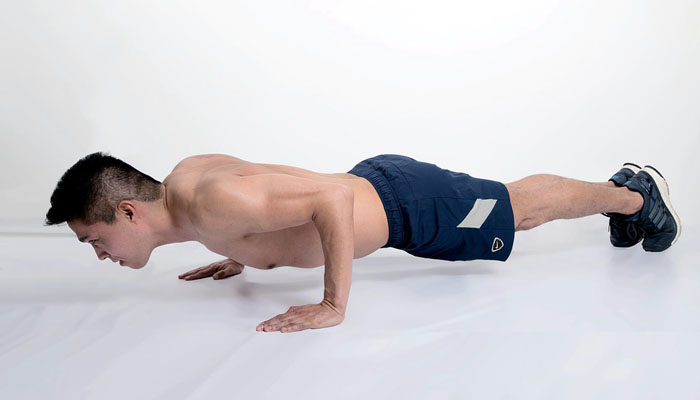
The participant assumes the standard starting position for a push-up—the hands directly below the shoulders, the arms extended, the whole body in a straight line, and the toes touching the floor or mat. The chest is lowered until the arms are at a right angle (90 degrees), the stopwatch is started, and the body is held in this position for as long as possible. The test ends as soon as the subject is unable to maintain the correct position (any movements such as bending, sagging, or swaying).
Scoring and Interpretation
Record the length of time the correct position was held, to the nearest second. Use the normative data table below to interpret your results:
Target Population
This test is used by those wanting to improve their push-up strength, particularly athletes in sports requiring upper body endurance and core stability. Common applications include:
- Military and Tactical Personnel: Combat readiness assessments
- Martial Artists: Wrestling, judo, and MMA conditioning
- Gymnasts: Static strength requirements
- CrossFit Athletes: Functional fitness benchmarking
- General Fitness: Upper body strength endurance tracking
Important Notes
Breath holding should be avoided—it should be emphasized to continuously breathe throughout the test. Holding breath (Valsalva maneuver) can spike blood pressure and reduce endurance performance. Encourage slow, controlled breathing throughout the hold.
⚠️ Warning: Individuals with shoulder injuries, wrist problems, or cardiovascular conditions should consult a healthcare professional before performing this test. Stop immediately if you experience any sharp pain or discomfort.
The Science Behind Isometric Testing
Isometric exercises involve muscle activation without joint movement. During the lowered push-up hold, your muscles contract to maintain position against gravity. Research by Schoenfeld et al. (2019) demonstrates that isometric training at longer muscle lengths (like the bottom of a push-up) produces greater strength adaptations than training at shorter muscle lengths.
The test primarily engages:
- Pectoralis Major: The main chest muscle maintaining horizontal adduction
- Anterior Deltoids: Front shoulder muscles supporting the load
- Triceps Brachii: Maintaining elbow flexion at 90 degrees
- Core Musculature: Rectus abdominis, obliques, and transverse abdominis preventing spinal sagging
- Scapular Stabilizers: Serratus anterior and rhomboids maintaining shoulder blade position
How to Improve Your Isometric Push-Up Hold
Based on sports science research, here are evidence-based strategies to improve your hold time:
- Progressive Overload: Start with shorter holds (10-15 seconds) and gradually increase duration by 5-10 seconds weekly
- Plank Training: Build core endurance with regular front and side plank holds
- Tempo Push-Ups: Practice slow eccentric (lowering) phases to build strength at the bottom position
- Isometric Holds at Various Angles: Train holds at different elbow angles (45°, 90°, 135°)
- Breathing Practice: Develop rhythmic breathing patterns during sustained effort
- Adequate Recovery: Allow 48-72 hours between isometric training sessions
Frequently Asked Questions
What is a good isometric push-up hold time?
A good hold time for adult males is 60-90 seconds, while adult females typically achieve 50-70 seconds. Elite athletes and military personnel often exceed 2 minutes. Performance varies significantly based on body weight, training history, and sport background.
What muscles does the isometric push-up hold test?
The test primarily assesses the pectoralis major (chest), anterior deltoids (front shoulders), triceps brachii, and core muscles including rectus abdominis and obliques. It measures muscular endurance rather than maximum strength, making it complementary to other push-up assessments.
How often should I test my isometric push-up hold?
Test every 4-6 weeks during a training program to track progress. More frequent testing can lead to fatigue accumulation without providing meaningful data. Ensure consistent testing conditions—same time of day, similar warm-up, and adequate rest prior to testing.
Is the isometric hold harder than regular push-ups?
The isometric hold challenges different aspects of muscular fitness. While regular push-ups test dynamic strength endurance through repetitions, the isometric hold tests sustained tension capacity. Many athletes find the sustained hold more mentally challenging due to the continuous muscle engagement without rest phases.
Can this test predict my push-up performance?
Research shows moderate correlation between isometric hold times and dynamic push-up repetitions. Athletes with longer hold times generally perform more push-ups, though the relationship isn't perfect. Both tests provide valuable but distinct information about upper body fitness.
What's the difference between the up and down position holds?
The Isometric Push-Up Hold Test (down position with arms at 90°) is significantly more challenging as muscles work at a longer length with greater mechanical disadvantage. The Brockport Isometric Push-Up Test (arms extended) tests different motor unit recruitment patterns and is typically easier to maintain for longer durations.
References
- American College of Sports Medicine. (2021). "ACSM's Guidelines for Exercise Testing and Prescription." 11th ed. Wolters Kluwer.
- Schoenfeld, B.J., et al. (2019). "Effects of range of motion on muscle development during resistance training interventions." Journal of Strength and Conditioning Research, 33(3), 684-695.
- Comfort, P., & Kasim, P. (2007). "Optimizing squat technique." Strength and Conditioning Journal, 29(6), 10-13.
- Winnick, J.P., & Short, F.X. (2014). "Brockport Physical Fitness Test Manual." 2nd ed. Human Kinetics.
- Clark, M.A., et al. (2018). "NASM Essentials of Personal Fitness Training." 6th ed. Jones & Bartlett Learning.
- Tong, T.K., et al. (2014). "Validity and reliability of isometric muscle strength testing." European Journal of Sport Science, 14(sup1), S485-S493.
- McGill, S.M. (2015). "Low Back Disorders: Evidence-Based Prevention and Rehabilitation." 3rd ed. Human Kinetics.
Similar Tests
- Isometric Push-Up Test — hold the raised push-up position for up to 40 seconds.
- Plank Fitness Test — hold the plank position for as long as you can.
- Side Ramp Fitness Test — hold the side-ramp position for as long as you can.
- Trunk Stability Push-Up Test — push up from the ground while keeping the body straight with no sagging.
- Seated Push-up — extend the arms and raise the body out of a chair, and hold this position for as long as possible.
- Wall Squat — hold a squatting position against a wall for as long as you can.
- Isometric Back Strength
- Isometric Leg Strength
- Isometric Leg Extension (Groningen)
Related Pages
- About Push-Up Fitness Testing
- About the Brockport Test Battery — health-related tests of physical fitness for use with young people with disabilities.
- Other Strength Tests
- About the Push-Up Fitness Exercise
 Any comments, suggestions, or corrections? Please let us know.