Navy PRT Push-Up Test Calculator
Quick Answer
This calculator determines your Navy Physical Readiness Test (PRT) push-up score based on official Navy standards. Results help you understand your performance category and identify training goals.
- Calculates your score using official Navy PRT scoring tables
- Based on age group and gender-specific standards
- Provides performance category from Probationary to Outstanding
This push-up test requires you to do as many push-ups as you can in two minutes. This test forms part of the Navy Physical Readiness Test (PRT), performed by US Navy personnel every six months.
Test Purpose and Equipment
Test purpose: Push-ups are used to assess the strength and endurance of the upper body muscle groups, specifically the chest (pectorals), shoulders (deltoids), and arms (triceps).
Equipment required: Floor mat or flat ground, stopwatch or timer.
Pre-test: Explain the test procedures to the subject. Perform screening of health risks and obtain informed consent. Prepare forms and record basic information such as age, height, body weight, gender and test conditions. Perform a standard warm-up. See more details of pre-test procedures.
Navy PRT Push-Up Test Procedure
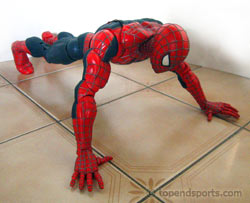
The aim of this test is to perform as many push-ups as you can in two minutes. The starting position is with your arms straight, elbows locked, body straight, hands placed slightly wider than shoulder-width apart with fingers pointing forward and both feet on the floor.
From the starting position, on the command 'go,' start the push-up by bending your elbows and lowering your body until the shoulders drop below the level of the elbows, then return to the starting position. Pausing to rest is permitted only in the up (starting) position.
Scoring: The maximum number of correctly performed push-ups is recorded.
Comments: For the push-up to be counted, the body must remain rigid in a generally straight line, and move as a unit while performing each rep, and the technique as described must be adhered to. If you rest on the ground or raise either hand or foot from the ground, the test will be terminated.
Understanding Navy PRT Push-Up Scoring
The Navy PRT uses a point-based scoring system where your push-up count is converted to points based on your age and gender. These points contribute to your overall PRT score alongside your cardio event (run, swim, or bike) and optional plank or curl-up event.
Outstanding (90-100 points)
Top-tier performance demonstrating exceptional muscular endurance. Required for special warfare and elite assignments.
Excellent (75-89 points)
Above-average fitness level. Shows dedication to physical conditioning beyond minimum requirements.
Good (60-74 points)
Meets Navy fitness expectations. Solid performance indicating good baseline conditioning.
Satisfactory (45-59 points)
Minimum passing score. Consider increasing training intensity to improve to Good category.
Navy PRT Push-Up Standards by Age Group
The following table shows representative push-up standards for males. Female standards are adjusted to account for physiological differences in upper body muscular endurance.
| Age Group | Outstanding (90+ pts) | Excellent (75-89 pts) | Good (60-74 pts) | Satisfactory (45-59 pts) | Minimum Pass |
|---|---|---|---|---|---|
| 17-19 | 92+ | 75-91 | 62-74 | 51-61 | 42 |
| 20-24 | 87+ | 72-86 | 57-71 | 47-56 | 37 |
| 25-29 | 84+ | 68-83 | 55-67 | 44-54 | 34 |
| 30-34 | 80+ | 64-79 | 51-63 | 39-50 | 30 |
| 35-39 | 76+ | 60-75 | 47-59 | 36-46 | 27 |
| 40-44 | 72+ | 56-71 | 43-55 | 32-42 | 24 |
| 45-49 | 66+ | 51-65 | 38-50 | 28-37 | 20 |
| 50-54 | 59+ | 45-58 | 33-44 | 24-32 | 17 |
| 55-59 | 52+ | 39-51 | 28-38 | 19-27 | 13 |
| 60+ | 45+ | 33-44 | 23-32 | 15-22 | 10 |
How to Improve Your Navy PRT Push-Up Score
Improving your push-up count requires a structured approach combining strength training, endurance work, and proper recovery. Research by Robert Wood, MSc Sports Science and founder of Topend Sports, indicates that most service members can improve their push-up count by 15-25% within 8 weeks of dedicated training.
Progressive Overload Training
Start with your current max and aim to add 2-3 reps per week. Use pyramid sets: 5-10-15-10-5 reps with 60-second rest intervals. This builds both strength and muscular endurance critical for the 2-minute test.
Variation Training
Incorporate different push-up variations to target all muscle fibers: wide grip for chest emphasis, close grip for triceps, decline push-ups for upper chest, and diamond push-ups for overall difficulty. Include 2-3 variations in each training session.
Supplementary Exercises
Strengthen supporting muscles with bench press (60-75% of your 1RM for 8-12 reps), dips (3 sets of max reps), tricep extensions, and shoulder presses. Core stability work including planks and dead bugs improves form maintenance during fatigue.
Test-Specific Practice
Practice the exact PRT protocol once weekly: timed 2-minute max effort with proper form. This conditions your body to maintain pace and manage fatigue during the actual test.
Sport-Specific Applications
Push-up performance and the muscular endurance it represents transfers directly to many athletic contexts beyond military fitness:
Combat Sports
Wrestlers, boxers, and MMA fighters rely on pushing strength for control and striking. Elite boxers typically perform 80+ push-ups in 2 minutes.
Football
Offensive and defensive linemen use pushing strength on every play. College football combines often test push-up endurance.
Swimming
Push-up strength correlates with pulling power in the water. Navy personnel often cross-train with swimming, making this connection important.
General Fitness
Push-ups remain one of the most effective bodyweight exercises for assessing and developing upper body fitness.
Frequently Asked Questions
How many push-ups do I need to pass the Navy PRT?
The minimum passing score varies by age and gender. For males aged 20-24, the minimum is 37 push-ups. For females in the same age group, the minimum is 16 push-ups. Requirements decrease with age, with those 60+ needing 10 push-ups (male) or 4 push-ups (female) minimum.
What is an outstanding score on the Navy PRT push-up test?
An outstanding score places you in the top performance tier. For males aged 20-24, this requires 87+ push-ups. For females aged 20-24, an outstanding score requires 48+ push-ups. Outstanding performance earns 90-100 points toward your overall PRT score.
How long do you have to complete push-ups in the Navy PRT?
The Navy PRT push-up test allows 2 minutes to complete as many correctly-formed push-ups as possible. The timer starts on the command 'go' and you may rest in the up position but not on the ground or the test terminates.
What happens if I fail the push-up portion of the PRT?
Failing any single event of the PRT results in an overall failure. Consequences may include restricted privileges, additional physical training, and documentation in your service record. Multiple failures can affect advancement and retention.
Can I rest during the Navy PRT push-up test?
Yes, but only in the up (starting) position with arms extended. Resting on the ground, breaking form, or lifting hands or feet from the floor terminates the test. Many test-takers benefit from brief rest periods in the up position to prevent muscular failure.
How often is the Navy PRT administered?
The Navy PRT is administered twice per year. Active duty personnel must pass both annual assessments. Body composition assessments are conducted alongside the physical fitness test events.
Does the Navy accept planks instead of push-ups or curl-ups?
The Navy has transitioned to the forearm plank as the primary core strength event, replacing curl-ups. However, push-ups remain a mandatory event. The plank is held for time rather than repetitions.
References
- U.S. Navy Bureau of Naval Personnel. (2024). "Physical Readiness Program Operating Guide." OPNAV Instruction 6110.1J.
- Navy Personnel Command. (2024). "PRT Scoring Standards." Official Navy Physical Fitness Assessment Guidelines.
- Wood, R.J. (2005). "Push-Up Fitness Testing: A Comprehensive Analysis." Topend Sports Research.
- American College of Sports Medicine. (2022). "ACSM's Guidelines for Exercise Testing and Prescription." 11th Edition, Lippincott Williams & Wilkins.
- Ratamess, N.A. et al. (2012). "Progression Models in Resistance Training for Healthy Adults." Medicine & Science in Sports & Exercise, 41(3), 687-708.
- Navy Physical Readiness Program. (2023). "Age-Adjusted Fitness Standards for Active Duty Personnel." Bureau of Naval Personnel.
- Kraemer, W.J. & Ratamess, N.A. (2004). "Fundamentals of Resistance Training: Progression and Exercise Prescription." Medicine & Science in Sports & Exercise, 36(4), 674-688.
Similar Tests
- A Simple Push-Up Test that can be done at home.
- Push-ups as performed in the US Army physical fitness test.
Related Pages
- General push-up test procedures.
- PRT testing discussion and scoring and links to other PRT test descriptions.
- World Records for Push Ups.
- Other speed and power tests.
- Why Spider-Man?
 Any comments, suggestions, or corrections? Please let us know.