Chair Push-Up Test Calculator
Quick Answer
This calculator scores your chair push-up test performance based on the 30-second protocol used in the AIS eTID talent identification program. Enter your completed push-ups to receive instant percentile rankings adjusted for age and gender.
- Measures upper body strength and muscular endurance
- Based on AIS/Volleyball Australia testing protocols
- Suitable for youth athletes, beginners, and general fitness assessment
About the Chair Push-Up Test
The push-up test is used to measure upper body strength and endurance. This variation, which uses a chair to raise the upper body, is used as part of the online Talent Identification for Beach Volleyball. In this test, the maximum number of push-ups performed in 30 seconds is recorded.
Equipment required: wall, a standard chair (about 46cm high), stopwatch, chalk/masking tape, even and firm floor surface.
Pre-test: Explain the test procedures to the subject. Perform screening of health risks and obtain informed consent. Prepare forms and record basic information such as age, height, body weight, gender and test conditions. Perform a standard warm-up. See more details of pre-test procedures.
Test Procedure
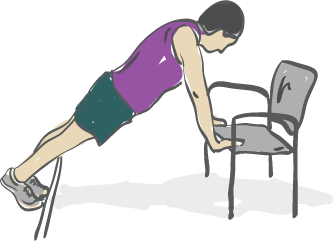 Shoes should be worn for best grip on the floor. Place the chair against the wall then lie face up with the soles of both feet in line with the front of the chair. Mark a line on the floor with the chalk/masking tape at the level of the elbows. Now stand and face the chair with the toes behind this marked line, and reach forward to place both hands shoulder width apart on the front edge of the chair. Straighten the arms, and ensure the body and legs are in a straight line, the arms should be at right angles to the body. When ready, complete as many push-ups as possible in 30 seconds. For a push-up to be counted, the subject must lower their body until their chest touches the front edge of the chair and then raise themselves back to the starting position until arms are fully extended. It is important that the body is kept in a straight line throughout the entire test. A push-up is not counted if not completed correctly.
Scoring: Record the total number of correctly completed push-ups that were performed in 30 seconds.
Understanding Your Results
Your chair push-up test score provides insight into your upper body muscular endurance. The calculator compares your performance against age and gender-matched norms to determine your fitness level.
Performance classifications are based on percentile rankings:
- Excellent (90th+ percentile): Top 10% of your age/gender group - indicates superior upper body endurance
- Good (70th-89th percentile): Above average performance suitable for most sports
- Average (40th-69th percentile): Typical fitness level for recreational athletes
- Below Average (20th-39th percentile): Room for improvement with targeted training
- Poor (Below 20th percentile): Significant improvement possible with consistent training
Sport-Specific Applications
Target population: This test is used in Volleyball talent ID testing, and also the general eTID testing. As it is easier to perform than the standard push-up, it would be suitable for children and those of lower fitness levels.
The chair push-up test is particularly relevant for:
- Beach Volleyball: Upper body strength for spiking, blocking, and defensive dives
- Swimming: Pushing power for starts and turns
- Gymnastics: Support positions and floor exercises
- Wrestling: Pushing and controlling opponents
- General Fitness: Foundation strength for progression to standard push-ups
Advantages: This test is easy and quick to perform, and is suitable for people of all fitness abilities.
How to Improve Your Score
To improve your chair push-up test results, focus on progressive overload training:
- Week 1-2: Practice 3 sets of 8-10 chair push-ups, 3 times per week
- Week 3-4: Increase to 3 sets of 12-15 repetitions
- Week 5-6: Add a 4th set or progress to a lower chair height
- Week 7+: Transition gradually to standard push-ups
Allow 48 hours rest between sessions for muscle recovery. Combine with exercises targeting the chest, shoulders, and triceps for comprehensive upper body development.
Frequently Asked Questions
How many chair push-ups should I be able to do in 30 seconds?
The average adult can complete 10-15 chair push-ups in 30 seconds. Athletes and those with good upper body fitness typically achieve 18-25 repetitions, while elite performers can exceed 30 push-ups.
Is the chair push-up test easier than regular push-ups?
Yes, chair push-ups are significantly easier because the elevated hand position reduces the percentage of body weight being lifted from approximately 64% to around 40-45%. This makes it an excellent starting point for building upper body strength.
What muscles does the chair push-up test assess?
The test primarily measures the strength and endurance of the pectoralis major (chest), anterior deltoids (front shoulders), and triceps brachii. The core muscles also engage isometrically to maintain proper body alignment throughout the movement.
How is this test used in volleyball talent identification?
The Australian Institute of Sport includes the chair push-up test in their eTID (Talent Identification) program for beach volleyball. Upper body pushing strength directly correlates with spiking power, blocking effectiveness, and the ability to execute defensive diving movements.
What is the correct chair height for this test?
The standard chair height is approximately 46cm (18 inches). Most standard dining or office chairs meet this requirement. The chair must be placed securely against a wall to prevent any movement during the test.
Can I use this test to track my fitness progress?
Yes, the chair push-up test is excellent for tracking progress. Retest every 4-6 weeks using identical conditions (same chair, same time of day, after similar warm-up) to accurately measure improvement in upper body endurance.
What should I do if I cannot complete any push-ups?
If you cannot complete any chair push-ups, start with wall push-ups at an even greater incline. Progress by gradually moving your feet further from the wall over several weeks until you can transition to chair push-ups.
References
- Australian Institute of Sport. (2023). "eTID Talent Identification Testing Protocols." AIS Sports Science.
- Volleyball Australia. (2024). "Beach Volleyball Physical Testing Battery." National Testing Standards.
- Baumgartner, T.A., et al. (2007). "Measurement for Evaluation in Physical Education and Exercise Science." McGraw-Hill.
- ACSM. (2022). "ACSM's Guidelines for Exercise Testing and Prescription." American College of Sports Medicine.
- Wood, R. (2005). "Push-Up Test Variations for Fitness Assessment." TopEndSports.
- Mayhew, J.L., et al. (1991). "Muscular endurance repetitions to predict bench press strength." Journal of Sports Medicine.
Similar Tests
- Modified push-up test — includes a clap behind the back
- Home Push Up — a simple push-up test that can be done at home
- Hand Release Pushup, the USA Army push-up test
- Push-Up (Seated) — extend the arms and raise the body out of a chair (part of the Brockport Protocol)
Related Pages
- Read about other variations of the push-up test
- Talent Identification for Beach Volleyball, part of the eTID Program
- List of other Strength Tests
 Any comments, suggestions, or corrections? Please let us know.