Sitting-Rising Test (SRT)
The sitting-rising is a simple fitness test designed by Brazilian Claudio Gil Araújo and colleagues (2012) to assess flexibility, balance and muscle strength of seniors. It is a simple assessment of the ability to sit on the floor then rise unaided. See more about Testing the Elderly.
test purpose: to assess the flexibility, balance and muscle strength of seniors.
equipment: no equipment required, just a clear space to perform the test.
pre-test: Explain the test procedures to the subject. Perform screening of health risks and obtain informed consent. Prepare forms and record basic information such as age, height, body weight, gender, test conditions. Perform an appropriate warm-up. See more details of pre-test procedures.
procedure: The test is administered on a nonslip surface, with individuals given the following instructions: "Without worrying about the speed of movement, try to sit and then to rise from the floor, using the minimum support that you believe is needed.". The image below is another version of this test, in which the participant is required to rise from a cross-legged position on the floor, without touching the floor with their hands.
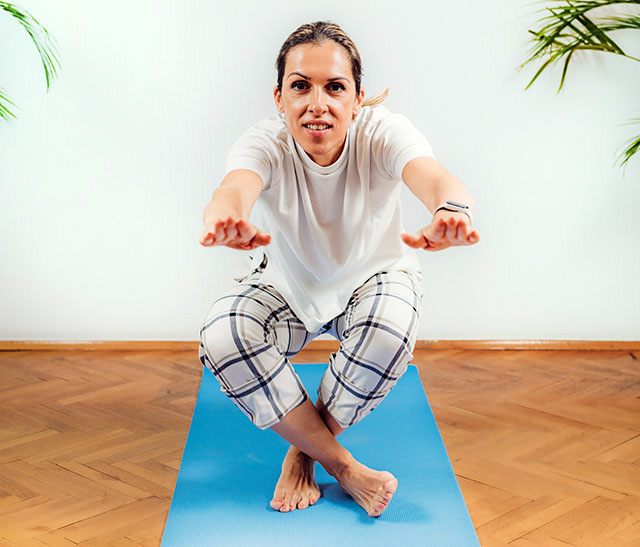 sitting and rising test
scoring: a maximum of 10 points is possible, 5 for sitting and 5 for rising without any supports. Each support used (hand, forearm, knee, side of leg, or hand on the knee) removes 1 point. Participants may also lose an additional 0.5 points for an unsteady performance.
target population: elderly
comments: the SRT was found to be a significant predictor of mortality in 51–80-year-old participants (Brito et al. 2012)
references:
- Brito LBB, Ricardo DR, Araujo DSMS, et al. Ability to sit and rise from the floor as a predictor of all-cause mortality. The European Journal of Cardiovascular Prevention and Rehabilitation, July 2014 21: 892-898.
Similar Tests
- Single leg squat test — functional leg strength test in which participants squat down until about 60° knee flexion.
- Chair Sit and Reach Test — lower body flexibility test
- 8-Foot Up and Go Test — agility test
Related Pages
- Other strength tests
- Read a discussion about testing the elderly
- All about the Senior Fitness Test
- Read about Fitness Testing for Specific Groups and Special Populations
 Any comments, suggestions, or corrections? Please let us know.