Ruffier Squat Test Calculator
Quick Answer
The Ruffier Squat Test calculator measures your cardiovascular fitness by analyzing heart rate recovery after performing 30 squats in 45 seconds. Lower Ruffier Index scores indicate better cardiac fitness and faster recovery.
- Calculates both Ruffier Index (RI) and Ruffier-Dickson Index (RDI) instantly
- Based on the validated Ruffier Formula from 1951, widely used in French sports medicine
- Excellent fitness rating: RI below 0; Average rating: RI between 6-9
The Ruffier Squat Test is a simple cardiovascular endurance test which involves measuring heart rate before and after performing 30 squats in 45 seconds. The test was originally developed in 1950s by James-Edward Ruffier and modified by J. Dickson, who developed the Ruffier-Dickson index (RDI). From the results of this squat test you can calculate the Ruffier-Dickson Index, commonly used in France to classify cardio-respiratory fitness.
How to Use This Calculator
Follow these simple steps to assess your cardiovascular fitness using the Ruffier method:
- Prepare for the Test - Find a quiet space, have a stopwatch or timer ready, and optionally set a metronome to 40 BPM. Rest for at least 2-3 minutes before starting.
- Measure Resting Heart Rate (HR1) - While seated or lying down, count your pulse for 15 seconds and multiply by 4 to get beats per minute.
- Perform the Squats - Complete 30 squats in exactly 45 seconds, bending knees to 90 degrees with arms extended forward and back straight.
- Measure Post-Exercise Heart Rate (HR2) - Immediately sit down and count your pulse during the first 15 seconds after completing the squats. Multiply by 4.
- Measure Recovery Heart Rate (HR3) - Wait until one minute after the exercise ended, then count your pulse for 15 seconds (from 1:00 to 1:15). Multiply by 4.
- Enter Your Values - Input all three heart rate measurements into the calculator above to get your Ruffier Index and Ruffier-Dickson Index scores.
Test purpose: This test assesses leg strength endurance and cardiovascular recovery capacity.
Equipment required: heart rate monitor (optional), metronome, stopwatch, recording sheets, chair, calculator, paper and pen.
Pre-test: Explain the test procedures to the subject. Perform screening of health risks and obtain informed consent. Prepare forms and record basic information such as age, height, body weight, gender, test conditions. See more details of pre-test procedures.
Procedure: Get the subject to sit or lie down, and after at least a few minutes, measure resting heart rate (HR1) by counting the pulse over 15 seconds. Set the metronome to a rate of 40 per minute. When ready, the subject performs 30 squats in time to the metronome (it should take 45 seconds). The squatting involves bending the knees to a 90-degree angle, while keeping the back straight and the arms extended straight forward. On completion of the 45 seconds, get the subject to immediately sit down, and the post-exercise heart rate is taken over the first 15 seconds (HR2), then again one minute after the test (HR3) from 1 minute to 1 minute 15 seconds post-exercise.
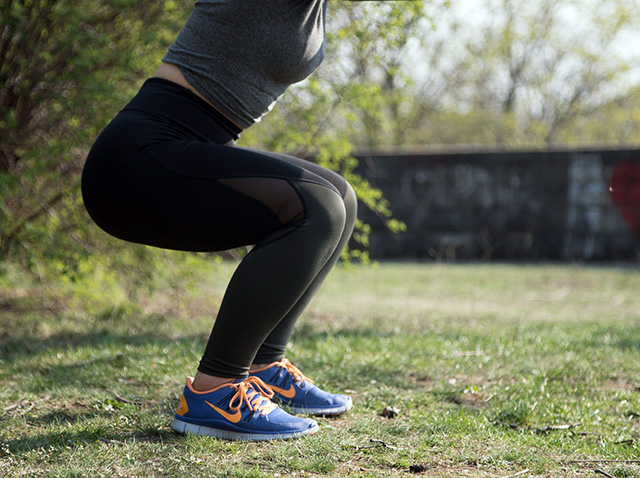 squat test
Understanding the Ruffier Index Scoring
Scoring: Use the heart rate measurements to calculate the Ruffier Index (RI) and the Ruffier-Dickson Index (RDI). Lower scores indicate better exercise tolerance and cardiovascular fitness. The RDI is designed to have less emphasis on resting heart rate measure.
Ruffier Index Formula: RI = (HR1 + HR2 + HR3 - 200) / 10
Ruffier-Dickson Index Formula: RDI = [(HR2 - 70) + 2(HR3 - HR1)] / 10
where HR1 is the average resting heart rate, HR2 is the maximum heart rate recorded during the first 15 seconds of recovery, and HR3 is the 15 second average after the 1st minute of recovery.
Ruffier Index Rating Scale
| RI Value | Endurance Rating | Athletic Interpretation |
|---|---|---|
| Less than 0 | Excellent | Elite athlete-level cardiovascular fitness |
| From 0 to 3 | Very Good | Well-trained athlete or highly fit individual |
| From 3 to 6 | Reasonably Good | Regular exerciser with good fitness base |
| From 6 to 9 | Average | Typical fitness level for moderately active person |
| From 9 to 12 | Moderate | Below average fitness, room for improvement |
| From 12 to 15 | Poor | Low fitness level, training recommended |
| From 15 and up | Very Poor | Significant cardiovascular deconditioning |
Sport-Specific Applications
The Ruffier test is particularly valuable for athletes in sports requiring repeated high-intensity efforts with quick recovery, including:
- Soccer/Football: Players need rapid heart rate recovery between sprints and plays
- Basketball: The up-and-down nature of the game demands excellent cardiovascular recovery
- Tennis: Recovery between points and games is crucial for sustained performance
- Combat Sports: Boxers, wrestlers, and martial artists benefit from monitoring recovery capacity
- Team Sports: Rugby, hockey, and volleyball players can track fitness improvements
Advantages: This simple test can be self-administered, and can be done with limited equipment.
Comments: The test was designed by French doctor James-Edward Ruffier. The test is widely used in France for pre-participation sports medical examinations.
Variations: The fitness index can also be calculated with different exercises, such as 20 push-ups performed for 30 seconds.
Frequently Asked Questions
What is a good Ruffier Index score for athletes?
Elite athletes typically achieve Ruffier Index scores below 0, indicating excellent cardiovascular recovery. Competitive athletes usually score between 0-3 (very good), while recreational athletes often fall in the 3-6 range (reasonably good). These benchmarks can help track training progress over a season.
How often should I perform the Ruffier test?
For training monitoring, perform the test every 4-6 weeks under consistent conditions (same time of day, similar rest, hydration status). Athletes may test monthly during pre-season and bi-monthly during competition season to track fitness changes.
Why is my HR3 (recovery) important?
HR3 reflects your cardiac recovery capacity—how quickly your heart rate returns toward resting levels after exercise. A lower HR3 relative to HR2 indicates better cardiovascular fitness and more efficient parasympathetic nervous system function, which is crucial for athletic performance.
What's the difference between RI and RDI?
The Ruffier-Dickson Index (RDI) places less emphasis on resting heart rate and more on the relationship between exercise and recovery heart rates. Athletes with naturally lower or higher resting heart rates may find the RDI provides a more accurate fitness assessment than the standard RI.
Can factors other than fitness affect my score?
Yes, several factors can influence results: caffeine intake, sleep quality, hydration status, recent training load, stress levels, ambient temperature, and time of day. For accurate tracking, perform the test under similar conditions each time, ideally in the morning before caffeine.
How can I improve my Ruffier Index score?
Regular aerobic training (running, cycling, swimming) combined with interval training typically improves cardiovascular recovery. Consistency is key—aim for 3-5 cardiovascular sessions per week. Most athletes see measurable improvements in 6-8 weeks of dedicated training.
Is this test safe for everyone?
The Ruffier test is generally safe for healthy individuals. However, those with cardiovascular conditions, joint problems, pregnancy, or other health concerns should consult a healthcare provider before performing this test. If you experience dizziness, chest pain, or unusual symptoms, stop immediately.
References
- Dickson, J. (1950). "Utilisation de l'indice cardiaque de Ruffier dans le contrôle médico-sportif." Med. Educ. Phys. Sport, 2, 65–79.
- Ruffier, J.E. (1951). "Considerations on the index of heart resistance to effort." Med Educ Phys Sport, 3, 7–12.
- Joussellin, E. (2007). "Le test de Ruffier, improprement appelé test de Ruffier-Dickson." Medicins du sport, 83(4), 33–34.
- Guo, Y., Bian, J., Li, Q., et al. (2018). "A 3-minute test of cardiorespiratory fitness for use in primary care clinics." PLOS ONE, 13(7), e0201002.
- Sartor, F., Bonato, M., Papini, G., et al. (2016). "A 45-Second Self-Test for Cardiorespiratory Fitness: Heart Rate-Based Estimation in Healthy Individuals." PLOS ONE, 11(12), e0168154.
- Borg, G. (1982). "Psychophysical bases of perceived exertion." Medicine and Science in Sports and Exercise, 14(5), 377-381.
- American College of Sports Medicine. (2021). ACSM's Guidelines for Exercise Testing and Prescription (11th ed.). Wolters Kluwer.
Similar Tests
- Chair Stand — stand up repeatedly from a chair for 30 seconds
- Home squat test — perform as many squats as you can
- Endurance Jump (30 Seconds) — jump across a hurdle as many times as possible in 30 seconds.
- Wall Squat — hold a sitting position while leaning back against a wall.
Related Pages
- List of other Strength Tests
- Measuring resting heart rate
- About Resting Heart Rate
 Any comments, suggestions, or corrections? Please let us know.