Step Test Calculator
Quick Answer
This calculator estimates your VO2max (maximal oxygen uptake) from step test heart rate data using validated scientific formulas. Results help assess cardiovascular fitness and track aerobic conditioning progress.
- Uses the McArdle formula (Queens College) with correlation of 0.75-0.85 to lab VO2max
- Supports Queens College, YMCA, and Harvard step test protocols
- Provides fitness category based on age and gender norms
This page provides a calculator for step tests used to measure aerobic fitness. For specific information about individual step test procedures, see the step test pages linked below. These tests vary in step heights, stepping frequency, physiological measures and results calculations, and as such vary in their suitability for specific populations.
How to Use This Calculator
Follow these steps to accurately estimate your VO2max from step test results:
- Select Your Protocol - Choose the step test you performed. The Queens College Step Test is most common for general fitness assessment, using a 16.25-inch step for 3 minutes.
- Enter Your Gender - The prediction equations differ between males and females due to physiological differences in cardiovascular response.
- Enter Your Post-Exercise Heart Rate - For Queens College protocol, count your pulse for 15 seconds starting 5 seconds after completion, then multiply by 4. For YMCA, count for 60 seconds.
- Review Your Results - Your estimated VO2max will be displayed along with a fitness category and percentile ranking compared to population norms.
Pro Tip: For most accurate results, avoid caffeine and intense exercise for 24 hours before testing. Perform the test at the same time of day for consistent comparisons.
Understanding Your VO2max Results
VO2max represents the maximum rate at which your body can consume oxygen during intense exercise. It is considered the gold standard measure of cardiovascular fitness and aerobic endurance capacity. Higher values indicate better cardiorespiratory fitness and are associated with improved athletic performance and reduced health risks.
The step test provides an estimated VO2max based on your heart rate response to submaximal exercise. While not as precise as laboratory testing with expired gas analysis, step tests offer a practical, low-cost method for assessing and tracking aerobic fitness over time.
Fitness Categories
Your VO2max result is compared against normative data to determine your fitness category. The categories are based on age and gender-specific percentile rankings from large population studies. A "Good" rating means you score above average for your demographic group.
The Science Behind Step Test Calculations
The Queens College Step Test formula was developed by McArdle, Katch, Pechar, Jacobson, and Ruck in 1972. The prediction equations are:
Males: VO2max (ml/kg/min) = 111.33 − (0.42 × Heart Rate)
Females: VO2max (ml/kg/min) = 65.81 − (0.1847 × Heart Rate)
These formulas were validated against directly measured VO2max with correlation coefficients of 0.75-0.85, making them suitable for fitness assessment in healthy adults. The equations assume a linear relationship between heart rate and oxygen consumption during submaximal exercise.
General Step Test Procedures
Purpose: Step tests have been developed to measure aerobic fitness using a simple test requiring minimal equipment and space.
Equipment required: The equipment required will vary on the test being conducted. The step or platform needs to be of solid construction, and will vary in height between 15-50 cm or 6-20 inches. You will also probably need a stopwatch, and you may need a metronome or pre-recorded cadence tape depending on which procedure you are using.
Pre-test: Explain the test procedures to the subject. Perform screening of health risks and obtain informed consent. Prepare forms and record basic information such as age, height, body weight, gender, test conditions. Check step height and set metronome. See more details of pre-test procedures.
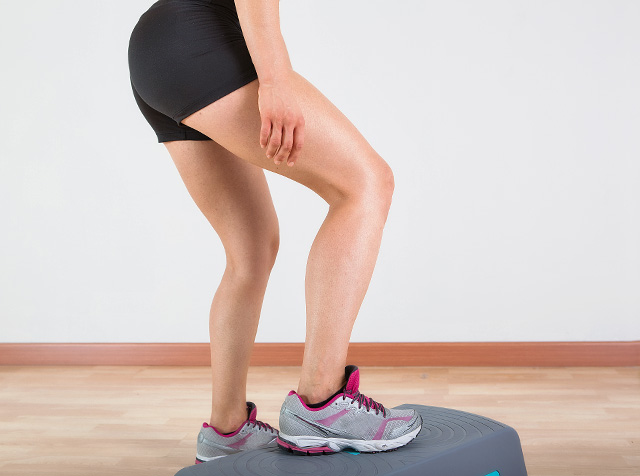 step test
Procedure: The athlete steps up and down on the platform at a given rate for a certain time or until exhaustion. Heart rate may be recorded during the test and/or for some period afterwards. See a video of Step tests being performed.
Scoring: The results are based on the stepping time and/or heart rate after exercise. A score can be calculated, which is then compared to normative values to determine a fitness rating. The American College of Sports Medicine (ACSM) also has an equation for determining a person's total gross VO2 from the stepping rate and step height.
Advantages of Step Tests
- Low cost for equipment
- Ease of portability
- Permanent calibration
- The fact that stepping is a natural activity
- Some tests can be also be self-administered
Disadvantages of Step Tests
- As biomechanical characteristics vary between individuals, a high step height may disadvantage shorter people, underestimating their aerobic fitness
- Body weight has also been shown to be a factor
- Testing large groups with this test will be time consuming
- It is sometimes difficult for the subject to maintain an exact pace set by a metronome or other device
- There is a danger of the subject tripping
- It is difficult to take some physiological measurements if they are required (e.g., heart rate, blood pressure)
Step Tests for Different Populations
Different step test protocols are suited to various athletic and fitness populations. The Queens College test works well for healthy adults aged 18-65. The YMCA test with its lower step height is better suited for older adults or those with lower fitness levels. The Harvard Step Test is more demanding and appropriate for athletic populations.
Sport-Specific Applications
Endurance Athletes: Runners, cyclists, and triathletes typically score VO2max values of 50-70+ ml/kg/min. Elite marathon runners often exceed 70 ml/kg/min.
Team Sport Athletes: Soccer, basketball, and hockey players benefit from regular aerobic testing to monitor conditioning. Typical values range from 45-60 ml/kg/min.
Combat Sports: Wrestlers, boxers, and martial artists require both aerobic and anaerobic conditioning. Step tests help establish aerobic base fitness.
Recreational Athletes: Weekend warriors and fitness enthusiasts can use step tests to track improvement from training programs.
How to Improve Your VO2max
If your step test results indicate room for improvement, consider these evidence-based strategies:
- High-Intensity Interval Training (HIIT): Short bursts of intense exercise followed by recovery periods are highly effective for improving VO2max
- Continuous Aerobic Training: Sustained exercise at 60-80% of maximum heart rate for 30-60 minutes builds aerobic base
- Progressive Overload: Gradually increase training volume or intensity by 5-10% per week
- Cross-Training: Mix different aerobic activities to reduce injury risk and maintain motivation
- Consistency: Regular training 3-5 times per week produces better results than sporadic intense sessions
Research suggests VO2max can improve by 15-30% with appropriate training over 8-12 weeks in previously untrained individuals. Well-trained athletes may see smaller but still meaningful improvements of 3-10%.
List of Step Tests
- Harvard Step Test
- Chester Step Test
- Canadian Home Fitness Test
- Balke Step Test
- YMCA 3-minute Step Test
- Sharkey (Forestry) Step Test
- Queens College Step Test
- Home step test
- Step in Place (no step)
Frequently Asked Questions
How accurate is the step test for measuring VO2max?
The Queens College Step Test has a correlation of 0.75-0.85 with directly measured VO2max from laboratory testing. While not as accurate as expired gas analysis, it provides a reliable estimate for fitness assessment and tracking progress over time. The error margin is typically ±10-15%.
What heart rate should I use for the step test calculator?
For the Queens College Step Test, measure your heart rate for 15 seconds starting 5 seconds after completing the test, then multiply by 4 to get beats per minute. For the YMCA test, measure for a full 60 seconds. Use a heart rate monitor or palpate your radial or carotid pulse.
What is a good VO2max score from a step test?
For men aged 20-39, a VO2max above 45 ml/kg/min is considered good, while above 50 is excellent. For women in the same age range, above 38 is good and above 45 is excellent. Elite endurance athletes often score above 60-70 ml/kg/min regardless of gender.
How often should I repeat the step test?
For tracking fitness progress, perform the step test every 4-8 weeks. More frequent testing is unnecessary as cardiovascular adaptations require time to develop. Always use the same protocol, time of day, and conditions for accurate comparisons between tests.
Which step test protocol is best for athletes?
The Queens College Step Test is most widely used for general athletic populations due to its simplicity and validated formulas. The Harvard Step Test is more demanding and suitable for well-conditioned athletes. The YMCA test is better for older adults or those beginning a fitness program.
Can step tests detect overtraining?
Yes, elevated resting heart rate and higher than normal exercise heart rates can indicate overtraining or incomplete recovery. If your step test heart rate is significantly higher than usual with no other explanation, consider reducing training load and allowing more recovery time.
What factors can affect step test results?
Results can be affected by caffeine intake, recent intense exercise, hydration status, ambient temperature, sleep quality, stress levels, step height accuracy, and stepping cadence consistency. Standardize these conditions for the most reliable and comparable results.
References
- McArdle, W.D., Katch, F.I., Pechar, G.S., Jacobson, L., & Ruck, S. (1972). "Reliability and interrelationships between maximal oxygen intake, physical work capacity and step-test scores in college women." Medicine and Science in Sports, 4(4), 182-186.
- American College of Sports Medicine. (2021). "ACSM's Guidelines for Exercise Testing and Prescription." 11th Edition, Wolters Kluwer.
- Brouha, L. (1943). "The Step Test: A Simple Method of Measuring Physical Fitness for Muscular Work in Young Men." Research Quarterly, 14(1), 31-37.
- Golding, L.A. (2000). "YMCA Fitness Testing and Assessment Manual." 4th Edition, Human Kinetics.
- Shephard, R.J. (2009). "Step Tests: Assessment of Cardiorespiratory Fitness." European Journal of Applied Physiology, 106, 149-162.
- Chatterjee, S., Chatterjee, P., & Bandyopadhyay, A. (2004). "Validity of Queen's College Step Test for estimation of maximum oxygen uptake in female students." Indian Journal of Medical Research, 120(1), 32-37.
- Santo, A.S., & Golding, L.A. (2003). "Predicting maximum oxygen uptake from a modified 3-minute step test." Research Quarterly for Exercise and Sport, 74(1), 110-115.
Related Pages
- See a video of Step tests being performed.
- About a Step Test iphone app
- More information on measuring heart rate
- Calculating VO2max from stepping exercise.
- General description of the step-up exercise
- Step up exercises at the beach or during pregnancy
- Online Metronome for setting the stepping pace
 Any comments, suggestions, or corrections? Please let us know.