Luge at the Winter Olympics
Quick Answer
Luge is billed as the fastest sport on ice, with competitors racing feet-first down an icy track at speeds exceeding 140 km/h. First included in the Winter Olympics at Innsbruck in 1964, luge now features five events: Men's Singles, Women's Singles, Men's Doubles, Women's Doubles (new in 2026), and Mixed-Team Relay.
- Luge has been a Winter Olympic sport since the 1964 Innsbruck Games
- Five events in 2026: Men's and Women's Singles, Men's and Women's Doubles, and Mixed-Team Relay
- Women's doubles was added as a new event for the 2026 Milan-Cortina Olympics
Luge is billed as the fastest sport on ice. Competitors race down a specially designed track feet-first only inches from the ice. Luge was added to the Winter Olympics program for the first time in Innsbruck in 1964. Also read information about the skeleton event, a head-first version of the luge.
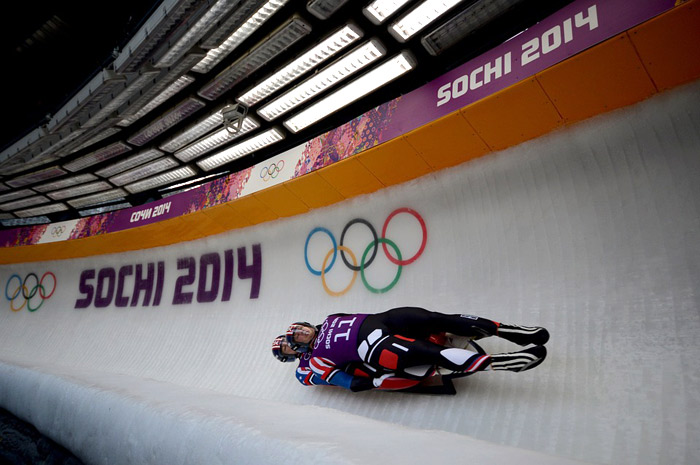 open double luge at the Sochi 2014 Olympics
"Luge has been one of the most thrilling events at the Winter Olympics since its introduction in 1964, with the sport expanding from three events to five by 2026 to include both men's and women's doubles."— Robert Wood, founder of Topend Sports
Pro Tip: Luge athletes steer using subtle calf pressure on the runners and slight shifts in body weight. Unlike bobsled, there are no brakes or steering mechanisms — the athlete's body is the only control system.
Milan & Cortina d'Ampezzo 2026 Luge Events
There are five events in Luge: Men's Singles, Women's Singles, Men's Doubles, Women's Doubles and Mixed-Team Relay event. The mixed team relay event was added to the program in 2014, and women's doubles added in 2026. At the same time, the open doubles event was changed to be men's doubles. The mixed team relay involves one sled from each of the other three events.
Luge Event Winners at the Milan & Cortina d'Ampezzo 2026
Here are some of the medalists who won gold, silver, and bronze in different Luge events:
Luge Men's Singles
| Gold | Silver | Bronze |
|---|---|---|
| LANGENHAN Max | MUELLER Jonas | FISCHNALLER Dominik |
Luge Women's Singles
| Gold | Silver | Bronze |
|---|---|---|
| TAUBITZ Julia | BOTA Elina | FARQUHARSON Ashley |
Luge Men's Doubles
| Gold | Silver | Bronze |
|---|---|---|
| RIEDER Emanuel KAINZWALDNER Simon |
STEU Thomas KINDL Wolfgang |
WENDL Tobias ARLT Tobias |
Luge Women's Doubles
| Gold | Silver | Bronze |
|---|---|---|
| VOETTER Andrea OBERHOFER Marion |
EITBERGER Dajana MATSCHINA Magdalena |
EGLE Selina KIPP Lara Michaela |
Luge Team Relay
| Gold | Silver | Bronze |
|---|---|---|
| Team Germany | Team Austria | Team Italy |
Record Breaker
German luge great Georg Hackl won the same individual event at three consecutive Winter Olympics (1992-1998), then added a silver in 2002 to become the first athlete ever to win five medals in one event.
Pro Tip: When watching luge competitions, pay attention to the start times. Athletes use spiked gloves to grip the ice and launch themselves from the start handles, and a difference of just hundredths of a second at the start can determine the final result.
"Luge athletes experience forces exceeding 5G in turns while traveling at speeds over 140 km/h, making it one of the most physically demanding and dangerous winter sports."— Robert J. Wood, PhD in Exercise Physiology
Trivia
- The first year that luge was on the Olympic program in 1964, sadly a British luger died in the course of a practice run a week before the competition started.
- In Grenoble in 1968, East German luge competitors Ortrun Enderlein and Anna-Maria Muller — in contention for a clean-sweep — were disqualified when it was discovered their toboggan runners had been heated.
- In Nagano in 1998, German luge great Georg Hackl became just the sixth Winter Olympian to win the same event in three consecutive Games. Then in 2002, he won a silver to become the first athlete ever to win five medals in one event.
- The $105-million sliding center on Blackcomb Mountain’s southeast side used for the 2010 Olympics, has 16 turns and drops steeply for 152 meters (500 feet), which is the world’s longest drop for such a course.
- A Georgian luger Nodar Kumaritashvili was tragically killed in a training run crash after flying off the Olympic track in Whistler, Canada in the day before the Games were to begin.
- In 2018, US luger Chris Mazdzer became the first non-European to win a medal (silver) in the men's singles event.
New in 2026
Women's Doubles was added as a new luge event for the 2026 Milan-Cortina Olympics, with Italy's Andrea Voetter and Marion Oberhofer winning the inaugural gold medal on home ice.
"European nations, particularly Germany, Austria, and Italy, have historically dominated Olympic luge, with Germany alone accounting for the majority of all gold medals in the sport's Olympic history."— Robert J. Wood, sports performance researcher at Topend Sports
Frequently Asked Questions
How many luge events are at the 2026 Winter Olympics?
There are five luge events at the 2026 Milan-Cortina Winter Olympics: Men's Singles, Women's Singles, Men's Doubles, Women's Doubles, and Mixed-Team Relay. Women's Doubles was added as a new event in 2026, while the previously open doubles event was changed to men's doubles.
When was luge first included in the Winter Olympics?
Luge was first added to the Winter Olympics program at the 1964 Games in Innsbruck, Austria. The Mixed-Team Relay was added in 2014, and Women's Doubles became the newest event in 2026.
What makes luge different from skeleton?
In luge, competitors race feet-first on their backs, steering with subtle body movements and leg pressure. In skeleton, athletes race head-first on their stomachs. Both sports use the same type of track but require different techniques and equipment.
Who is the most successful Olympic luger of all time?
German luger Georg Hackl is one of the most decorated Olympic lugers, winning gold in the Men's Singles at three consecutive Games (1992, 1994, 1998) and adding a silver medal in 2002, becoming the first athlete ever to win five medals in one luge event.
Has there been a fatal accident in Olympic luge?
Tragically, yes. Georgian luger Nodar Kumaritashvili was killed in a training run crash at the 2010 Vancouver Olympics in Whistler, Canada, the day before the Games began. A British luger also died during a practice run a week before the 1964 Innsbruck competition.
Which countries dominate Olympic luge?
European nations dominate Olympic luge, particularly Germany, Austria, and Italy. In 2018, US luger Chris Mazdzer became the first non-European to win a medal (silver) in the men's singles event, highlighting how dominant European athletes have been in the sport.
References
- International Olympic Committee. (2026). Luge at the Olympic Winter Games. IOC Official Records.
- International Luge Federation (FIL). (2026). FIL Competition Results - Milan-Cortina 2026. FIL Official Records.
- International Olympic Committee. (2022). Beijing 2022 - Luge Results and Records. IOC Official Report.
- Olympic Channel. (2024). The History of Luge at the Winter Olympics. Olympic Channel Editorial.
- Wallechinsky, D. & Loucky, J. (2014). The Complete Book of the Winter Olympics. Aurum Press.
- NBC Sports. (2018). Chris Mazdzer Makes Luge History for Team USA. NBC Olympic Coverage.
- Vancouver Organizing Committee. (2010). Whistler Sliding Centre - Technical Specifications. VANOC Official Report.
Related Pages
 Any comments, suggestions, or corrections? Please let us know.