Skeleton at the Winter Olympics
Quick Answer
Skeleton is an extreme ice sport where athletes ride a small sled head-first and face-down at speeds up to 130 km/h (80 mph). First contested at the 1928 Olympics in St. Moritz, skeleton returned permanently in 2002 and now features three events at the 2026 Milano Cortina Games, including the new mixed team event.
- Athletes race head-first on a sled with no steering or braking mechanism
- Three events in 2026: Men's Individual, Women's Individual, and Mixed Team (new)
- Skeleton shares the same track as luge and bobsled events
Skeleton is one of the 'ice sports' on the Winter Olympic Games program. This extreme sport requires individuals to ride a small sled down a frozen track while lying face down and forward facing.
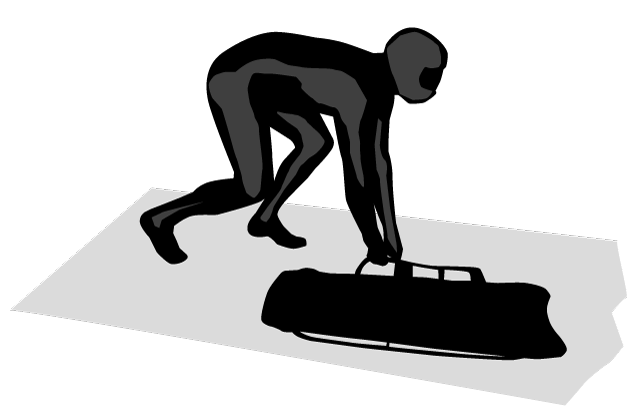 Skeleton
"Skeleton is one of the most extreme Winter Olympic sports, requiring athletes to race head-first down an icy track at speeds up to 130 km/h with no steering or braking mechanism."— Robert Wood, founder of Topend Sports
Skeleton was first on the program at the 1928 Winter Olympics in St. Moritz, and again in 1948 Winter Olympics. After a long hiatus, it was reintroduced at the 2002 Winter Olympics with both men's and women's events.
Pro Tip: Skeleton athletes steer their sled entirely through body movements, using subtle shifts of their shoulders, knees, and head while lying face-down on the sled. There is no mechanical steering or braking system on a skeleton sled.
Skeleton is a head-first version of the luge, and is run on the same track (as is bobsled). Amazingly, the skeleton sled has no steering or braking mechanism, the participants steer by movements of the body and travel at speeds up to 130 km/hr (80 mph).
2026 Skeleton Events
- Men's individual skeleton
- Women's individual skeleton
- Mixed team skeleton (added in 2026)
Skeleton Event Winners at the Milano Cortina 2026 Olympics
Here are the athletes who won gold, silver, and bronze in the Skeleton event at the Milano Cortina 2026 Olympics:
Men's Individual Skeleton
| Gold | Silver | Bronze |
|---|---|---|
| WESTON Matt | JUNGK Axel | GROTHEER Christopher |
Women's Individual Skeleton
| Gold | Silver | Bronze |
|---|---|---|
| FLOCK Janine | KREHER Susanne | PFEIFER Jacqueline |
"Skeleton has one of the most unusual histories among Olympic sports, appearing in 1928 and 1948 before a 54-year absence, then returning permanently in 2002 with both men's and women's events."— Robert J. Wood, PhD in Exercise Physiology
Mixed Team Skeleton
| Gold | Silver | Bronze |
|---|---|---|
| STOECKER Tabitha WESTON Matt |
KREHER Susanne JUNGK Axel |
PFEIFER Jacqueline GROTHEER Christopher |
The Heaton Brothers
American brothers Jennison and John Heaton made Olympic skeleton history. Jennison won gold at the 1928 St. Moritz Games beating his brother John who took silver. When skeleton returned 20 years later in 1948, John Heaton again won the silver medal.
Pro Tip: When watching skeleton competitions, notice how athletes sprint at the start before diving onto the sled. The start push is critical as hundredths of a second at the start can determine final positions.
Trivia (History)
- American Jennison Heaton won the first Olympic skeleton gold medal at St Moritz in 1928, beating his brother John, who took the silver.
- The event of skeleton appeared in St Moritz in 1948 for the first time since the previous St. Moritz Games 20 years earlier. American John Heaton won the silver, as he had done the previous time.
- In 2002, Skeleton returned as an event for the first time since 1948, this time with both men and women competitions.
- Athletes from Great Britain have won a medal every time skeleton has featured at the Olympic Games (up to and including 2014).
- Russian Aleksandr Tretyakov originally won gold in the 2014 Skeleton, but due to problems with his urine sample, was banned in 2017 and stripped of his medal.
New in 2026
Mixed Team Skeleton was added as a new event for the 2026 Milano Cortina Olympics. Great Britain's Tabitha Stoecker and Matt Weston won the inaugural gold medal in the event.
"Great Britain has maintained a remarkable medal record in Olympic skeleton, winning at least one medal every time the sport has featured at the Games."— Robert J. Wood, sports performance researcher at Topend Sports
Frequently Asked Questions
How many skeleton events are at the 2026 Winter Olympics?
There are three skeleton events at the 2026 Milano Cortina Winter Olympics: Men's Individual, Women's Individual, and Mixed Team. The Mixed Team event was added as a new discipline for 2026, expanding the program from two events to three.
What is the difference between skeleton and luge?
In skeleton, athletes race head-first on their stomachs, while in luge, competitors ride feet-first on their backs. Both sports use the same type of track and sleds without engines, but skeleton sleds also lack steering and braking mechanisms, with athletes steering purely through body movements.
When was skeleton first included in the Winter Olympics?
Skeleton first appeared at the 1928 Winter Olympics in St. Moritz, Switzerland. It was held again at the 1948 St. Moritz Games, then had a 54-year absence before being reintroduced permanently at the 2002 Salt Lake City Olympics with both men's and women's events.
How fast do skeleton athletes travel?
Skeleton athletes can reach speeds up to 130 km/h (80 mph) while racing head-first down the frozen track. The sled has no steering or braking mechanism, so athletes must steer entirely through subtle movements of their body.
Who won the first Olympic skeleton gold medal?
American Jennison Heaton won the first Olympic skeleton gold medal at the 1928 St. Moritz Games, beating his brother John Heaton who took the silver. Remarkably, John Heaton won silver again when skeleton returned to the Olympics 20 years later in 1948.
Which countries are most successful in Olympic skeleton?
Great Britain has an outstanding record in Olympic skeleton, winning at least one medal every time the sport has featured at the Games through 2014. Germany has also been highly successful, with athletes winning multiple medals at the 2026 Milano Cortina Olympics.
References
- International Olympic Committee. (2026). Skeleton at the Olympic Winter Games. IOC Official Records.
- International Bobsleigh and Skeleton Federation (IBSF). (2026). IBSF Competition Results - Milan-Cortina 2026. IBSF Official Records.
- International Olympic Committee. (2022). Beijing 2022 - Skeleton Results and Records. IOC Official Report.
- Olympic Channel. (2024). The History of Skeleton at the Winter Olympics. Olympic Channel Editorial.
- Wallechinsky, D. & Loucky, J. (2014). The Complete Book of the Winter Olympics. Aurum Press.
- British Olympic Association. (2022). Great Britain's Skeleton Medal History. Team GB Records.
- World Anti-Doping Agency. (2017). WADA Investigation Findings - Sochi 2014. WADA Official Report.
Related Pages
 Any comments, suggestions, or corrections? Please let us know.