Direct Calorimetry BMR Calculator
Quick Answer
This calculator estimates your Basal Metabolic Rate (BMR) using validated scientific equations. Direct calorimetry measures heat production directly, while this calculator applies proven formulas that correlate closely with calorimetric measurements.
- Compares BMR across multiple equations (Mifflin-St Jeor, Harris-Benedict, Katch-McArdle)
- Based on peer-reviewed research validated against direct calorimetry
- Optimized for athletic populations with sport-specific interpretation
Measuring the body's resting metabolism (how much energy the body is consuming at rest) can be useful for planning weight loss programs and optimizing athletic nutrition. One way to measure this is by direct calorimetry, using a box calorimeter to measure directly the heat produced by the body.
What is Direct Calorimetry?
Human Whole Body Direct Calorimetry obtains a direct measurement of the energy use of the body by measuring the amount of heat generated by the body. To do this, the body is fully enclosed in a structure. The heat generated by body changes the temperature of the space, which is then measured, usually by changes in the temperature of water flowing through the walls.
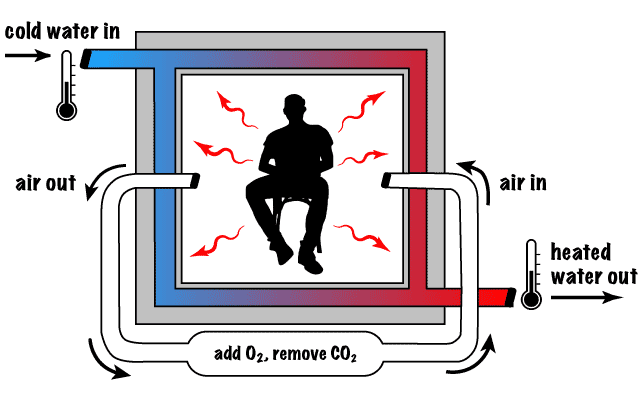
Direct calorimetry set-up showing the insulated chamber used to measure heat production
This method is most commonly used in a resting situation, though it is still possible to use a calorimeter to measure the energy production during exercise. An easier and more reliable method of assessing energy consumption during exercise is indirect calorimetry. With this method, it is also possible to determine the respiratory exchange ratio to estimate the contribution of fats and carbohydrates for energy production.
Understanding BMR vs RMR
While often used interchangeably, Basal Metabolic Rate (BMR) and Resting Metabolic Rate (RMR) have specific definitions. BMR represents the minimum amount of energy required to keep your body functioning, including your heart, lungs, and maintaining normal body temperature. It is measured under strict conditions: after 8-12 hours of fasting, in a thermoneutral environment, following a full night's sleep.
RMR is measured under slightly less stringent conditions and is typically 10-20% higher than BMR due to the thermic effect of food and minor physical activity. For most practical applications, including athletic nutrition planning and weight loss programs, RMR provides sufficient accuracy while being more convenient to measure.
The Science Behind BMR Calculations
The calculator above uses several validated equations that have been extensively compared to direct calorimetry measurements:
Mifflin-St Jeor Equation (1990)
Considered the most accurate for most individuals. Developed using indirect calorimetry data from 498 healthy individuals.
Male: BMR = 10W + 6.25H - 5A + 5
Female: BMR = 10W + 6.25H - 5A - 161
Harris-Benedict Equation (1918)
One of the earliest BMR prediction equations, revised in 1984. Still widely used in clinical settings.
Male: BMR = 88.362 + 13.397W + 4.799H - 5.677A
Female: BMR = 447.593 + 9.247W + 3.098H - 4.330A
Katch-McArdle Formula
Uses lean body mass for calculation, making it more accurate for athletes with higher muscle mass.
BMR = 370 + (21.6 × Lean Body Mass in kg)
Sport-Specific Applications
Different sports have varying energy demands, and understanding your BMR is the foundation for calculating appropriate caloric intake:
Endurance Sports
Marathon runners, cyclists, and triathletes often have elevated BMR due to increased mitochondrial density and lean muscle mass. During heavy training periods, TDEE can reach 4,000-6,000 kcal/day. Accurate BMR calculation helps prevent the relative energy deficiency in sport (RED-S) syndrome common in endurance athletes.
Power Sports
Weightlifters, sprinters, and throwers typically have higher BMR due to greater muscle mass. Each kilogram of muscle burns approximately 13 kcal/day at rest. Elite powerlifters may have BMR values 15-25% above predicted values based on standard equations.
Team Sports
Football, basketball, and soccer players require careful energy management across seasons. Pre-season conditioning may increase energy demands by 40-60% above BMR, while recovery periods require adjusted intake to prevent unwanted weight gain.
How to Use Your BMR Results
Once you have calculated your BMR, you can determine your Total Daily Energy Expenditure (TDEE) by applying an activity multiplier:
TDEE Activity Multipliers:
- Sedentary (1.2): Desk job, little exercise
- Lightly Active (1.375): Light training 1-3 days/week
- Moderately Active (1.55): Moderate training 3-5 days/week
- Very Active (1.725): Hard training 6-7 days/week
- Extremely Active (1.9): Professional athlete, 2x daily training
For Weight Loss
Create a moderate caloric deficit of 300-500 kcal below your TDEE. Never consume fewer calories than your BMR for extended periods, as this can lead to metabolic adaptation and muscle loss. According to sports nutritionist guidelines, a deficit of 10-20% below TDEE is sustainable for athletes while preserving performance.
For Muscle Gain
A caloric surplus of 250-500 kcal above TDEE, combined with resistance training and adequate protein intake (1.6-2.2 g/kg body weight), supports muscle hypertrophy while minimizing fat gain.
For Performance Maintenance
Match energy intake to TDEE, adjusting for training load variations. Periodize nutrition alongside training blocks for optimal adaptation.
Frequently Asked Questions
What is direct calorimetry and how does it measure BMR?
Direct calorimetry measures the body's energy expenditure by directly measuring the heat produced by the body. The subject is enclosed in an insulated chamber, and the heat generated changes the temperature of water flowing through the walls, providing a precise measurement of metabolic rate. This is considered the gold standard for measuring BMR but requires specialized laboratory equipment.
What is the difference between BMR and RMR?
Basal Metabolic Rate (BMR) is measured under strict conditions after 8-12 hours of fasting and complete rest in a thermoneutral environment. Resting Metabolic Rate (RMR) has slightly less stringent requirements and is typically 10-20% higher than BMR due to the thermic effect of food and minor physical activity. For most practical applications, the difference is minimal.
How accurate are BMR prediction equations compared to direct calorimetry?
BMR prediction equations like Harris-Benedict and Mifflin-St Jeor are accurate within 10-15% for most individuals when validated against direct calorimetry. The Mifflin-St Jeor equation is generally considered most accurate for the general population. For athletes with high muscle mass, the Katch-McArdle formula using lean body mass may provide better estimates.
Why do athletes typically have higher BMR values?
Athletes generally have higher BMR due to increased lean muscle mass, which is more metabolically active than fat tissue. Each pound of muscle burns approximately 6 calories per day at rest, compared to 2 calories per pound of fat. Additionally, chronic exercise training can increase overall metabolic efficiency and elevate resting metabolic rate.
How can I use BMR calculations for weight loss?
Your BMR represents the minimum calories needed for basic body functions. To lose weight safely, calculate your Total Daily Energy Expenditure (TDEE) by multiplying BMR by an activity factor, then create a moderate caloric deficit of 300-500 calories. Never eat below your BMR for extended periods, as this can cause metabolic adaptation and muscle loss.
How often should athletes measure their metabolic rate?
Athletes should reassess their metabolic rate every 3-6 months, or whenever significant changes occur in body composition, training intensity, or dietary habits. Seasonal variations in training load may also warrant more frequent assessments during pre-season preparation and competition periods.
What factors affect basal metabolic rate?
BMR is influenced by age (decreases approximately 2% per decade after age 20), sex (males typically have higher BMR), body composition (muscle-to-fat ratio), body size, hormonal status, genetics, and environmental temperature. Training status also plays a significant role, with regular exercise increasing BMR through increased muscle mass and improved metabolic efficiency.
References
- Mifflin, M.D., et al. (1990). "A new predictive equation for resting energy expenditure in healthy individuals." American Journal of Clinical Nutrition, 51(2), 241-247.
- Harris, J.A., & Benedict, F.G. (1918). "A Biometric Study of Human Basal Metabolism." Proceedings of the National Academy of Sciences, 4(12), 370-373.
- Katch, F., et al. (1996). "Estimation of body composition from anthropometric and skinfold measurements." Medicine & Science in Sports & Exercise.
- Speakman, J.R., & Selman, C. (2003). "Physical activity and resting metabolic rate." Proceedings of the Nutrition Society, 62(3), 621-634.
- Mountjoy, M., et al. (2018). "IOC consensus statement on relative energy deficiency in sport (RED-S)." British Journal of Sports Medicine, 52(11), 687-697.
- Thomas, D.T., et al. (2016). "Position of the Academy of Nutrition and Dietetics: Nutrition and Athletic Performance." Journal of the Academy of Nutrition and Dietetics, 116(3), 501-528.
- Levine, J.A. (2005). "Measurement of energy expenditure." Public Health Nutrition, 8(7a), 1123-1132.
Related Pages
- Method for measuring basal or resting metabolic rate using indirect calorimetry.
- Direct Calorimetry use during exercise
- All about Basal Metabolic Rate
- The calculations for indirect calorimetry measurement.
- All about the respiratory exchange ratio
- Equations for calculating BMR and RMR
- Power output and energy expenditure for running and walking
- About Energy Expenditure — methods, formula and calculators.
- Calories Burned Running — determines how many calories you have burned based on your weight and distance run.
- Daily Calorie Counter — determines how many calories you need each day
- Calculating Daily Energy Expenditure — a few formulas to estimate your daily energy expenditure.
- Lose weight while doing nothing — Not really nothing, but indirectly by changing your metabolism through exercise.
 Any comments, suggestions, or corrections? Please let us know.