Force Plates in Sport Science
Force platforms or force plates are instruments that measure the ground reaction forces generated when someone stands or jumps on it, or moves across it. They are used mostly in biomechanical research to quantify balance and gait, and used in sport fitness testing to quantify strength and power profiles. In the sports setting, they are used for monitoring training effectiveness, return to play protocols, and athlete screening.
The force plate is usually comprised of a rectangular metal plate with piezoelectric or strain gauge transducers attached at each corner, which give an electrical output that is proportional to the force on the plate. A commercially available piezoelectric type force plate is made by Kistler.
Force plates usually provide a force-time-curve. As well as vertical forces, some force plates can measure shear forces (e.g. lateral and horizontal forces).
The data provided from the force plate can be used to determine a whole range of other measurements, including:
- Velocity (m/s)
- Power (Watts)
- Displacement (Meters)
- Temporal parameters (seconds)
- Left/Right Asymmetry (for bilateral systems)
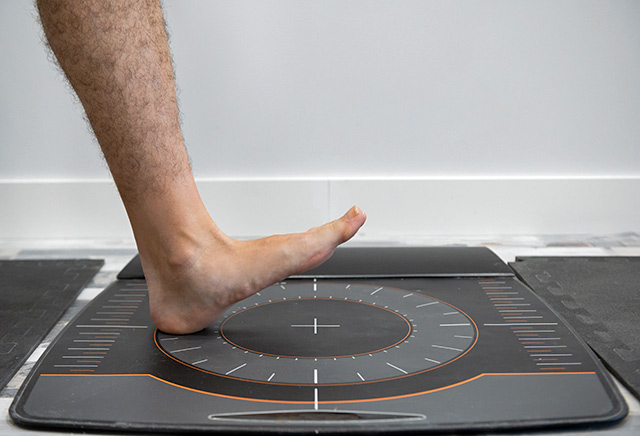 foot landing on a force plate
Use of Force Plates in Fitness Testing
Force plates are still usually reserved for use in scientific research. As they become cheaper and more widely available, more tests are being developed (reactive and Dynamic Strength Index), and also they can be used to provide more information on current tests (e.g. vertical jump).
A common use of a force plate is for measuring vertical jump height, though more simple timing mats can do the same thing. Instead of just placing a mark on the wall, jump height can be more accurately measured using lasers or timing mats, and extra information about the force/velocity curve can be gained by jumping from a force plate.
You can calculate vertical jump height using various measures from a force platform. The vertical jump height in meters can be calculated from the time (in seconds) using this formula: jump height = 4.9 x (0.5 x Time)2. It can also be calculated by applying the impulse–momentum theorem to the force–time curve, and by applying the work–energy theorem to the force-displacement curve. Ground contact time is the time between the first foot contact with the force platform and when the participant's feet left the mat.
Example Products
The Kistler Force plate is a research platform linked to a video camera that provides information about forces passing through foot joints and the foot in all three planes of space.
Fitness Tests Using Force Plates
- Force Plate Vertical Jump — guide to measuring vertical jump using a force platform.
- Reactive Strength Index — the ratio between the height jumped and the ground contact time.
- Dynamic Strength Index — the ratio of ballistic peak force to isometric peak force.
- NHL Vertical Jump Test — their protocol uses a Kistler Force plate, though only uses hang time to calculate jump height.
Fitness Tests Using Timing Mats
- Drop Jump — a test of leg strength and power which requires the athlete to drop off a box and immediately jump as high as they can
- Drop Jump (Bosco) — the athlete jumps after dropping from heights of 20 cm, 40 cm, 60 cm, 80 cm and 100 cm.
- Drop Jump (Incremental) — the athlete jumps after a drop from a series of heights, starting from a 30cm box and working upwards to a 75cm box.
- Vertical jump using a timing mat
Related Pages
- Multichannel Computerized Strength Dynamometer
- A discussion about the various vertical jump equipment available
- See the list of anaerobic tests for other fitness tests of leg power.
- Links to other fitness testing products
- Speed and power fitness tests
- Strength Tests
 Any comments, suggestions, or corrections? Please let us know.