Incremental Drop Jump Calculator
Quick Answer
This calculator determines your Reactive Strength Index (RSI) from incremental drop jump tests. RSI measures how efficiently you can reverse eccentric loading into explosive concentric power.
- Calculates jump height from flight time using kinematic equations
- Computes RSI by dividing jump height by ground contact time
- Tests across 30-75cm drop heights to find optimal training height
- Based on validated sports science methodology
This procedure describes the method used for measuring reactive leg strength using the Drop Jump, where the athlete jumps after a drop from a series of heights, starting from a 30cm box and working upwards to a 75cm box. There is also a drop jump test as part of the Bosco Ergo Jump System. See about other vertical jump tests.
How to Use This Calculator
Follow these steps to accurately measure your reactive strength index:
- Select the Drop Height - Choose the box height you're testing from (30cm, 45cm, 60cm, or 75cm). For comprehensive assessment, test all four heights.
- Perform the Drop Jump - Step off the box, land on the timing mat, and immediately jump vertically as high as possible.
- Record Your Data - Enter the flight time (time in air) and ground contact time displayed by your measurement device.
- Calculate Results - Click "Calculate RSI" to see your jump height and reactive strength index.
- Compare Heights - Click "Add to Comparison" after each height to build a complete profile and identify your optimal drop height.
Pro Tip: Your optimal drop height for training is the height at which you achieve your highest RSI score. This represents where you can most efficiently convert eccentric loading into explosive power.
Test Protocol and Equipment
Purpose: To measure the reactive strength index of the lower limbs across multiple drop heights, identifying the optimal height for plyometric training.
Equipment required: Vertical jump measurement mat (e.g., just jump mat, Myotest, infrared laser system), boxes or elevated platforms of different heights: 30 cm, 45 cm, 60 cm, 75 cm.
Pre-test preparation: Explain the test procedures to the subject. Perform screening of health risks and obtain informed consent. Prepare forms and record basic information such as age, height, body weight, gender, test conditions. Check and calibrate the timing mat measurement. Subject to perform an appropriate warm-up. See more details of pre-test procedures.
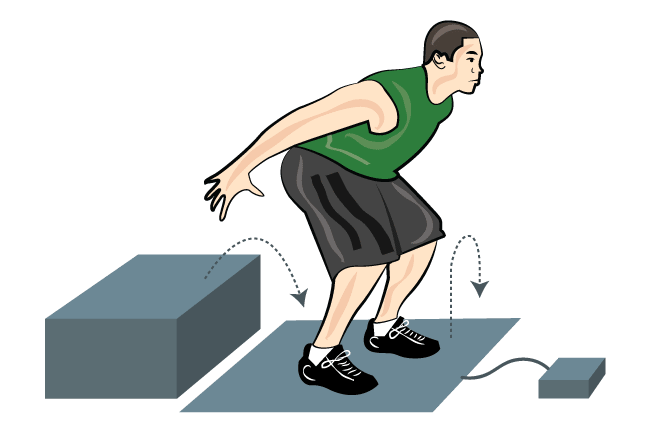
Procedure: A drop jump is performed from a range of box heights (30 cm, 45 cm, 60 cm, 75 cm), starting from the lowest height. The athlete stands on the box adjacent to the timing mat. Hands are placed on the hips, and stay there throughout the jump. The athlete steps down off the box onto the mat, bending the knees on landing, then immediately going into a maximal vertical jump. The athlete jumps vertically as high as possible, and lands back on the mat with both feet landing at the same time. The test is repeated for increasing box heights, for example using 30 cm, 45 cm, 60 cm, 75 cm boxes. Allow an adequate rest between trials.
Understanding Your Results
The RSI Formula
Reactive Strength Index is calculated using two measurements:
RSI = Jump Height (m) ÷ Ground Contact Time (s)
Jump height is derived from flight time:
Jump Height = 4.9 × (0.5 × Flight Time)²
Where 4.9 m/s² is half the acceleration due to gravity (9.8/2)
Scoring: Reactive strength index (RSI) can be calculated by dividing the jump height by the ground contact time. The jump height time is the time between the participant's feet leaving the timing mat or force platform and when they contacted it again. The vertical jump height in meters can be calculated from the time (in seconds) using this formula: jump height = 4.9 × (0.5 × Time)². Ground contact time is the time between the first foot contact with the force platform and when the participant's feet left the mat.
Results: If an athlete jumped 36cm with a contact time of 0.18 seconds then they would have an RSI of 2.0 (0.36 ÷ 0.18 = 2.0). The athlete can therefore improve their RSI by increasing the height of their jump, by decreasing their ground contact time, or both of these.
RSI Performance Standards
RSI values vary significantly based on sport, training background, and athletic level:
Elite Level (RSI > 3.0)
Olympic sprinters, elite jumpers, professional basketball players. Exceptional reactive strength capacity.
Advanced Level (RSI 2.0-3.0)
Collegiate athletes, competitive team sport players, trained plyometric athletes.
Intermediate Level (RSI 1.5-2.0)
Regular training athletes, recreational competitors, developing athletes.
Developing Level (RSI < 1.5)
Beginners, athletes returning from injury, those new to plyometric training.
Sport-Specific Applications
Different sports have varying requirements for reactive strength:
Track and Field Sprinters: Elite 100m sprinters typically demonstrate RSI values of 3.0-4.0. The ground contact time during sprinting is similar to that in drop jumps (0.08-0.12s), making this test highly relevant for sprint training prescription.
Basketball and Volleyball Players: Athletes in these sports benefit from optimal RSI at moderate drop heights (45-60cm), as they frequently perform rebounds and blocks requiring quick ground contact transitions.
Football and Rugby Players: Position-specific requirements vary, with backs typically showing higher RSI values (2.5-3.5) compared to linemen (1.8-2.5). Testing helps optimize position-specific plyometric programming.
Soccer Players: Midfielders and wingers often demonstrate RSI values of 2.0-2.8, reflecting the need for quick directional changes and explosive movements during match play.
Training Recommendations Based on Results
If Your RSI is Below 1.5: Focus on developing general strength through squats, deadlifts, and lunges before progressing to intensive plyometrics. Begin with low-intensity jumping drills such as line hops and ankle bounces.
If Your RSI is 1.5-2.0: Incorporate moderate-intensity plyometrics including box jumps, broad jumps, and depth jumps from your optimal height. Maintain strength training while gradually increasing plyometric volume.
If Your RSI is 2.0-3.0: Progress to high-intensity plyometrics and shock training methods. Use your optimal drop height identified through testing for depth jump training. Consider sport-specific reactive drills.
If Your RSI Exceeds 3.0: Maintain reactive strength through quality plyometric sessions. Focus on transferring reactive ability to sport-specific movements and consider weighted plyometrics for continued development.
Advantages and Limitations
Advantages: The incremental drop jump test provides objective measurement of reactive strength capacity across multiple loading conditions. Testing at various heights identifies the optimal training stimulus for each athlete, allowing personalized plyometric programming.
Disadvantages: Drop jumps require athletes to have a good degree of leg strength, as the forces through the body are much higher than for a standard vertical jump test. The standard size boxes are not readily available, and may even need to be custom made. Athletes with lower limb injuries or insufficient base strength should avoid this test.
Comments: Though this is the standard test of reactive strength, there are also other methods to assess an athlete's reactive strength ability. See more about the Reactive Strength Index.
Frequently Asked Questions
What is a good Reactive Strength Index score?
RSI scores vary by athletic population. Elite sprinters typically achieve RSI values above 3.0, while recreational athletes may score between 1.0-1.5. Values above 2.0 indicate excellent reactive strength capacity for most athletic populations.
What is the optimal drop height for training?
The optimal drop height is where you achieve your highest RSI score. This varies individually but typically falls between 30-60cm for most athletes. If your RSI decreases significantly at higher boxes, this indicates you've exceeded your reactive strength capacity.
Why does my RSI decrease at higher drop heights?
At higher drop heights, ground contact time typically increases more than jump height improves. This longer amortization phase indicates the eccentric loading exceeds your current reactive strength capacity, resulting in a lower RSI ratio.
How often should I test my RSI?
Most strength and conditioning professionals recommend testing every 4-6 weeks during training blocks. This allows sufficient time for adaptation while providing regular feedback for program adjustments.
Can I use this test if I'm recovering from injury?
Drop jump testing involves significant ground reaction forces. Athletes returning from lower limb injuries should only perform this test after clearance from medical staff and completion of progressive return-to-plyometrics protocols. Consider starting with lower heights and monitoring for any discomfort.
How accurate is the flight time method for calculating jump height?
The flight time method provides jump height estimates with approximately ±2-3% accuracy when proper technique is used. Ensure full hip, knee, and ankle extension at takeoff and landing for the most accurate measurements.
References
- Flanagan, E.P. & Comyns, T.M. (2008). "The Use of Contact Time and the Reactive Strength Index to Optimize Fast Stretch-Shortening Cycle Training." Strength and Conditioning Journal, 30(5), 32-38.
- Young, W.B. (1995). "Laboratory strength assessment of athletes." New Studies in Athletics, 10(1), 89-96.
- Schmidtbleicher, D. (1992). "Training for power events." Strength and Power in Sport. Oxford: Blackwell Scientific Publications, 381-395.
- Bobbert, M.F. et al. (1987). "Drop jumping. I. The influence of jumping technique on the biomechanics of jumping." Medicine and Science in Sports and Exercise, 19(4), 332-338.
- Bosco, C., Luhtanen, P. & Komi, P.V. (1983). "A simple method for measurement of mechanical power in jumping." European Journal of Applied Physiology, 50(2), 273-282.
- McClymont, D. (2003). "Use of the reactive strength index (RSI) as an indicator of plyometric training conditions." Science and Football V, 408-416.
- Ebben, W.P. & Petushek, E.J. (2010). "Using the reactive strength index modified to evaluate plyometric performance." Journal of Strength and Conditioning Research, 24(8), 1983-1987.
Similar Tests
- Drop Jump — a test of leg strength and power which requires the athlete to drop off a box and immediately jump as high as they can
- Drop Jump (Bosco) — the athlete jumps after dropping from heights of 20 cm, 40 cm, 60 cm, 80 cm and 100 cm.
- Force Plate Vertical Jump
- Vertical jump using a timing mat
- No arms vertical jump
Related Pages
Reactive Strength Index
Learn more about the ratio between jump height and ground contact time.
Learn More →Vertical Jump Equipment
Discussion about the various vertical jump measurement equipment available.
Learn More →Vertical Jump Techniques
Overview of different vertical jump testing techniques and protocols.
Learn More →Anaerobic Tests
See the complete list of anaerobic fitness tests for leg power assessment.
Learn More → Any comments, suggestions, or corrections? Please let us know.