1 Mile Run Test Calculator
Quick Answer
The 1 Mile Run Test measures aerobic fitness by timing how fast you can complete one mile (1.609 km). Your time is used to estimate VO2max—the gold standard measure of cardiovascular endurance.
- Calculates estimated VO2max using the validated Cureton equation
- Provides fitness ratings based on age and gender norms
- Converts your time to pace (min/km) and speed (km/h)
This is a test of aerobic fitness, an important component of endurance-based and team sports. The 1.6 km endurance run is part of the eTID Talent Identification Testing Program, and their protocol is listed here. One mile = 1.609344 kilometers. See also a description of another 1-mile run test and the 1-mile walk test.
Test Purpose and Equipment
Test purpose: This test measures aerobic fitness and leg muscles endurance. The 1 mile run is one of the most practical field tests for assessing cardiovascular fitness in athletes, students, and fitness enthusiasts.
Equipment required: 1.6 km flat running course (e.g., 4 x 400m track), marker cones, stopwatch.
Pre-test: Explain the test procedures to the subject. Perform screening of health risks and obtain informed consent. Prepare forms and record basic information such as name, age, height, body weight, gender, test conditions (weather, running surface). Measure and mark out the course using cones. See more details of pre-test procedures.
Test Procedure
Procedure: The aim of this test is to complete a 1.6 kilometer course in the shortest possible time. At the start, all participants are to line up behind the starting line. On the command 'go,' the clock will start, and the athletes begin running at their own pace.
Scoring: The total time to complete the course is recorded for each participant, in minutes and seconds.
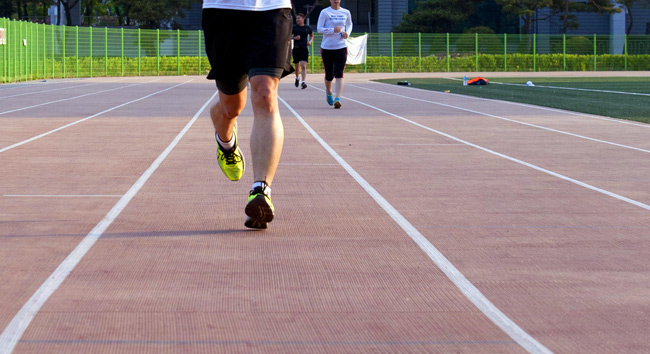 Running around the track during a 1 mile fitness test
Advantages and Disadvantages
Advantages: Large groups of athletes can be tested at once, and it is a very cheap and simple test to perform. If the test is conducted on a 400m running track, all the athletes will be in view throughout the test.
Disadvantages: Practice and pacing are required, and performance on this test can be affected greatly by motivation. If running around a 400m oval, you will be able to provide continual feedback on the time to help with pacing.
Pro Tip: To achieve the best result for this test, adequate practice and good pacing are required. Performance on this test can be affected greatly by motivation—encourage athletes to push themselves and provide split times at each 400m mark.
Understanding Your VO2max Results
VO2max (maximal oxygen uptake) represents the maximum amount of oxygen your body can utilize during intense exercise. It's measured in milliliters of oxygen per kilogram of body weight per minute (ml/kg/min). Higher values indicate better cardiovascular fitness and aerobic capacity.
The calculator uses the Cureton equation to estimate VO2max from your mile run time. This equation has been validated against laboratory testing and provides a reliable estimate of aerobic fitness for most healthy individuals.
1 Mile Run Norms for Males
| Rating | Age 13-19 | Age 20-29 | Age 30-39 | Age 40-49 | Age 50+ |
|---|---|---|---|---|---|
| Excellent | <6:00 | <6:30 | <7:00 | <7:30 | <8:00 |
| Good | 6:00-7:00 | 6:30-7:30 | 7:00-8:00 | 7:30-8:30 | 8:00-9:30 |
| Average | 7:00-8:30 | 7:30-9:00 | 8:00-9:30 | 8:30-10:00 | 9:30-11:00 |
| Below Average | 8:30-10:00 | 9:00-10:30 | 9:30-11:00 | 10:00-11:30 | 11:00-13:00 |
| Poor | >10:00 | >10:30 | >11:00 | >11:30 | >13:00 |
1 Mile Run Norms for Females
| Rating | Age 13-19 | Age 20-29 | Age 30-39 | Age 40-49 | Age 50+ |
|---|---|---|---|---|---|
| Excellent | <7:00 | <7:30 | <8:00 | <8:30 | <9:30 |
| Good | 7:00-8:00 | 7:30-8:30 | 8:00-9:30 | 8:30-10:00 | 9:30-11:00 |
| Average | 8:00-9:30 | 8:30-10:00 | 9:30-11:00 | 10:00-12:00 | 11:00-13:00 |
| Below Average | 9:30-11:00 | 10:00-12:00 | 11:00-13:00 | 12:00-14:00 | 13:00-15:00 |
| Poor | >11:00 | >12:00 | >13:00 | >14:00 | >15:00 |
Sport-Specific Applications
The 1 mile run test is widely used across various sports and fitness programs. Different sports have varying requirements for aerobic fitness.
Endurance Sports
Marathon runners, triathletes, and cyclists typically need excellent mile times (under 6 minutes for males, under 7 minutes for females) as a baseline indicator of aerobic capacity. Elite endurance athletes often complete the mile in under 5 minutes.
Team Sports
Soccer, basketball, and field hockey players benefit from good aerobic fitness for sustained performance throughout matches. A mile time of 6:30-7:30 (males) or 7:30-8:30 (females) indicates adequate fitness for most team sports.
Military and Law Enforcement
Many military and police fitness tests include the 1.5 mile run, making the 1 mile test an excellent training benchmark. The U.S. Army requires soldiers to complete 2 miles, so a strong 1 mile foundation is essential.
Training Recommendations
To improve your mile time, incorporate interval training (400m repeats at goal pace), tempo runs at 80-85% effort, and long slow distance runs for building aerobic base. Most athletes can expect to improve their mile time by 30-60 seconds over 8-12 weeks of consistent training.
How to Improve Your Mile Time
Improving your 1 mile run time requires a combination of aerobic base building, speed work, and proper recovery. Here are evidence-based strategies used by coaches and sports scientists.
Build Your Aerobic Base: Run 3-4 times per week at a comfortable conversational pace. This builds the cardiovascular foundation needed for faster mile times.
Add Interval Training: Once per week, perform 4-8 x 400m repeats at your target mile pace with 90-120 seconds rest between intervals.
Include Tempo Runs: Run 2-3 miles at a "comfortably hard" pace—faster than easy runs but sustainable for 20-30 minutes.
Practice Race Pacing: Many athletes start too fast and fade. Practice running even splits—aim for the same time for each 400m lap.
Strength Training: Include leg exercises like squats, lunges, and calf raises to improve running economy and reduce injury risk.
Frequently Asked Questions
What is a good 1 mile run time?
A good 1 mile run time varies by age and gender. For adult males aged 20-29, under 7 minutes is considered good, under 6:30 is excellent, and under 6 minutes is elite. For adult females in the same age range, under 8 minutes is good, under 7:30 is excellent, and under 7 minutes is elite. Times naturally slow with age.
How does the 1 mile run test estimate VO2max?
This calculator uses the Cureton equation, which was developed through research correlating mile run times with laboratory VO2max testing. The equation factors in your mile time, age, and gender to provide an estimated VO2max value in ml/kg/min.
How accurate is the 1 mile run test for VO2max?
The 1 mile run test has a correlation of approximately 0.71-0.89 with laboratory VO2max testing, depending on the population studied. It provides a reasonable estimate for most athletes but may be less accurate at extreme fitness levels or for individuals with poor pacing strategies.
Should I warm up before the 1 mile run test?
Yes, a proper warm-up of 5-10 minutes of light jogging and dynamic stretching is recommended before the test. This helps prevent injury and ensures your body is ready to perform at its best for an accurate result.
How often should I do the 1 mile run test?
For training purposes, testing every 4-8 weeks allows enough time for measurable fitness improvements. Testing too frequently may not show significant changes and can lead to overtraining or injury.
What factors affect my 1 mile run time?
Several factors affect your mile time including aerobic fitness, running economy, pacing strategy, motivation, weather conditions, altitude, running surface, and whether you've properly warmed up. Training status and recovery also play significant roles.
Is the 1 mile run or 1.5 mile run better for testing fitness?
Both tests are valid measures of aerobic fitness. The 1 mile run is better for younger athletes and those new to running, while the 1.5 mile run may be more accurate for highly trained individuals and is commonly used in military fitness testing.
References
- Cureton, K.J., et al. (1995). "A generalized equation for prediction of VO2peak from 1-mile run/walk performance." Medicine and Science in Sports and Exercise, 27(3), 445-451.
- Safrit, M.J., et al. (1988). "The validity generalization of distance run tests." Canadian Journal of Sport Sciences, 13(4), 188-196.
- Morrow, J.R., et al. (2010). "Measurement and Evaluation in Human Performance." Human Kinetics, 4th Edition.
- American College of Sports Medicine. (2021). "ACSM's Guidelines for Exercise Testing and Prescription." Wolters Kluwer, 11th Edition.
- Cooper, K.H. (1968). "A means of assessing maximal oxygen intake: Correlation between field and treadmill testing." JAMA, 203(3), 201-204.
- Leger, L.A., & Lambert, J. (1982). "A maximal multistage 20-m shuttle run test to predict VO2max." European Journal of Applied Physiology, 49(1), 1-12.
- Plowman, S.A., & Meredith, M.D. (2013). "Fitnessgram/Activitygram Reference Guide." The Cooper Institute, 4th Edition.
The Test in Action
- The 1.6 km endurance run is part of the eTID Talent Identification Testing Program.
- The FitnessGram program uses the 1 mile run as a standard assessment for students.
- Many school physical education programs worldwide use this test for fitness assessment.
Similar Tests
- FitnessGram 1-mile walk/run test — walk or run one mile as fast as you can.
- 1 Mile Endurance Run / Walk Test — complete one mile in the fastest possible time.
- 1-mile walk test — walk one mile in the quickest possible time.
Related Pages
- About the eTID Talent Identification Testing Program.
- General Walk / Run tests
- See the comparison page for an overview of the walk and run tests.
- Other aerobic tests
- All fitness test list
 Any comments, suggestions, or corrections? Please let us know.