Walk Run Test Calculator
Quick Answer
This calculator estimates your VO2max (maximal oxygen uptake) from walk or run fitness test results using validated prediction equations. Enter your test performance to get an instant aerobic fitness assessment.
- Supports Cooper 12-minute, 1-mile run, 1.5-mile run, and Rockport walk tests
- Based on published research with correlations of 0.65-0.90 to laboratory VO2max
- Includes age and gender-specific percentile rankings
There are quite a few variations of the walking or running test as a measure of aerobic fitness. Here is a general description of this type of test, along with a calculator to estimate your VO2max from test results. For specific instructions for a particular walking or running test, see the tests listed in Related Pages below. Also see the comparison page for an overview of the walk and run tests.
Procedure: There are several tests which involve running for a set time (e.g. 9, 10, 12 minutes) or a set distance (1 mile, 1.5 mile, 1200m), and the distance covered or time required being recorded. The time required for these tests normally range from 8 to 15 minutes, depending on the population being tested.
Modifications: In addition to different times and distances used for this test, different exercise modes such as swimming can be used. There are a few standard variations of this test, see the List of Walk and Run Tests below.
Scoring: Norms are available for many of these tests. It is important to compare results to normative tables that have the same test procedures and with a similar target group. Use the calculator above to estimate your VO2max from your test results.
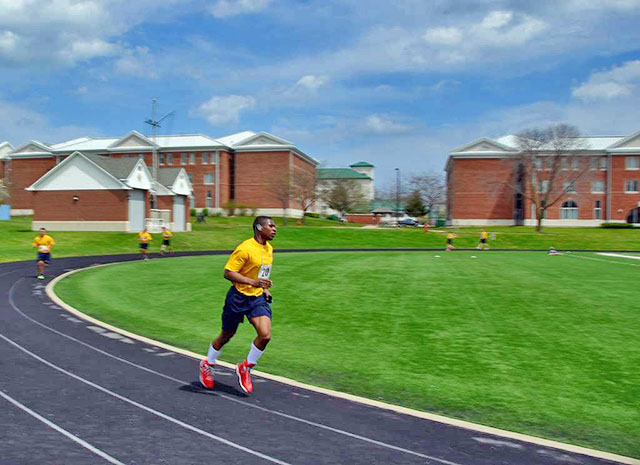
Run Test around the track
Target population: This test can be modified to be suitable for most populations. For adults, the test should be at least 10 minutes to ensure the energy demands are primarily supplied by the aerobic system. Shorter runs are more suitable for children.
Equipment required: oval or running track, marking cones, recording sheets, stopwatch.
Validity: Published studies generally have a correlation of 0.65 or better for runs of greater than 9 minutes or a mile.
Reliability: Reliability would depend on practice and pacing strategies and motivation level. There should be good reliability if these issues are addressed.
Advantages: Large groups can be tested at once, and it is a very cheap and simple test to perform.
Disadvantages: Practice and pacing are required, and performance on this test can be affected greatly by motivation.
List of Walk and Run Tests
Here are some of the specific walking / running endurance tests, some are conducted over a set distance and others over a set time period. Even more are listed on the aerobic fitness tests lists.
SET DISTANCE TESTS
- 800 meter run test
- Half Mile Walk
- 1000m (1km) Run Test
- 1.5km run test
- 1.6 km (1 mile) Run
- Endurance Run / Walk (1 mile)
- 1-Mile Walk Test
- Rockport Walk Test (1 mile)
- 2 km Walk Test
- 2km Run Test
- PRT 1.5 mile run test
- Cooper 2.4 km run test
- 3km Run Test
- APFT 2-Mile Run Test
- Marine PFT 3-Mile Run
- Track run for calculating Maximal Aerobic Speed
SET TIME TESTS
- 6-Minute Run Test
- 6-minute Walk Test
- 9-Minute Run Test
- Miller 20m Test (5 minutes)
- Cooper 12-minute test
- Balke Test (15 minute run)
How to Use This Calculator
Follow these steps to calculate your estimated VO2max from your walk or run test results:
- Select Your Test Type: Choose from the Cooper 12-minute run, 1-mile run, 1.5-mile run, 2.4km run, Rockport walk test, or 6-minute run test. Each test has specific requirements and is suited for different fitness levels.
- Enter Your Performance: Input either the distance covered (for timed tests like the Cooper test) or your completion time (for fixed-distance tests like the 1-mile run). The Rockport walk test also requires your finishing heart rate and body weight.
- Optional Demographics: Adding your age and gender enables percentile comparison against population norms, giving you context for your fitness level.
- Review Your Results: The calculator displays your estimated VO2max, fitness category, MET equivalent, and personalized training recommendations.
Pro Tip: For the most accurate results, perform the test after a proper warm-up, maintain consistent pacing, and test under similar conditions each time you repeat the assessment.
Understanding Your Results
VO2max, or maximal oxygen uptake, represents the maximum rate at which your body can use oxygen during intense exercise. It is measured in milliliters of oxygen per kilogram of body weight per minute (ml/kg/min) and is considered the gold standard measure of cardiovascular fitness.
VO2max Categories
Your fitness category is determined by comparing your VO2max to age and gender-matched population norms. The categories are:
- Excellent: Top 10% of the population. Indicates elite-level cardiovascular conditioning typical of competitive endurance athletes.
- Good: Above average fitness level. Reflects consistent aerobic training and healthy cardiovascular function.
- Average: Typical fitness level for moderately active adults. There is significant room for improvement with regular training.
- Fair: Below average aerobic capacity. May indicate sedentary lifestyle or early stages of fitness development.
- Poor: Low cardiovascular fitness. Associated with increased health risks and indicates need for gradual exercise program.
MET Equivalent
The calculator also provides your MET (Metabolic Equivalent of Task) value. One MET equals resting metabolic rate (approximately 3.5 ml O2/kg/min). Your VO2max in METs indicates the maximum intensity of activity you can sustain. For example, a VO2max of 35 ml/kg/min equals 10 METs, meaning you can perform activities up to 10 times your resting metabolic rate.
The Science Behind the Calculations
This calculator uses several validated prediction equations depending on the test selected:
Cooper 12-Minute Run Test Formula
Developed by Dr. Kenneth Cooper in 1968, this equation estimates VO2max from the distance covered in 12 minutes:
VO2max = (Distance in meters - 504.9) / 44.73
This formula has a correlation of 0.90 with laboratory-measured VO2max in trained individuals and remains one of the most widely used field tests for aerobic fitness assessment.
1-Mile Run Test Formula
The Cureton equation for the 1-mile run provides estimates based on completion time and body weight:
VO2max = 108.94 - (8.41 × time in minutes) + (0.34 × time² in minutes) + (0.21 × age × gender)
Where gender equals 1 for males and 0 for females. This formula is particularly useful for school-based fitness testing.
1.5-Mile Run Test Formula
Used extensively by military and law enforcement, this prediction equation is:
VO2max = 483 / time in minutes + 3.5
Alternative: VO2max = 88.02 - (0.1636 × body weight in kg) - (1.438 × time in minutes) - (0.1928 × heart rate)
Rockport Walk Test Formula
The Rockport equation is ideal for sedentary individuals or those who cannot run:
VO2max = 132.853 - (0.0769 × weight in lbs) - (0.3877 × age) + (6.315 × gender) - (3.2649 × time in minutes) - (0.1565 × heart rate)
Where gender equals 1 for males and 0 for females. This formula requires accurate heart rate measurement immediately upon completing the 1-mile walk.
Sport-Specific Applications
Different sports have varying demands for aerobic fitness. Here is how walk/run test results apply across athletic disciplines:
Endurance Sports
Marathon runners, cyclists, and triathletes typically have VO2max values of 55-75 ml/kg/min for males and 50-65 ml/kg/min for females. Elite endurance athletes like professional cyclists may exceed 80 ml/kg/min. The Cooper test is particularly relevant for these athletes as it directly assesses sustained aerobic capacity.
Team Sports
Soccer, basketball, hockey, and rugby players require both aerobic and anaerobic fitness. Typical VO2max ranges are 50-60 ml/kg/min for male players and 45-55 ml/kg/min for females. The 1.5-mile run is commonly used in these sports for its balance of aerobic and speed demands.
Combat Sports and Military
Boxing, wrestling, and military personnel benefit from high aerobic capacity for recovery between intense efforts. Target VO2max values are typically 50-60 ml/kg/min. The 1.5-mile and 2.4km tests are standard assessments in military fitness evaluations worldwide.
Recreational Fitness
For general health and fitness, a VO2max above 40 ml/kg/min for males and 35 ml/kg/min for females is associated with reduced cardiovascular disease risk. The Rockport walk test is ideal for beginners establishing baseline fitness levels.
How to Improve Your Results
Aerobic fitness can be improved significantly with consistent training. Research shows VO2max improvements of 5-20% are typical over 8-12 weeks of dedicated training. Here are evidence-based strategies:
- Frequency: Train 3-5 times per week with at least one rest day between hard sessions
- Long Slow Distance: Include one weekly run at 65-75% max heart rate for 45-90 minutes to build aerobic base
- Tempo Training: Perform 20-40 minutes at 80-85% max heart rate (comfortably hard pace) once per week
- Interval Training: High-intensity intervals of 3-5 minutes at 90-95% max heart rate with equal recovery periods, once per week
- Progressive Overload: Increase weekly training volume by no more than 10% to avoid overtraining
Frequently Asked Questions
How accurate is the Cooper test for estimating VO2max?
The Cooper 12-minute run test has a correlation of 0.90 with laboratory VO2max measurements for trained individuals. Accuracy is typically ±10% when subjects are motivated and properly paced. Factors affecting accuracy include motivation, pacing strategy, weather conditions, and running surface.
What is a good VO2max score for my age?
VO2max norms vary by age and gender. For males aged 20-29, a "good" score is 46-50 ml/kg/min, while "excellent" is above 55 ml/kg/min. For females aged 20-29, "good" is 40-44 ml/kg/min and "excellent" is above 49 ml/kg/min. Scores naturally decline with age but can be maintained or improved with regular aerobic training.
Which walk/run test should I use?
Choose based on your fitness level and testing purpose. The Cooper 12-minute test is best for athletes and moderately fit individuals who can maintain a running pace. The Rockport Walk Test is ideal for beginners, older adults, or those who cannot run. The 1.5-mile run is standard for military and law enforcement fitness assessments.
How can I improve my walk/run test results?
Improve aerobic fitness through consistent training 3-5 times per week. Include long slow distance runs for base building, tempo runs at 80-85% max heart rate, and interval training at higher intensities. Most athletes see 5-15% improvement in VO2max over 8-12 weeks of dedicated training.
Should I warm up before taking a walk/run fitness test?
Yes, always warm up for 5-10 minutes with light jogging and dynamic stretches before any fitness test. A proper warm-up can improve performance by 2-5% and significantly reduces injury risk. Avoid static stretching immediately before the test as it may temporarily reduce power output.
How often should I repeat the walk/run fitness test?
Test every 6-12 weeks to track meaningful fitness progress. More frequent testing can be demotivating if improvements are small. Allow at least 48 hours of rest before testing and avoid testing when fatigued, ill, or under-recovered from training.
What factors can affect walk/run test accuracy?
Key factors include motivation level, pacing strategy, weather conditions (heat increases heart rate), altitude (reduces oxygen availability), running surface (track vs trail), and prior fatigue. For reliable tracking over time, test at the same time of day, on the same surface, and under similar environmental conditions.
References
- Cooper, K.H. (1968). "A means of assessing maximal oxygen intake." Journal of the American Medical Association, 203(3), 201-204.
- Kline, G.M., et al. (1987). "Estimation of VO2max from a one-mile track walk, gender, age, and body weight." Medicine and Science in Sports and Exercise, 19(3), 253-259.
- Cureton, K.J., et al. (1995). "A generalized equation for prediction of VO2peak from 1-mile run/walk performance." Medicine and Science in Sports and Exercise, 27(3), 445-451.
- American College of Sports Medicine. (2021). ACSM's Guidelines for Exercise Testing and Prescription. 11th ed. Wolters Kluwer.
- Balke, B. (1963). "A simple field test for the assessment of physical fitness." Civil Aeromedical Research Institute Report, 63-6.
- Leger, L.A. & Lambert, J. (1982). "A maximal multistage 20-m shuttle run test to predict VO2max." European Journal of Applied Physiology, 49(1), 1-12.
- George, J.D., et al. (1993). "VO2max estimation from a submaximal 1-mile track jog for fit college-age individuals." Medicine and Science in Sports and Exercise, 25(3), 401-406.
Similar Tests
- The Navy PRT Elliptical Trainer Test or Stationary Cycle Test.
- Lucas 12 test - not only includes 12 minutes of running like in the Cooper test, additionally there is 12 minutes of rowing and cycling exercise
Related Pages
- Read the Walk / Run Test Review page for an overview of the walk and run tests.
- Fitness tests involving walking
- More aerobic fitness tests
 Any comments, suggestions, or corrections? Please let us know.