3km Run Test Calculator
Quick Answer
The 3km Run Test Calculator estimates your VO2max (maximal oxygen uptake) based on your completion time for a 3-kilometer run. This metric is the gold standard for measuring cardiovascular fitness and aerobic endurance capacity.
- Estimates VO2max using validated running performance formulas
- Provides age and gender-adjusted fitness ratings
- Calculates average pace and running speed automatically
The 3 km (1.86 miles) run test is one of many running field tests for aerobic fitness. Participants are required to run 3km in the fastest possible time. This is one of many running and walking fitness tests, including the similar distance 3-Mile Run Test.
How to Use This Calculator
Follow these simple steps to calculate your aerobic fitness level from your 3km run performance:
- Complete the 3km Run Test - Run the full 3-kilometer distance on a measured course (such as a 400m track) as fast as possible while recording your total time.
- Enter Your Time - Input your completion time in minutes and seconds in the calculator above.
- Add Your Details - Select your gender and enter your age for accurate fitness rating comparisons against age-appropriate norms.
- View Your Results - Click "Calculate Results" to see your estimated VO2max, fitness rating, average pace, and percentile ranking.
Understanding Your Results
The calculator provides several key metrics to help you understand your aerobic fitness level:
VO2max (Estimated) represents your maximal oxygen uptake measured in milliliters of oxygen per kilogram of body weight per minute (ml/kg/min). This is considered the gold standard measurement of cardiovascular fitness. Higher values indicate better aerobic capacity and endurance potential.
Fitness Rating compares your performance against established norms for your age and gender. Ratings range from "Poor" to "Superior" based on where your VO2max falls within population distributions.
Percentile Ranking shows where you stand compared to others of similar age and gender. A 75th percentile means you performed better than 75% of the comparison population.
3km Run Test Performance Standards
| Rating | Male Time | Female Time | Est. VO2max (ml/kg/min) |
|---|---|---|---|
| Superior | < 10:30 | < 12:00 | > 55 |
| Excellent | 10:30 - 12:00 | 12:00 - 14:00 | 50 - 55 |
| Good | 12:00 - 14:00 | 14:00 - 16:00 | 45 - 50 |
| Average | 14:00 - 16:00 | 16:00 - 18:00 | 40 - 45 |
| Below Average | 16:00 - 18:00 | 18:00 - 20:00 | 35 - 40 |
| Poor | > 18:00 | > 20:00 | < 35 |
Note: These standards are general guidelines for healthy adults aged 20-39. Expectations vary by age group, with slightly longer times being acceptable for older age groups.
The Science Behind the Calculation
The VO2max estimation uses a validated formula based on running velocity and the established relationship between running speed and oxygen consumption. The formula calculates the average running velocity from your 3km time, then estimates VO2max using the following approach:
Formula: VO2max ≈ (Running velocity in m/min × 0.2) + (Running velocity × 0.9) + 3.5
This is a simplified adaptation of the ACSM metabolic equation for running, which accounts for the oxygen cost of horizontal running plus resting metabolism.
According to sports science expert Robert Wood, who has analyzed sports performance data for over 25 years, "Field-based running tests like the 3km run provide practical and reasonably accurate estimates of aerobic fitness when laboratory testing isn't available. The key is standardizing test conditions and ensuring maximal effort from the participant."
Test Protocol and Procedures
Test Purpose: This test measures aerobic fitness and cardiovascular endurance capacity.
Equipment Required: 3 km flat running course (e.g., 400m track = 7.5 laps), stopwatch, marker cones, recording sheets.
Pre-Test Procedures: Explain the test procedures to the participant. Perform screening of health risks and obtain informed consent. Prepare forms and record basic information such as age, height, body weight, gender, and test conditions. Measure and mark out the course using cones. See more details of pre-test procedures.
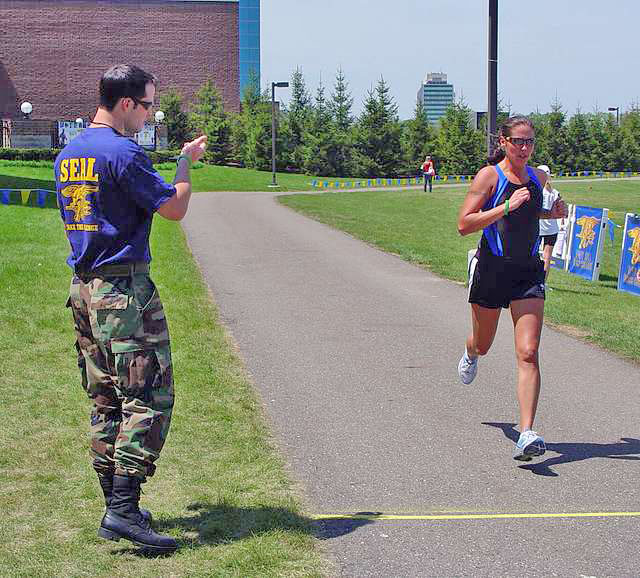
Test Procedure: The aim of this test is to complete a three-kilometer course in the shortest possible time. At the start, all participants are required to line up behind a starting line. On the command 'go,' the clock will start, and the athletes begin running at their own pace. Walking is allowed, but not encouraged for accurate fitness assessment.
 run test finish
Scoring: The total time to complete the course is recorded for each participant. Use the calculator above to convert your time into estimated VO2max and fitness ratings.
Sport-Specific Applications
The 3km run test is widely used across various sports and fitness contexts:
Endurance Sports (Running, Cycling, Triathlon): Athletes typically aim for times under 11 minutes (males) or 13 minutes (females). Elite distance runners often complete 3km in under 9 minutes. The test helps track aerobic base development during training cycles.
Team Sports (Soccer, Basketball, Hockey): Field sport athletes use the 3km test to assess aerobic capacity for match fitness. Target times typically range from 12-14 minutes for males and 14-16 minutes for females, depending on position requirements.
Military and Law Enforcement: Many agencies include the 3km run or similar distances in physical fitness assessments. Standard passing times vary by organization but typically require completion under 15-16 minutes.
General Fitness: For recreational exercisers, the 3km test provides an accessible benchmark for tracking cardiovascular fitness improvements over time. Completing the distance without stopping is an initial goal for many beginners.
How to Improve Your 3km Run Time
Improving your 3km run performance requires a balanced training approach targeting multiple aspects of running fitness:
Build Aerobic Base: Include 2-3 easy-paced runs per week at conversational intensity (60-70% max heart rate). These runs develop mitochondrial density and capillary networks that support endurance.
Tempo Training: Weekly tempo runs at lactate threshold pace (comfortably hard effort you could sustain for about an hour) improve your body's ability to clear lactate and maintain faster paces.
Interval Training: Include one session per week of high-intensity intervals such as 400m or 800m repeats at faster than 3km race pace. This improves VO2max and running economy.
Pacing Strategy: Practice even pacing during training runs. Starting too fast leads to significant slowdowns in the second half. Aim for consistent lap times throughout the test.
Running Economy: Work on running form, cadence, and relaxation while running. More efficient running mechanics translate to faster times at the same effort level.
Frequently Asked Questions
What is a good 3km run time?
A good 3km run time varies by age and fitness level. For adult males, under 12 minutes is considered excellent, 12-14 minutes is good, and 14-16 minutes is average. For females, under 14 minutes is excellent, 14-16 minutes is good, and 16-18 minutes is average. Elite runners can complete 3km in under 9 minutes.
How accurate is the VO2max estimation from a 3km run?
The VO2max estimation from running tests is generally accurate to within ±3-5 ml/kg/min compared to laboratory testing. Accuracy depends on running at maximal effort, proper pacing, and favorable environmental conditions. The estimation works best for trained individuals who can pace themselves effectively.
How often should I do the 3km run test?
For tracking fitness progress, performing the 3km run test every 4-8 weeks is recommended. This allows sufficient time for training adaptations while providing regular feedback on your aerobic fitness improvements. Avoid testing when fatigued from recent hard training.
What factors affect 3km run performance?
Key factors include cardiovascular fitness (VO2max), running economy, pacing strategy, motivation level, environmental conditions (temperature, humidity, altitude, wind), course terrain and surface, recent training load, sleep quality, and nutritional status before the test.
How can I improve my 3km run time?
Improve your 3km time through consistent aerobic training including easy runs for base building, tempo runs at lactate threshold, and interval training for VO2max development. Also focus on running economy drills, proper pacing practice, adequate recovery, and maintaining healthy body composition.
Is the 3km run test suitable for beginners?
The 3km run can be challenging for beginners or sedentary individuals. Those new to running should build a base fitness level first through walking and progressive jogging programs before attempting a maximal timed test. Walking during the test is permitted but may affect the accuracy of VO2max estimations.
How does the 3km run compare to other running tests?
The 3km run is shorter than the Cooper 12-minute test or 3-mile run but longer than the 1.5-mile (2.4km) test. It provides a good balance between assessing aerobic capacity and being practical to administer, typically taking 10-20 minutes for most people. All these tests estimate similar fitness parameters.
References
- American College of Sports Medicine. (2022). "ACSM's Guidelines for Exercise Testing and Prescription." 11th Edition. Wolters Kluwer.
- Cooper, K.H. (1968). "A means of assessing maximal oxygen intake." Journal of the American Medical Association, 203(3), 201-204.
- Léger, L.A., & Lambert, J. (1982). "A maximal multistage 20-m shuttle run test to predict VO2max." European Journal of Applied Physiology, 49(1), 1-12.
- Bassett, D.R., & Howley, E.T. (2000). "Limiting factors for maximum oxygen uptake and determinants of endurance performance." Medicine & Science in Sports & Exercise, 32(1), 70-84.
- Midgley, A.W., McNaughton, L.R., & Jones, A.M. (2007). "Training to enhance the physiological determinants of long-distance running performance." Sports Medicine, 37(10), 857-880.
- Wood, R.J. (2008). "Fitness Testing: A Guide for Personal Trainers and Coaches." Topend Sports.
- Tanaka, H., Monahan, K.D., & Seals, D.R. (2001). "Age-predicted maximal heart rate revisited." Journal of the American College of Cardiology, 37(1), 153-156.
Similar Tests
- 3-Mile Run Test — run 3 miles in the fastest possible time.
- 2 Mile Run Test (APFT) — run two miles as fast as you can (Army test)
- Cooper 2.4km (1.5mile) run test — run 2.4km as fast as you can.
Related Pages
- Results of some 3 km run testing
- General Walk / Run test
- See the comparison page for an overview of the walk and run tests.
- Other aerobic tests
- All fitness test list
 Any comments, suggestions, or corrections? Please let us know.