IPFT Flexed-Arm Hang Test Calculator
Quick Answer
This calculator evaluates your IPFT flexed-arm hang performance against age and gender-specific norms, helping you understand your upper body relative strength and muscular endurance level.
- Instant percentile ranking based on research-validated standards
- Healthy Fitness Zone assessment (FitnessGram criteria)
- Personalized training recommendations
The Flexed-Arm Hang test measures upper body relative strength and muscular endurance. The participant hangs from a bar with arms flexed and attempts to hold this position for as long as possible. The following describes the procedures as used in the International Physical Fitness Test. See also the flexed arm hang test used for the Marines and as used in the President's Challenge Fitness Awards.
How to Perform the IPFT Flexed-Arm Hang Test
Equipment required: Stopwatch, a horizontal bar 4cm in diameter, placed at a height so that participants are unable to touch the ground when hanging from it, ladder.
Pre-test: Explain the test procedures to the subject. Perform screening of health risks and obtain informed consent. Prepare forms and record basic information such as age, height, body weight, gender and test conditions. Record the height of the overhead bar. See more details of pre-test procedures.
Procedure: The participant climbs the ladder to a height so that the chin is level with the bar. Grasp the overhead bar using an overhand grip (palms facing away from body), with the hands at shoulder width apart. On the command, "ready, go," the person removes their feet from the ladder, and the timing starts. The participant should attempt to hold this position for as long as possible.
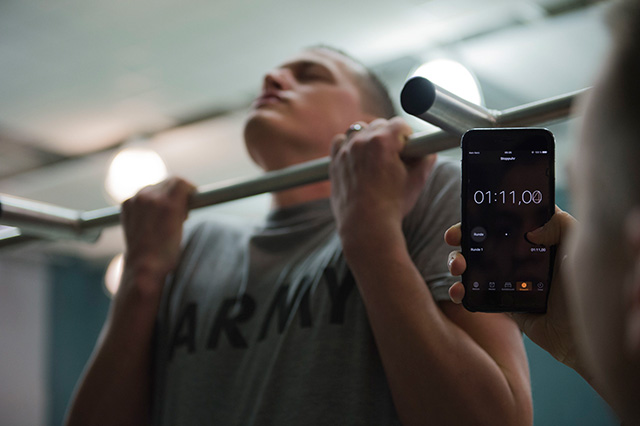 US Army soldier performing the flexed arm hang test
Scoring: The total time in seconds is recorded - timing is stopped when the person's chin falls below the level of the bar or the head tilts backward to enable the chin to stay level with the bar.
Flexed-Arm Hang Test Norms by Age and Gender
The following table shows the FitnessGram Healthy Fitness Zone minimum requirements for the flexed-arm hang test. These standards represent the minimum time needed to achieve a passing score for each age group.
| Age | Boys (seconds) | Girls (seconds) |
|---|---|---|
| 5 | ≥2 | ≥2 |
| 6 | ≥2 | ≥2 |
| 7 | ≥3 | ≥3 |
| 8 | ≥3 | ≥3 |
| 9 | ≥4 | ≥4 |
| 10 | ≥4 | ≥4 |
| 11 | ≥6 | ≥6 |
| 12 | ≥10 | ≥7 |
| 13 | ≥12 | ≥8 |
| 14 | ≥15 | ≥8 |
| 15 | ≥15 | ≥8 |
| 16 | ≥15 | ≥8 |
| 17+ | ≥15 | ≥8 |
Source: FitnessGram/Activitygram Test Administration Manual, The Cooper Institute
Understanding Your Flexed-Arm Hang Results
The flexed-arm hang is a test of isometric muscular endurance, measuring how long you can maintain a static muscle contraction. Unlike dynamic exercises such as pull-ups, this test specifically evaluates your ability to sustain force over time, which is crucial for sports like climbing, gymnastics, and obstacle course racing.
Performance Categories
- Excellent (85th+ percentile): Elite-level upper body endurance, typical of competitive climbers and gymnasts
- Above Average (70-84th percentile): Strong upper body development, good foundation for pull-up progression
- Average (50-69th percentile): Meets healthy fitness standards for general health
- Below Average (25-49th percentile): Room for improvement through targeted training
- Needs Improvement (below 25th percentile): Focus on building foundational strength
Muscles Tested in the Flexed-Arm Hang
The flexed-arm hang primarily assesses the isometric strength and endurance of several muscle groups working together to maintain the hold position. Understanding which muscles are involved can help you develop a more effective training program.
The primary muscles tested include the biceps brachii, brachialis, and brachioradialis (elbow flexors), along with the latissimus dorsi, teres major, and rhomboids (shoulder extensors and scapular stabilizers). Secondary muscles include the forearm flexors for grip strength, core muscles for body stabilization, and the lower trapezius for scapular depression.
Sport-Specific Applications
The flexed-arm hang test has particular relevance for athletes in several sports where upper body relative strength and muscular endurance are critical performance factors.
Rock Climbing and Bouldering: Climbers require exceptional isometric grip and arm endurance. Elite climbers often achieve 60+ seconds on the flexed-arm hang, with some specialized finger-hang variants exceeding several minutes.
Gymnastics: Gymnasts performing on rings, bars, and other apparatus need sustained upper body strength. The flexed-arm hang correlates well with performance on static hold elements like the iron cross and maltese.
Military and Tactical Athletes: The US Marine Corps includes the flexed-arm hang in their Physical Fitness Test for female Marines. A minimum of 15 seconds is required to pass, with scoring of 1 point per second up to 40 seconds, then 2 points per second thereafter.
Obstacle Course Racing: Events like Spartan Race and Tough Mudder feature numerous hanging and climbing obstacles where isometric arm endurance is essential for completion.
How to Improve Your Flexed-Arm Hang Time
Improving your flexed-arm hang requires a progressive approach that develops both strength and muscular endurance. According to sports science research, the following training progression is most effective.
Stage 1 - Foundation (0-10 seconds): Begin with dead hangs (straight arms) for 3 sets of 30-60 seconds. Add lat pulldowns at 60-70% of body weight. Practice scapular pulls to develop shoulder blade control. Train 2-3 times per week.
Stage 2 - Building (10-20 seconds): Progress to assisted flexed-arm hangs using a resistance band or box. Incorporate negative (eccentric) pull-ups, lowering slowly over 5-10 seconds. Add isometric holds at various arm angles (90°, 120°, full flexion).
Stage 3 - Advanced (20+ seconds): Practice unassisted flexed-arm hangs with progressive time goals. Implement weighted hangs with light dumbbells between feet. Train grip-specific exercises like farmer's carries and towel hangs.
⚠️ Training Note: Allow adequate recovery between training sessions (48-72 hours). Avoid training to complete failure on every set, as this can lead to overuse injuries in the elbow and shoulder joints.
Test Variations
Three other procedures for the flexed-arm hang are described on this site:
- The flexed-arm hang test used in the President's Challenge Fitness Awards
- The Eurofit Bent Arm Hang
- The flexed-arm hang test used for the Marines
These procedures vary only slightly from that described here, primarily in grip options and starting position assistance.
Advantages and Disadvantages
Advantages: The equipment is readily available, and the test is easy and quick to perform. It requires no specialized training to administer and provides a reliable measure of upper body muscular endurance. The test has high test-retest reliability (ICC = 0.89-0.99 in adults).
Disadvantages: The body weight of the subject has a great effect on the results of this test. Heavier individuals must support more mass, potentially disadvantaging them regardless of absolute strength. A better test of upper body strength in which body weight is not as important is the push-up test.
Frequently Asked Questions
What is a good flexed-arm hang time?
For youth, the FitnessGram Healthy Fitness Zone requires boys aged 14+ to hold for at least 15 seconds, while girls need 8 seconds. Adult males typically average 20-25 seconds, while females average 7-10 seconds. Elite athletes and military personnel often exceed 45-60 seconds. The 85th percentile for adult females is approximately 29 seconds.
How do I improve my flexed-arm hang time?
Progress through dead hangs (30-60 seconds), scapular pulls, negative pull-ups, and isometric holds at various angles. Train 2-3 times per week with adequate rest between sessions. Grip strength exercises like farmer's carries and lat pulldowns also help build the necessary muscular endurance for longer hang times.
What muscles does the flexed-arm hang test?
The flexed-arm hang primarily tests the biceps brachii, brachialis, brachioradialis (elbow flexors), latissimus dorsi, and forearm grip muscles. It measures isometric muscular endurance and relative upper body strength—the ability to support your body weight with bent arms.
What is the difference between IPFT and other flexed-arm hang tests?
The IPFT version requires an overhand grip with hands shoulder-width apart and chin level with the bar. Other versions like the President's Challenge allow underhand grip, while the Marine PFT has specific scoring where points increase after 40 seconds. The Eurofit version uses similar procedures but different normative data.
How does body weight affect flexed-arm hang performance?
Body weight significantly affects performance since heavier individuals must support more mass. This is why the test measures relative strength rather than absolute strength. Athletes with lower body fat percentages typically perform better due to improved strength-to-weight ratio. Losing excess body fat while maintaining muscle can improve scores.
Can the flexed-arm hang predict pull-up ability?
Yes, research shows moderate correlation between flexed-arm hang time and pull-up performance. Generally, individuals who can hold a flexed-arm hang for 30+ seconds can typically perform multiple pull-ups. The hang develops the isometric strength base needed for the dynamic pull-up movement.
Is overhand or underhand grip better for the flexed-arm hang?
For the IPFT, overhand grip (palms away) is required. However, underhand grip typically allows longer hang times due to better bicep engagement. The President's Challenge permits either grip. When training, practice both grips to develop balanced strength.
References
- The Cooper Institute. (2017). "FitnessGram/Activitygram Test Administration Manual." 5th Ed. Human Kinetics.
- Pate, R.R., Burgess, M.L., Woods, J.A., Ross, J.G., & Baumgartner, T. (1993). "Validity of field tests of upper body muscular strength." Research Quarterly for Exercise and Sport, 64(1), 17-24.
- Winnick, J.P. & Short, F.X. (2014). "The Brockport Physical Fitness Test Manual." 2nd Ed. Human Kinetics.
- Council of Europe. (1993). "EUROFIT: Handbook for the EUROFIT Tests of Physical Fitness." Council of Europe.
- Rosandich, T.J. (1978). "International Physical Fitness Test Manual." United States Sports Academy.
- Vanderburgh, P.M. & Dooman, C.S. (2000). "Considering body mass differences in traditional assessment methods." Journal of Strength and Conditioning Research.
- Castro-Piñero, J., et al. (2010). "Criterion-related validity of field-based fitness tests in youth." British Journal of Sports Medicine, 44(13), 934-943.
The Test in Action
- This test is part of the International Physical Fitness Test
Similar Tests
- See the similar Flexed Arm Hang test used for the Marine PFT
- The flexed arm hang test used in the President's Challenge Fitness Awards
- Bent-Arm Hang from the Eurofit tests
- Extended (Straight) Arm Hang Test — hanging from an overhead bar with straight arms for as long as possible, part of the Brockport assessment
- Similar pull-up and push-up upper body strength tests
Related Pages
- Other strength tests
- Overhand or underhand - a description of each of the grip types
- More details about the International Physical Fitness Test
 Any comments, suggestions, or corrections? Please let us know.