Flexed Arm Hang Calculator
Quick Answer
This calculator determines your flexed arm hang score using official Marine PFT formulas and fitness assessment standards. Enter your hang time to instantly receive your PFT points, performance rating, and training recommendations.
- Calculates Marine Corps PFT points (1 pt/sec up to 40s, then 2 pts/sec)
- Compares to FitnessGram Healthy Fitness Zone standards by age
- Provides percentile ranking based on population norms
In the Flexed Arm Hang Test, the participant hangs from a bar with the arms flexed and attempts to hold this position for as long as possible. This test forms part of the US Marine Physical Fitness Test (PFT), performed by US Marine personnel every six months. The flexed arm hang test was historically performed by female Marines, though pull-ups are now the standard. It remains a valuable assessment of isometric upper body strength and muscular endurance.
How to Use This Flexed Arm Hang Calculator
Follow these simple steps to calculate your flexed arm hang score and compare your performance to athletic standards:
- Perform the Test - Grasp the bar with either an overhand or underhand grip. Using assistance, raise your body until your chin clears the bar. Hold this position as long as possible while a partner times you.
- Enter Your Time - Input your total hang time in seconds into the calculator above.
- Select Your Details - Choose your gender for the most accurate scoring comparison.
- View Results - Click "Calculate Score" to see your PFT points, performance rating, percentile ranking, and personalized training recommendations.
Pro Tip: For the most accurate results, have a training partner time you and ensure your chin stays above the bar throughout the test. Use the same grip technique each time you test for consistent comparisons.
Understanding the Flexed Arm Hang Test
Test Purpose: The flexed arm hang measures upper body strength and muscular endurance, specifically targeting the isometric strength of the biceps, brachialis, latissimus dorsi, and grip muscles. Unlike pull-ups which measure dynamic strength, the flexed arm hang assesses your ability to maintain a contracted position under sustained load.
Equipment Required: Stopwatch, horizontal overhead (pull up) bar at the appropriate height. The bar should allow the participant to hang with feet clear of the ground.
Pre-test: Explain the test procedures to the subject. Perform screening of health risks and obtain informed consent. Prepare forms and record basic information such as age, height, body weight, gender and test conditions. Record the height of the overhead bar. See more details of pre-test procedures.
Procedure: The starting position is with the chin above the bar, and both feet off the ground. You can reach the starting position by standing on a support, or if necessary assisted by others. The grip can be either with both palms facing forward (overhand/pronated) or to the rear (underhand/supinated), though with both facing in the same direction (see more about grip types). The aim of the test is to hold this position for as long as possible. The timer is started when the participant is in position, and does not stop until they cannot maintain some degree of flexion at the elbow. The feet may not touch the floor during the test.
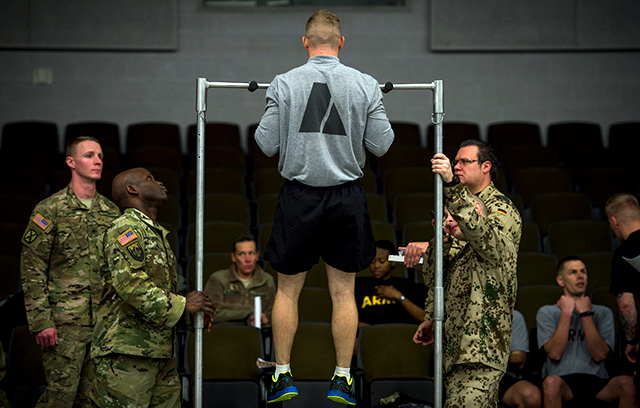
National Guard personnel performing the flexed arm hang test
Marine PFT Flexed Arm Hang Scoring
The Marine Corps PFT uses a specific scoring formula for the flexed arm hang event:
| Time Range | Points Calculation | Example |
|---|---|---|
| 0-40 seconds | 1 point per second | 25 seconds = 25 points |
| 41-70 seconds | 40 + (2 × each second over 40) | 55 seconds = 40 + (15×2) = 70 points |
| Maximum Score | 100 points | 70 seconds = 100 points |
| Minimum Passing | 15 points required | 15 seconds minimum |
FitnessGram Healthy Fitness Zone Standards
The FitnessGram assessment uses criterion-referenced standards called the "Healthy Fitness Zone" (HFZ). These standards vary by age and gender:
| Age | Boys (seconds) | Girls (seconds) |
|---|---|---|
| 5-6 | ≥2 | ≥2 |
| 7-8 | ≥3 | ≥3 |
| 9-10 | ≥4 | ≥4 |
| 11 | ≥6 | ≥6 |
| 12 | ≥10 | ≥7 |
| 13 | ≥12 | ≥8 |
| 14-17+ | ≥15 | ≥8 |
Adult Performance Standards
For adults (18+ years), flexed arm hang performance can be categorized based on available research and Presidential Challenge data:
| Rating | Females (seconds) | Males (seconds) |
|---|---|---|
| Excellent | 30+ | 50+ |
| Good | 15-29 | 30-49 |
| Average | 7-14 | 15-29 |
| Below Average | 2-6 | 5-14 |
| Poor | <2 | <5 |
Sport-Specific Applications
The flexed arm hang test has particular relevance for athletes in sports requiring upper body strength endurance and grip strength. Rock climbers use isometric holds extensively, with elite climbers capable of holding for 90+ seconds. Gymnasts rely on similar strength for rings, bars, and support positions. The test remains part of military fitness assessments worldwide, including various branches and special operations units. Combat sports athletes, particularly in wrestling and Brazilian jiu-jitsu, benefit from the grip endurance developed through flexed arm hang training.
How to Improve Your Flexed Arm Hang Time
Improving your flexed arm hang performance requires training both isometric strength and muscular endurance. Here are evidence-based strategies:
Progressive Training Program
- Dead Hangs (Grip Strength) - Start with straight-arm hangs for 30-60 seconds. This builds the grip foundation needed for longer holds.
- Negative Pull-ups - Jump or step to the top position, then lower yourself as slowly as possible (5-10 seconds). Perform 5-8 reps for 3 sets.
- Isometric Holds at Various Angles - Hold at different elbow angles (90°, 120°, 135°) for time. This builds strength throughout the range of motion.
- Assisted Pull-ups - Use resistance bands or a partner to reduce bodyweight. Focus on slow, controlled movement.
- Frequency - Train 2-3 times per week with at least 48 hours between sessions for adequate recovery.
Training Tip: Body weight significantly affects flexed arm hang performance. Athletes with lower body fat percentages typically achieve longer hold times. Combining strength training with appropriate nutrition can improve your power-to-weight ratio.
Frequently Asked Questions
What is a good flexed arm hang time for adults?
For adult females, 15-30 seconds is considered good to excellent, while 30+ seconds indicates superior upper body strength. For males, 30-50 seconds is good, with elite performers exceeding 60 seconds. These standards vary based on body weight and training background.
How is the Marine Corps PFT flexed arm hang scored?
The Marine PFT awards 1 point per second for the first 40 seconds, then 2 points per second for time beyond 40 seconds. Maximum score of 100 points requires holding for 70 seconds. The minimum passing standard is 15 seconds.
What muscles does the flexed arm hang test?
The flexed arm hang primarily tests the biceps brachii, brachialis, latissimus dorsi, grip strength (forearm flexors), and core stabilizers. It measures isometric strength and muscular endurance of the upper body pulling muscles.
Should I use overhand or underhand grip for the flexed arm hang?
Both grips are typically allowed. Underhand (supinated) grip places more emphasis on the biceps and many find it slightly easier. Overhand (pronated) grip activates more back muscles. Use the grip that feels strongest and most comfortable for you.
How often should I test my flexed arm hang?
For tracking progress, test every 4-6 weeks. This allows enough time for training adaptations to occur. Always use the same protocol, grip type, and testing conditions for accurate comparisons.
Why does body weight affect flexed arm hang performance?
The flexed arm hang is a relative strength test—you're supporting your own body weight. Athletes with lower body weight relative to their strength (better strength-to-weight ratio) typically achieve longer hold times. This is why the test is sometimes called a "relative strength" assessment.
Is the flexed arm hang still used in Marine Corps testing?
The flexed arm hang was historically used for female Marines but was phased out in 2014-2016 when pull-ups became the standard for all Marines. However, the test remains valuable for fitness assessment and is still used in various military and school fitness programs worldwide.
⚠️ Testing Disclaimer: This calculator provides estimates for educational and fitness assessment purposes. Results should not replace professional fitness evaluation. Consult with a qualified fitness professional before beginning any exercise program, especially if you have health concerns or injuries.
References
- Cooper Institute. (2017). FITNESSGRAM Administration Manual. 5th Edition. Human Kinetics.
- Winnick, J. P. & Short, F.X. (2014). The Brockport Physical Fitness Test Manual. 2nd Ed. Human Kinetics.
- Marine Corps Order 6100.13A. (2018). Marine Corps Physical Fitness and Combat Fitness Tests. United States Marine Corps.
- President's Council on Physical Fitness and Sports. (2012). The President's Challenge Physical Fitness Test.
- Council of Europe. (1988). EUROFIT: Handbook for the EUROFIT Tests of Physical Fitness.
- Pate, R.R., et al. (2006). "Criterion-referenced standards for youth health-related fitness tests." Journal of School Health.
- Mayhew, J.L., et al. (2014). "Construct validity of a modification of the flexed arm hang test." Journal of Strength and Conditioning Research.
The Test in Action
- This test forms part of the US Marine Physical Fitness Test
Similar Tests
- President's Challenge Flexed Arm Hang
- International Physical Fitness Test Flexed Arm Hang
- Bent-Arm Hang from the Eurofit tests.
- Extended (Straight) Arm Hang Test — hanging from an overhead bar with straight arms for as long as possible, part of the Brockport assessment.
- The similar pull-up and push-up upper body strength test
Related Pages
- PFT testing discussion and scoring
- Other strength tests
- Overhand or underhand - a description of each of the grip types
- All fitness test list
 Any comments, suggestions, or corrections? Please let us know.