Foot Tapping Speed Test Calculator
Quick Answer
This calculator analyzes your foot tapping speed test results by calculating your tapping frequency and comparing your performance to athletic standards.
- Calculates taps per second (frequency) from your 30-second count
- Provides performance ratings from Below Average to Elite
- Offers sport-specific applications for tennis, basketball, soccer, and more
The foot tapping speed test is a speed of movement and coordination test using a timing mat. This calculator helps you analyze your foot tapping results by calculating your tapping frequency and comparing your performance against athletic standards. The quick feet test is another assessment of this physical attribute.
What Does This Calculator Measure?
The foot tapping speed test calculator processes your raw tap count from the 30-second test and provides several key metrics. First, it calculates your tapping frequency in taps per second, which allows comparison with research data that often uses different time intervals (10 or 15 seconds). Second, it assigns a performance rating based on athletic norms. Third, it provides sport-specific context for your results.
Research by Pribble et al. (2021) demonstrated that the foot tapping test exhibits high test-retest reliability (Pearson's R > 0.90) and inter-rater reliability (ICC > 0.80), making it a valid tool for assessing lower limb neuromuscular function in both athletic and clinical settings.
Test Purpose and Applications
Test purpose: To assess the speed of movement and coordination of the lower body, specifically measuring the neuromuscular system's ability to produce rapid, repetitive leg movements.
The foot tapping speed test is particularly valuable for athletes in sports requiring quick foot movements and rapid direction changes. A good level of foot speed is directly associated with successful performance in game situations where fast movements determine competitive advantage.
Equipment Required
The following equipment is needed to perform the foot tapping speed test:
- Timing mat - Electronic timing mats provide accurate tap counts
- Stopwatch - For timing the 30-second test interval
- Alternative equipment: A force plate or high-speed video can also be used to count steps accurately
Pre-Test Procedures
Proper preparation ensures accurate and reliable test results:
- Explain the test procedures to the subject
- Obtain informed consent
- Prepare forms and record basic information such as age, height, body weight, and gender
- Ensure the testing surface is flat and non-slip
- Allow a brief warm-up including light jogging and dynamic stretches
- Provide a practice trial to familiarize with the movement pattern
See more details of pre-test procedures.
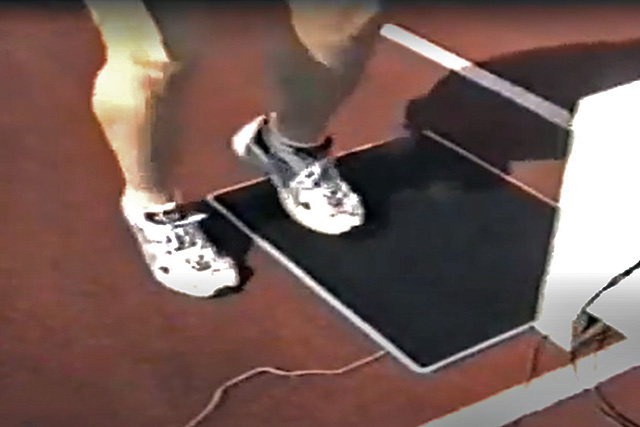
Athlete performing the foot tapping speed test on a timing mat
Test Procedure
Procedure: Stand with one foot on the timing mat and the other next to the mat. On the instruction to start, begin timing while the participant alternately lifts each foot off the ground, making as many foot taps as possible in 30 seconds. Arms should swing naturally at the sides to support the movement. Feet should only be lifted slightly during tapping—the goal is speed, not height. See a video of this test being performed.
Scoring: The number of foot taps in 30 seconds is recorded. Perform the test twice and record the best result. Each time a foot contacts the mat counts as one tap.
Performance Standards
The following table provides performance standards for the 30-second foot tapping speed test based on athletic populations:
| Rating | Taps (30 sec) | Frequency (taps/sec) | Description |
|---|---|---|---|
| Elite | 100+ | 3.33+ | National/professional athlete level |
| Excellent | 90-99 | 3.00-3.29 | Competitive athlete standard |
| Above Average | 75-89 | 2.50-2.96 | Good athletic ability |
| Average | 60-74 | 2.00-2.46 | General fitness population |
| Below Average | <60 | <2.00 | May benefit from coordination training |
Note: Research with soccer players (Makhlouf et al., 2022) found that national-level players demonstrated significantly higher tapping scores than regional-level players, with average frequencies around 8.35 taps per second in a 4-second standing protocol. The 30-second seated alternating protocol used here produces different absolute values but follows similar performance patterns.
Target Population and Sport Applications
The foot tapping speed test is suitable for sports in which fast foot movements are required:
- Tennis - Quick lateral movements and split-step timing
- Basketball - Defensive shuffling and rapid direction changes
- Soccer/Football - Ball control, dribbling, and defensive positioning
- Badminton - Court coverage and rapid footwork
- Table Tennis - Quick stance adjustments and weight transfers
- Boxing/Martial Arts - Stance changes and evasive movements
- Volleyball - Defensive positioning and approach steps
- Squash/Racquetball - Court coverage and recovery movements
How to Improve Foot Tapping Speed
Athletes can improve their foot tapping speed through targeted training methods that develop neuromuscular coordination and fast-twitch muscle fiber activation:
Agility Ladder Drills
Practice various ladder patterns including in-in-out-out, lateral shuffles, and ickey shuffle. Start slowly for accuracy, then progressively increase speed while maintaining form.
Jump Rope Training
Jump rope develops foot speed, timing, and coordination. Progress from basic two-foot jumps to alternating feet, double-unders, and high-knee variations.
Plyometric Training
Include exercises such as ankle hops, quick feet drills, and small box jumps that emphasize rapid ground contact times rather than height.
Sport-Specific Movement Patterns
Practice the quick footwork patterns specific to your sport, such as defensive slides for basketball, split-step drills for tennis, or shuffle patterns for soccer.
Regular Test Practice
Perform the foot tapping test itself as a training exercise. Research shows familiarization improves scores, with significant differences between first visits and subsequent attempts.
Frequently Asked Questions
What is a good foot tapping test score?
For the 30-second foot tapping test, elite athletes typically achieve 100+ taps (3.33+ taps per second). Scores of 90-99 taps are excellent, 75-89 are above average, 60-74 are average, and below 60 may indicate room for improvement. These standards vary based on sport and competition level.
How do you perform the foot tapping speed test?
Stand with one foot on a timing mat and the other beside it. On the start signal, alternately lift each foot off the ground as quickly as possible, tapping on the mat for 30 seconds. Count the total taps completed. Perform two trials and use the best result. Keep feet low during tapping—speed is more important than height.
What sports benefit from good foot tapping speed?
Sports requiring quick foot movements benefit most, including tennis, basketball, soccer, badminton, table tennis, boxing, martial arts, volleyball, and racquet sports. Fast foot speed is essential for rapid direction changes, defensive positioning, court coverage, and reactive movements.
How can I improve my foot tapping speed?
Improve foot speed through agility ladder drills, jump rope exercises, plyometric training, and sport-specific footwork patterns. Practice the foot tapping test regularly to develop neuromuscular coordination. Focus on quick ground contacts rather than high knee lifts during training.
Is the foot tapping test reliable?
Yes, research confirms high reliability. Pribble et al. (2021) found test-retest reliability exceeding 0.90 (Pearson's R) and inter-rater reliability above 0.80 (ICC). The test produces consistent results when performed under standardized conditions with proper warm-up and familiarization.
Does dominant foot affect the test results?
Research by Hinman (2019) showed slightly higher tap counts (approximately 2 taps more) with the dominant foot compared to non-dominant. However, the alternating foot protocol used in this test involves both legs equally, minimizing this effect.
Should I wear shoes during the test?
Research indicates slightly higher tap counts (about 2 taps) when wearing shoes compared to barefoot. For consistency, perform all tests with the same footwear. Athletic shoes appropriate for your sport are typically recommended.
References
- Pribble, B.A., Larson, D.J., Black, C.D., et al. (2021). "An evaluation of the reliability of the foot-tapping test in a healthy sample." Journal of Electromyography and Kinesiology, 59, 102563.
- Makhlouf, I., et al. (2022). "A Simple Field Tapping Test for Evaluating Frequency Qualities of the Lower Limb Neuromuscular System in Soccer Players." International Journal of Environmental Research and Public Health, 19(7), 3792.
- Hinman, M. (2019). "Validity and reliability of a 10-second foot-tap test in older adults." MOJ Gerontology & Geriatrics, 4(1), 42-46.
- Numasawa, T., et al. (2012). "Foot Tapping Test as Part of Routine Neurologic Examination in Degenerative Compression Myelopathies." Spine Surgery and Related Research.
- Raghavendran, K., et al. (2015). "Foot tapping test for assessment of corticospinal tract involvement." Journal of Clinical Neuroscience.
- Wood, R. (2021). "Foot Tapping Speed Fitness Test." Topend Sports.
Similar Tests
- Quick Feet Test — run along a ladder placing a foot in each space
- Plate Tapping Test — move the hand back and forth between discs as quickly as possible
- Quick Strike Test — punch a boxing bag as fast and as hard as possible for a set time
Related Pages
 Any comments, suggestions, or corrections? Please let us know.