Arm Flexed Girth Calculator
Quick Answer
This calculator determines your flexed arm girth percentile ranking using CDC anthropometric reference data, and optionally calculates upper arm muscle area using the validated Heymsfield formula.
- Average flexed arm size: 14.6 inches (37.1 cm) for men, 13.4 inches (34.0 cm) for women
- Based on NHANES population data adjusted for muscle contraction (~5-10% increase over relaxed)
- Includes sport-specific comparisons for athletes, bodybuilders, and fitness enthusiasts
Girths are circumference measures at standard anatomical sites around the body. The flexed arm girth measurement, also known as flexed bicep circumference, is a measure of the circumference of the upper arm when the biceps is maximally contracted. This measurement is commonly used by bodybuilders, strength athletes, and fitness enthusiasts to track muscle development. See the list of girth measurement locations for other anthropometric sites.
How to Use the Arm Flexed Girth Calculator
Follow these steps to calculate your flexed arm girth percentile and muscle area:
- Measure Your Flexed Arm: Raise your arm horizontally, bend at the elbow (approximately 45 degrees), and flex your biceps as hard as possible. Wrap a flexible tape measure around the largest point of your upper arm.
- Enter Your Data: Input your flexed arm measurement in centimeters or inches, along with your age and gender for accurate percentile calculation.
- Optional - Triceps Skinfold: For upper arm muscle area estimation, enter your triceps skinfold measurement (requires skinfold calipers).
- View Results: Click "Calculate" to see your percentile ranking, category classification, and athletic comparisons.
Pro Tip: For consistent tracking, always measure at the same time of day (morning is ideal) and use the same technique. Flexed measurements should be taken "cold" (not immediately after training) for accurate comparisons.
What is Arm Flexed Girth?
Arm flexed girth (or flexed bicep circumference) is the measurement of your upper arm's total circumference when the biceps muscle is maximally contracted. This measurement includes the biceps brachii, triceps brachii, brachialis, and surrounding tissues.
Unlike the relaxed arm measurement taken at the mid-upper arm with muscles at rest, the flexed measurement captures the muscle at its largest state and is the standard used in bodybuilding and strength sports for tracking arm development.
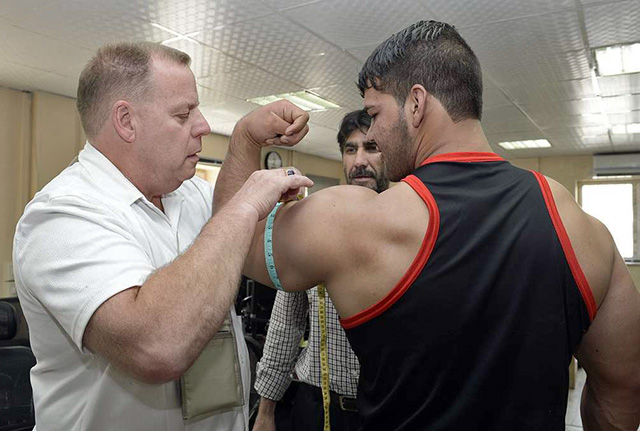
Measuring flexed biceps girth at the point of maximum circumference
Why Measure Flexed Arm Girth?
- Track Muscle Growth: Monitor hypertrophy progress from resistance training programs
- Assess Symmetry: Compare left and right arm development to identify imbalances
- Sport Classification: Some sports use arm measurements for weight class or body type categorization
- Body Composition: Combined with skinfold data, estimate muscle versus fat mass in the upper arm
The Science Behind the Calculations
Percentile Calculation
The percentile rankings in this calculator are based on CDC NHANES anthropometric reference data, adjusted for the typical 5-10% increase observed when flexing versus relaxed measurements. This data represents population norms for American adults and provides a reliable benchmark for comparison.
Upper Arm Muscle Area Formula
When triceps skinfold is provided, the calculator uses the Heymsfield corrected formula to estimate bone-free upper arm muscle area:
Corrected AMA (women) = [(MAC - π × TSF)² / 4π] - 6.5
Where:
- AMA = Arm Muscle Area (cm²)
- MAC = Mid-Arm Circumference (cm) - we use flexed girth adjusted to mid-arm equivalent
- TSF = Triceps Skinfold Thickness (cm)
- Correction factor = 10 cm² for men, 6.5 cm² for women (accounts for bone cross-sectional area)
This formula was validated against computed tomography measurements by Heymsfield et al. and provides approximately ±7-8% accuracy for most individuals.
Flexed to Relaxed Conversion
Research indicates that flexed arm measurements are typically 5-10% larger than relaxed measurements. This calculator estimates your relaxed arm girth using a 7.5% average conversion factor, useful for comparing against medical or clinical standards that use relaxed mid-arm circumference.
Average Arm Size by Age and Gender
Understanding average arm sizes helps contextualize your measurements. The following data is based on CDC/NHANES anthropometric surveys, adjusted for flexed measurements:
Average Flexed Arm Size for Men
| Age Group | Average Flexed (inches) | Average Flexed (cm) |
|---|---|---|
| 20-29 years | 14.6 | 37.1 |
| 30-39 years | 15.2 | 38.6 |
| 40-49 years | 15.4 | 39.1 |
| 50-59 years | 14.9 | 37.8 |
| 60-69 years | 14.5 | 36.8 |
| 70+ years | 13.6 | 34.5 |
Average Flexed Arm Size for Women
| Age Group | Average Flexed (inches) | Average Flexed (cm) |
|---|---|---|
| 20-29 years | 13.4 | 34.0 |
| 30-39 years | 13.8 | 35.1 |
| 40-49 years | 14.1 | 35.8 |
| 50-59 years | 13.9 | 35.3 |
| 60-69 years | 13.5 | 34.3 |
| 70+ years | 12.5 | 31.8 |
Sport-Specific Arm Size Standards
Different sports have varying arm size expectations based on the demands of the activity:
Strength Sports
- Natural Bodybuilders: 16-18 inches (40.6-45.7 cm) for competitive amateurs
- Powerlifters: Variable, often 16-19 inches depending on weight class
- Olympic Weightlifters: Typically 15-17 inches, with emphasis on shoulder and leg development
Team Sports
- NFL Players: Linemen average 17-19 inches; skill positions 14-16 inches
- NBA Players: Guards 14-15 inches; forwards/centers 15-17 inches
- Rugby Players: Forwards typically 16-18 inches; backs 14-16 inches
Combat Sports
- Boxers: Variable by weight class, typically lean with 13-16 inches
- MMA Fighters: Similar range, 14-17 inches for heavier weight classes
- Wrestlers: Often 15-17 inches with lower body fat
How to Improve Your Arm Size
If your goal is to increase flexed arm girth, consider these evidence-based strategies:
Training Recommendations
- Progressive Overload: Gradually increase weight, volume, or frequency over time
- Compound Movements: Chin-ups, rows, and pressing movements build overall arm mass
- Isolation Work: Bicep curls, tricep extensions, and hammer curls for targeted development
- Volume: Research suggests 10-20 sets per muscle group per week for optimal hypertrophy
- Triceps Focus: The triceps comprise approximately 60% of upper arm mass - don't neglect them
Nutrition Considerations
- Caloric Surplus: Building muscle requires adequate energy intake (200-500 calories above maintenance)
- Protein Intake: 1.6-2.2g per kg bodyweight daily for muscle protein synthesis
- Recovery: Adequate sleep (7-9 hours) and rest days between arm training sessions
Test Procedure
Purpose: To measure the circumference of the arm when flexed, providing a measure of the underlying musculature and adipose tissue. Girth measurements combined with skinfold measurements can give a clearer picture of changes in tissue composition and distribution of muscle and fat.
Equipment required: Flexible metal tape measure and pen suitable for marking the skin. If a plastic or cloth tape is used, it should be checked regularly against a metal tape as they may stretch over time.
Pre-test: Explain the test procedures to the subject. Prepare forms and record basic information such as age, height, body weight, gender. See more details of pre-test procedures.
Procedure: This girth measurement is usually taken on the right side of the body. The arm is raised to a horizontal position in the sagittal (forward) plane, with the elbow at about 45 degrees. The subject maximally contracts the biceps muscle, and the largest circumference is measured. When recording, you need to make sure the tape is not too tight or too loose, is lying flat on the skin, and is kept horizontal. The maximal girth is not always obvious, and the tape may need to be moved along to find the point of maximum circumference.
Reliability: Factors that may affect reliability include changes to the testing personnel, constant and even tension on the tape, and correct landmarking (finding the correct anatomical site for measurement).
Advantages: Low costs involved in the testing procedure, can be performed anywhere, and provides immediate feedback on arm development.
Comments: Clothing over the site should be removed if possible to make sure measuring tape is positioned correctly and that the correct circumference is determined.
Frequently Asked Questions
What is the average flexed arm size for men?
Based on CDC anthropometric data adjusted for flexion, the average flexed arm size for adult men aged 20-29 is approximately 14.6 inches (37.1 cm). This increases to about 15.2 inches for men in their 30s-40s before gradually declining with age. Natural lifters who train consistently can expect to develop 16-17 inch arms over several years.
How do you measure flexed arm girth correctly?
Raise your arm horizontally in the forward plane with the elbow bent at about 45 degrees. Maximally contract the biceps muscle by making a fist and flexing hard. Wrap a flexible tape measure around the largest circumference of the upper arm. The tape should be snug but not compressing the muscle. Take measurements "cold" (not after training) for consistency.
What is considered big arms for a man?
For natural athletes, 16-inch flexed arms are considered above average and impressive. Arms measuring 17-18 inches represent advanced development typically achieved after years of consistent training. Professional bodybuilders may achieve 20+ inches, though this often involves pharmaceutical assistance. Context matters - height, body fat, and frame size all affect how arm size appears.
What is the difference between relaxed and flexed arm measurements?
Flexed arm measurements are typically 5-10% larger than relaxed measurements. For example, a 13.5-inch relaxed arm typically measures around 14.5-15 inches when flexed. Bodybuilders and athletes typically report flexed measurements, while medical assessments often use relaxed mid-arm circumference (MUAC) for nutritional status.
How can I calculate my upper arm muscle area?
Upper arm muscle area is calculated using the Heymsfield formula: AMA = (MAC - π × TSF)² / (4π) - correction factor. This requires measuring both arm circumference and triceps skinfold thickness with calipers. The correction factor is -10 cm² for men and -6.5 cm² for women to account for bone area. Our calculator performs this calculation automatically when you enter a triceps skinfold value.
How often should I measure my arm girth?
For tracking training progress, measure every 4-8 weeks. More frequent measurements may not show meaningful changes and can be discouraging. Always measure at the same time of day, using the same technique, and ideally on the same arm. Natural muscle growth is gradual - expect 0.5-1 inch of growth per year with optimal training and nutrition.
Why are my arms different sizes?
Asymmetry of up to 0.5 inches between arms is normal and common. This can result from handedness (dominant arm often slightly larger), past injuries, or unilateral training habits. If asymmetry exceeds 1 inch or is rapidly changing, consider evaluation for underlying causes. You can address minor imbalances with unilateral exercises starting with your weaker arm.
Disclaimer: This calculator provides estimates for educational and fitness tracking purposes only. Results should not replace professional medical advice. The percentile data is based on US population norms and may not apply to all populations. Individual results may vary based on factors not included in this calculation. Consult with a qualified healthcare provider or certified fitness professional for personalized assessment.
References
- Fryar CD, Gu Q, Ogden CL. (2021). "Anthropometric reference data for children and adults: United States, 2015-2018." National Center for Health Statistics. Vital Health Stat 3(46).
- Heymsfield SB, McManus C, Smith J, Stevens V, Nixon DW. (1982). "Anthropometric measurement of muscle mass: revised equations for calculating bone-free arm muscle area." American Journal of Clinical Nutrition, 36(4):680-90.
- Rolland-Cachera MF, Brambilla P, Manzoni P, et al. (1997). "Body composition assessed on the basis of arm circumference and triceps skinfold thickness: a new index validated in children by magnetic resonance imaging." American Journal of Clinical Nutrition, 65(6):1709-13.
- Frisancho AR. (1981). "New norms of upper limb fat and muscle areas for assessment of nutritional status." American Journal of Clinical Nutrition, 34(11):2540-5.
- Norton K, Olds T. (1996). Anthropometrica: A Textbook of Body Measurement for Sports and Health Courses. UNSW Press.
- Ostchega Y, Dillon C, Carroll M, Prineas RJ, McDowell M. (2004). "Estimating equations and tables for adult mid-arm circumference based on measured height and weight." Blood Pressure Monitoring, 9(3):123-131.
- Lohman TG, Roche AF, Martorell R. (1988). Anthropometric Standardization Reference Manual. Human Kinetics Books.
Similar Tests
- See the similar relaxed arm girth measurement
Related Pages
- General description of taking girth measurements, and links to other girth measures.
- Using MyoTape for girth measurement.
- A discussion about Body Size Testing
- Other anthropometric tests
- Videos of Anthropometric Tests
 Any comments, suggestions, or corrections? Please let us know.