Mid-Thigh Girth Calculator
Quick Answer
This calculator determines your mid-thigh circumference classification and compares it to athletic population norms. Enter your measurement in centimeters or inches to see how your thigh development compares to athletes in various sports.
- Converts between metric (cm) and imperial (inches) instantly
- Based on ISAK anthropometric standards
- Compares to sport-specific athletic norms
Girths are circumference measures at standard anatomical sites around the body. The mid-thigh girth measurement is a circumference measure around the middle of the thigh, providing valuable data about muscular development of the quadriceps and hamstrings. See the list of girth measurement locations for other common anthropometric sites used in athletic assessment.
Purpose of Mid-Thigh Girth Measurement
Purpose: To measure the circumference of the thigh, as a measure of the underlying musculature and adipose tissue. Girth measurements combined with skinfold measurements can give a clearer picture of changes in tissue composition and distribution of muscle and fat. For athletes, tracking mid-thigh girth over time helps monitor the effectiveness of strength training programs and identify muscular asymmetries between limbs.
Equipment Required
Equipment required: Flexible metal tape measure and pen suitable for marking the skin. If a plastic or cloth tape is used, it should be checked regularly against a metal tape as they may stretch over time. ISAK recommends Lufkin steel tapes for standardized measurements. A measurement box or platform can help position the tester at an appropriate height.
Pre-Test Procedures
Pre-test: Explain the test procedures to the subject. Prepare forms and record basic anthropometric information such as age, height, body weight, and gender. Athletes should avoid training the lower body immediately before testing, as acute muscle swelling (pump) can temporarily increase girth measurements by 1-3 cm. See more details of pre-test procedures.
Measurement Procedure
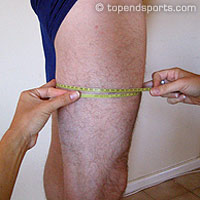
Procedure: First mark the site to be measured. This girth measurement is usually taken on the right side of the body following ISAK protocols. The subject stands erect with their weight evenly distributed on both feet and legs slightly parted. The circumference measure is taken at the level of the mid-point on the lateral (outer side) surface of the thigh, midway between the trochanterion (top of the thigh bone, femur) and tibiale laterale (top of the tibia bone). When recording, you need to make sure the tape is not too tight or too loose, is lying flat on the skin, and the tape held horizontal.
Test Reliability and Accuracy
Reliability: Factors that may affect reliability include changes to the testing personnel, constant and even tension on the tape, and correct landmarking (finding the correct anatomical site for measurement). Technical error of measurement (TEM) for trained practitioners is typically 0.5-1.0 cm, representing excellent reliability for tracking longitudinal changes in athletes.
Advantages of This Test
Advantages: Low costs involved in the testing procedure, ease of self testing, non-invasive assessment method, quick administration time (under 2 minutes), and high reliability when standardized protocols are followed. The measurement provides valuable data for tracking training adaptations without requiring expensive equipment.
Additional Comments
Comments: Clothing over the site should be removed if possible to make sure the measuring tape is positioned correctly and that the correct circumference is determined. It may help to have the subject stand on a box to make the measurement easier. Athletes should be measured at the same time of day and under similar hydration conditions for accurate comparisons over time.
Understanding Athletic Thigh Girth Norms
Mid-thigh girth varies considerably across different sports based on the specific physical demands and training adaptations required. Power athletes such as sprinters, weightlifters, and football players typically display larger thigh circumferences due to the emphasis on explosive lower body strength. Endurance athletes like marathon runners and cyclists may have more moderate measurements despite excellent muscular endurance.
| Sport Category | Male Range (cm) | Female Range (cm) | Primary Muscle Emphasis |
|---|---|---|---|
| Powerlifting/Weightlifting | 60-72 | 55-65 | Quadriceps, Glutes |
| Sprinting/Track | 56-66 | 52-60 | Fast-twitch development |
| Rugby/American Football | 58-70 | 54-62 | Power and stability |
| Soccer/Basketball | 52-60 | 48-56 | Balanced development |
| Cycling | 54-64 | 50-58 | Quadriceps endurance |
| Distance Running | 46-54 | 44-50 | Lean muscle mass |
Tracking Changes Over Time
For athletes engaged in hypertrophy or strength training programs, monthly measurements can help track progress. Expected muscle gain rates for the thighs are approximately 0.25-0.5 cm per month during effective training programs for intermediate athletes. Beginners may see faster initial gains, while advanced athletes typically see slower rates of change. Consistency in measurement technique and timing is essential for accurate trend analysis.
Measurement Frequency
Hypertrophy phase: Monthly measurements. Competition phase: Quarterly assessments. Off-season: Every 6-8 weeks.
Best Practices
Measure at the same time of day, under similar hydration status, and at least 48 hours after lower body training.
Bilateral Comparison
Measure both legs to identify asymmetries. Differences greater than 2 cm may indicate muscle imbalances requiring attention.
Factors Affecting Thigh Girth
Several factors influence mid-thigh circumference beyond training status:
- Genetics: Muscle fiber type distribution and insertion points affect potential for muscular development
- Training History: Years of resistance training create cumulative adaptations
- Body Composition: Both muscle mass and subcutaneous fat contribute to circumference
- Hydration Status: Dehydration can reduce measurements by 1-2%
- Time of Day: Evening measurements tend to be slightly larger due to daily activity
- Recent Training: Acute muscle swelling post-exercise temporarily increases girth
Frequently Asked Questions
What is a good mid-thigh girth for athletes?
For male athletes, a mid-thigh girth of 52-68 cm is typical, with elite strength athletes often exceeding 60 cm. Female athletes typically range from 48-64 cm, depending on their sport and training focus. The optimal measurement depends on your specific sport requirements and body composition goals.
How do I measure my mid-thigh girth accurately?
Stand with weight evenly distributed on both feet. Find the midpoint between the hip joint (greater trochanter) and the top of the knee (tibiale laterale) on the outer thigh. Wrap a flexible tape measure around the thigh at this point, keeping it horizontal and snug without compressing the skin. Record the measurement in centimeters.
Why is mid-thigh girth important for athletic performance?
Mid-thigh girth reflects quadriceps and hamstring muscle mass, which are crucial for power, speed, jumping ability, and overall athletic performance. Tracking changes helps monitor training adaptations, identify muscular development, and assess body composition changes over time.
How often should athletes measure thigh girth?
For athletes in hypertrophy or strength training phases, monthly measurements are recommended to track progress. During competition phases, quarterly measurements are sufficient. Always measure at the same time of day, under similar hydration conditions, and at least 48 hours after lower body training for consistent results.
What is the difference between mid-thigh and upper thigh girth?
Mid-thigh girth is measured at the midpoint of the thigh, while upper thigh (gluteal thigh girth) is measured just below the gluteal fold. Mid-thigh measurements better reflect quadriceps development specifically, while upper thigh measurements include more gluteal and hip musculature contribution.
Can I use mid-thigh girth to track muscle gain?
Yes, mid-thigh girth is an excellent metric for tracking lower body muscle development. Combined with skinfold measurements, you can differentiate between muscle gain and fat changes. Expect increases of 0.25-0.5 cm per month during effective hypertrophy programs for intermediate athletes.
Should I measure both legs?
Yes, measuring both legs helps identify asymmetries that may indicate muscle imbalances or injury risk. A difference greater than 2 cm between legs warrants attention and may require targeted training interventions or physiotherapy assessment.
References
- Norton, K., & Olds, T. (1996). "Anthropometrica: A textbook of body measurement for sports and health courses." UNSW Press.
- Stewart, A., Marfell-Jones, M., Olds, T., & de Ridder, H. (2011). "International Standards for Anthropometric Assessment." ISAK.
- Heyward, V.H., & Wagner, D.R. (2004). "Applied Body Composition Assessment." Human Kinetics.
- Ackland, T.R., et al. (2012). "Current status of body composition assessment in sport." Sports Medicine, 42(3), 227-249.
- Withers, R.T., Craig, N.P., Bourdon, P.C., & Norton, K.I. (1987). "Relative body fat and anthropometric prediction of body density of male athletes." European Journal of Applied Physiology, 56(2), 191-200.
- ACSM. (2021). "ACSM's Guidelines for Exercise Testing and Prescription." Wolters Kluwer, 11th Edition.
- Lohman, T.G., Roche, A.F., & Martorell, R. (1988). "Anthropometric Standardization Reference Manual." Human Kinetics.
Similar Tests
Related Pages
Girth Measurements
General description of taking girth measurements and links to other anatomical sites.
View Girth Guide →MyoTape Tool
Using the MyoTape device for easy self-measurement of body circumferences.
Learn More →Body Size Testing
Discussion about body size testing methods and their applications in sports.
Read Article →Anthropometric Tests
Complete overview of anthropometric assessment methods for athletes.
Explore Tests → Any comments, suggestions, or corrections? Please let us know.