Goniometer ROM Calculator
Quick Answer
This goniometer ROM calculator compares your measured joint angles against established normative values. Enter your goniometer reading to instantly see if your range of motion is within normal limits for athletic populations.
- Compares measurements to ACSM and sports medicine standards
- Covers all major joints: shoulder, hip, knee, ankle, spine, and more
- Provides athletic context and training recommendations
What is a Goniometer?
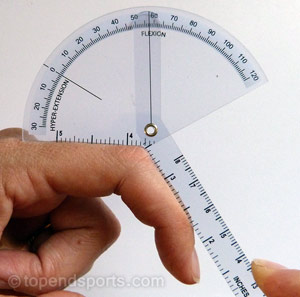
A goniometer is a tool for measuring the range of motion of various joints around the body. It consists of two arms connected at a fulcrum (pivot point), with a protractor scale that displays the angle between the arms. Another instrument that can be used to measure flexibility is the flexometer.
Test Purpose
The aim of this test is to measure the flexibility of a joint, which is important for injury prevention and execution of many sporting movements.
Equipment Required
Goniometer (standard or digital). There is also a goniometer phone app available.
Accuracy
±5° with trained assessor using standardized positioning and anatomical landmarks.
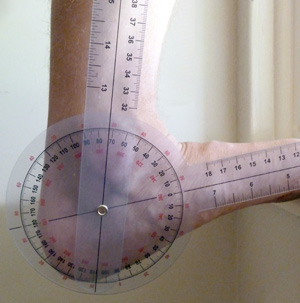
How to Use a Goniometer for ROM Testing
Pre-Test Procedures
Explain the test procedures to the subject. Prepare forms and record basic information such as age, height, body weight, gender. See more details of pre-test procedures.
Measurement Procedure
To measure the range of motion at a joint, the center of the goniometer is positioned at the axis of rotation of a joint, and the arms of the goniometer are aligned with the long axis of the bones of the adjacent segments or to an external reference.
Follow these steps for accurate goniometer measurement:
- Position the subject correctly - Ensure proper starting position for the joint being measured
- Identify anatomical landmarks - Locate bony prominences for consistent arm placement
- Align the stationary arm - Position along the proximal (closer to body) bone segment
- Align the moveable arm - Position along the distal (farther from body) bone segment
- Record the starting angle - Note the initial position (usually 0° for most joints)
- Move through full ROM - Have subject actively or passively move to end range
- Record the ending angle - Read the final angle from the goniometer scale
Scoring
The measurement is the angle in degrees as read off the goniometer. Range of motion is typically expressed as the difference between starting and ending positions, or as the final angle achieved from anatomical position.
Disadvantages and Limitations
It is sometimes difficult to position and maintain the arms of the goniometer along the bones of the segments throughout the measurement, and the axis of rotation is not always clear, especially for complex joints. To improve reliability:
- Use consistent anatomical landmarks
- Have the same tester perform repeated measurements
- Average multiple trials (typically 3 measurements)
- Ensure proper warm-up before testing
Pro Tip: For athletic populations, always compare bilateral measurements. A difference of more than 10° between left and right sides may indicate asymmetry that could increase injury risk.
Normal Range of Motion Values for Athletes
The following table provides normal ROM values based on American College of Sports Medicine (ACSM) guidelines and sports medicine research. Athletes may display sport-specific adaptations that fall outside these ranges.
| Joint | Movement | Normal Range | Athletic Considerations |
|---|---|---|---|
| Shoulder | Flexion | 150-180° | Swimmers, throwers need upper range |
| Abduction | 150-180° | Essential for overhead athletes | |
| External Rotation | 80-100° | Throwing arm often exceeds normal | |
| Hip | Flexion | 110-130° | Sprinters, hurdlers need full range |
| Extension | 10-30° | Critical for running mechanics | |
| Internal Rotation | 30-45° | Often limited in runners | |
| Knee | Flexion | 130-150° | Full squat depth requires 140°+ |
| Extension | 0-10° | Hyperextension common in gymnastics | |
| Ankle | Dorsiflexion | 10-20° | Critical for squat mechanics |
| Plantarflexion | 40-55° | Important for jumping, sprinting |
Sport-Specific ROM Requirements
Different sports place varying demands on joint flexibility. Understanding these requirements helps athletes and coaches set appropriate flexibility goals.
Throwing Sports
Baseball, softball, cricket, and javelin athletes typically develop increased shoulder external rotation (often 110-130°) with decreased internal rotation. This is a functional adaptation but should be monitored.
Swimming
Swimmers require exceptional shoulder flexibility (180° flexion), ankle plantarflexion (55-65°), and thoracic rotation. Limited ROM can reduce stroke efficiency.
Gymnastics
Gymnasts often display hypermobility in multiple joints. While beneficial for skills, excessive mobility without adequate strength control increases injury risk.
Running Sports
Sprinters need hip extension (25-30°) and hip flexor mobility. Distance runners benefit from adequate hip internal rotation and ankle dorsiflexion for efficient gait.
Weightlifting
Olympic lifters require excellent ankle dorsiflexion (15-20°), hip flexion (130°+), and overhead shoulder mobility for proper squat and overhead positions.
Combat Sports
Martial artists need hip abduction and external rotation for kicks, along with thoracic rotation for striking. BJJ athletes require overall joint mobility.
"Flexibility testing with a goniometer provides objective data that helps identify limitations before they become injuries. Regular ROM assessment should be part of every athlete's monitoring program, especially during periods of high training load or when returning from injury."— Robert J. Wood, PhD, Founder of Topend Sports
Fitness Tests That Use a Goniometer
- Straight Leg Raise - Hamstring and hip flexion assessment
- Flex 90/90 Hamstring Flexibility Test - Specific hamstring length test
- Modified Thomas Test - Hip flexor and quadriceps flexibility
- Straight leg lift abdominal strength test - Core stability assessment
How to Improve Your Range of Motion
If your goniometer measurements reveal limited flexibility, consider these evidence-based strategies:
For Limited ROM
- Static stretching - Hold stretches for 30-60 seconds, 2-4 repetitions per muscle group
- PNF techniques - Proprioceptive neuromuscular facilitation provides faster gains
- Foam rolling - Self-myofascial release before stretching can enhance results
- Dynamic warm-up - Include movement through full ROM before training
- Eccentric training - Loaded stretching builds strength at end range
For Hypermobility
- Strength training - Build muscle control throughout full ROM
- Stability exercises - Improve joint control at end ranges
- Avoid over-stretching - Focus on control rather than increasing ROM
- Proprioceptive training - Enhance body awareness and joint position sense
Frequently Asked Questions
What is a goniometer used for in sports?
A goniometer is used to measure joint range of motion (ROM) in athletes. It helps identify flexibility limitations that may affect performance or increase injury risk, and tracks progress during rehabilitation or flexibility training programs. Regular ROM testing is essential for injury prevention and monitoring training effects.
How accurate is goniometer measurement?
Goniometer measurements typically have an accuracy of ±5 degrees when performed by trained professionals. Reliability improves with standardized positioning, consistent anatomical landmarks, and averaging multiple measurements. Digital goniometers may offer improved precision.
What is normal range of motion for the shoulder?
Normal shoulder ROM includes flexion of 150-180°, extension of 40-60°, abduction of 150-180°, internal rotation of 60-90°, and external rotation of 80-100°. Athletes in throwing sports often develop asymmetrical ROM due to sport-specific adaptations, which should be monitored but is generally considered normal.
How do you read a goniometer correctly?
Position the goniometer's fulcrum at the joint axis of rotation, align the stationary arm with the proximal bone segment, and the moveable arm with the distal segment. Read the angle where the moveable arm crosses the scale. Always record both starting and ending positions for accurate ROM calculation.
What causes limited range of motion in athletes?
Limited ROM in athletes can result from muscle tightness, joint capsule restrictions, scar tissue from injuries, bony abnormalities, or sport-specific muscle imbalances. Training adaptations, poor posture, and inadequate stretching programs also contribute to reduced flexibility.
How often should athletes test their flexibility?
Athletes should assess key ROM measures monthly during training and weekly during rehabilitation. Pre-season screening establishes baselines, while regular monitoring identifies developing restrictions before they cause injury or performance decline.
Can you use a phone app instead of a goniometer?
Yes, goniometer phone apps use the device's accelerometer to measure angles. While convenient, they may have slightly lower accuracy than physical goniometers. Apps work best for joints where the phone can be placed directly on the limb segment.
References
- American College of Sports Medicine. (2021). "ACSM's Guidelines for Exercise Testing and Prescription." 11th Edition. Wolters Kluwer.
- Norkin, C.C., & White, D.J. (2016). "Measurement of Joint Motion: A Guide to Goniometry." 5th Edition. F.A. Davis Company.
- Magee, D.J. (2014). "Orthopedic Physical Assessment." 6th Edition. Elsevier Saunders.
- Clarkson, H.M. (2012). "Musculoskeletal Assessment: Joint Motion and Muscle Testing." 3rd Edition. Lippincott Williams & Wilkins.
- Reese, N.B., & Bandy, W.D. (2016). "Joint Range of Motion and Muscle Length Testing." 3rd Edition. Elsevier.
- Kendall, F.P., et al. (2005). "Muscles: Testing and Function with Posture and Pain." 5th Edition. Lippincott Williams & Wilkins.
- Wilk, K.E., et al. (2011). "Shoulder Range of Motion in Professional Baseball Pitchers." American Journal of Sports Medicine, 39(2), 329-335.
- Myer, G.D., et al. (2014). "Injury Risk in Youth Athletes." Sports Health, 6(5), 384-391.
Related Pages
- Buy a goniometer
- There is a goniometer phone app
- More flexibility tests
- about flexibility testing
- See also the flexibility exercises on this list of stretches
 Any comments, suggestions, or corrections? Please let us know.