Standing Height (Stature) Measurement Calculator
Quick Answer
This calculator converts standing height measurements between metric and imperial units while comparing your stature to sport-specific athletic norms.
- Converts using ISO standard: 1 inch = 2.54cm exactly
- Compares height to averages for 10+ sports including basketball, volleyball, gymnastics
- Provides percentile rankings within athletic populations
The measurement of height, from the feet to the top of the head, is a standard component of most fitness assessments. Height (or lack of height) is an important attribute for many sports, influencing everything from position selection in team sports to weight class advantages in combat sports.
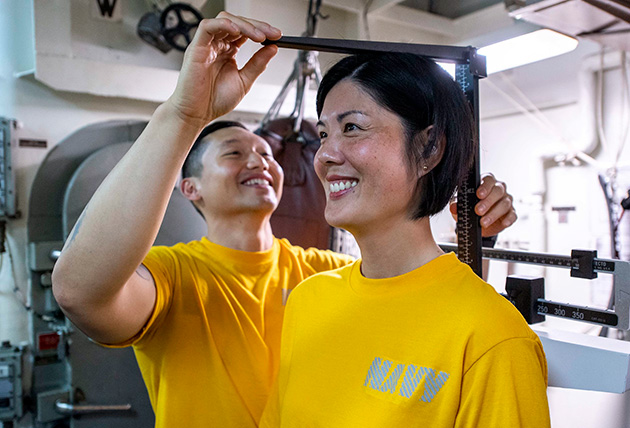
Measuring height with proper technique using a wall-mounted stadiometer
Standing Height Measurement Protocol
Equipment required: Stadiometer (or steel ruler or tape measure placed against a wall). Wall-mounted stadiometers provide accuracy within ±2mm when properly calibrated. Portable units may vary by ±5mm depending on surface stability.
Procedure: Standing height is the measurement of the maximum distance from the floor to the highest point of the head, when the subject is facing directly ahead. Shoes should be off, feet together, and arms by the sides. Heels, buttocks and upper back should also be in contact with the wall when the measurement is made.
Reliability: Height measurement can vary throughout the day, usually being higher in the morning by 1-2cm due to spinal compression from gravitational forces. To ensure reliability, height should be measured at the same time of day, preferably within 2 hours of waking for maximum accuracy.
Advantages: This is a low cost and quick test to perform, requiring minimal equipment and training.
Pro Tip: For athletes requiring precise measurements, take a deep breath and hold briefly during measurement. This extends the spine to maximum natural length without artificial stretching.
Comment: If the subject is unable to stand, such as for infants and those with illness or injury, then recumbent length can be measured.
Height Standards in Professional Sports
Understanding height requirements across different sports helps athletes, coaches, and parents make informed decisions about sport selection and position specialization. Research by Robert J. Wood, PhD in Exercise Physiology from the University of Western Australia and founder of Topend Sports, indicates that height advantages vary dramatically by sport.
| Sport | Men's Average | Women's Average | Height Advantage |
|---|---|---|---|
| Basketball | 6'6" (198cm) | 6'0" (183cm) | Very High |
| Volleyball | 6'7" (201cm) | 6'1" (185cm) | Very High |
| Rowing | 6'4" (193cm) | 5'11" (180cm) | High |
| Swimming | 6'2" (188cm) | 5'9" (175cm) | Moderate-High |
| Tennis | 6'1" (185cm) | 5'8" (173cm) | Moderate |
| Soccer | 5'11" (180cm) | 5'6" (168cm) | Position-Dependent |
| Distance Running | 5'7" (170cm) | 5'3" (160cm) | Moderate (shorter) |
| Gymnastics | 5'5" (165cm) | 5'1" (155cm) | High (shorter) |
| Weightlifting | 5'6" (168cm) | 5'3" (160cm) | High (shorter) |
Data compiled by Robert Wood, PhD, shows that basketball and volleyball athletes are the tallest, averaging 6'6"-6'7" for men and 6'0"-6'1" for women. In contrast, gymnasts are among the shortest athletes at 5'5" (men) and 5'1" (women), where lower centers of gravity provide rotational control advantages.
Height Conversion Formulas
Accurate height conversions between metric and imperial systems are essential for international athletic competition, medical records, and equipment sizing. The calculator uses ISO standard conversion factors:
Centimeters to Feet and Inches:
Total Inches = Centimeters ÷ 2.54
Feet = Total Inches ÷ 12 (whole number)
Remaining Inches = Total Inches mod 12
Example: 180cm ÷ 2.54 = 70.87 inches = 5 feet 10.87 inches (≈ 5'11")
Feet and Inches to Centimeters:
Total Inches = (Feet × 12) + Inches
Centimeters = Total Inches × 2.54
Example: 5'10" = (5 × 12) + 10 = 70 inches × 2.54 = 177.8cm
Height Measurement Best Practices for Athletes
Accurate height measurement protocols ensure consistent data for training optimization and competition eligibility. Sports science research emphasizes standardized measurement techniques for reliable athletic assessments.
Measurement Timing and Conditions
Height fluctuates throughout the day due to spinal compression from gravitational forces. Morning measurements typically show 1-2cm greater height than evening measurements. For consistent athletic records:
- Optimal Timing: Measure within 2 hours of waking for maximum height
- Avoid Post-Training: Do not measure immediately after intense training involving spinal loading (squats, deadlifts, overhead pressing)
- Consistency: Always measure at the same time of day for longitudinal tracking
Body Position Requirements
- Stance: Stand against a flat wall with heels, buttocks, shoulders, and head touching the surface
- Feet: Together with weight distributed evenly
- Head Position: Look straight ahead with eyes level (Frankfort plane) - not tilted up or down
- Breathing: Take a deep breath and hold briefly during measurement
⚠️ Important: For official competition entry, always verify sport-specific measurement protocols. Some federations require certified officials, specific equipment, or multiple measurements for verification. Barefoot vs. athletic shoe protocols can create 1-3cm differences.
"Height measurement accuracy within ±2mm is achievable with proper technique and calibrated equipment. However, the most common errors occur from improper head positioning and failure to account for diurnal variation."— Robert J. Wood, MSc Sports Science, Founder of Topend Sports
Sport-Specific Height Applications
Basketball Position Requirements
According to sports science expert Robert Wood, who has analyzed sports performance data for over 25 years, basketball demonstrates the most dramatic height requirements among team sports:
- Point Guards: 6'1" to 6'3" (185-191cm) - Need agility and court vision over pure height
- Shooting Guards: 6'3" to 6'5" (191-196cm) - Balance of height and mobility
- Small Forwards: 6'5" to 6'8" (196-203cm) - Versatility required
- Power Forwards: 6'8" to 6'10" (203-208cm) - Height for rebounding
- Centers: 6'10" to 7'2" (208-218cm) - Maximum height for shot blocking and post play
Gymnastics Biomechanical Advantages
Gymnastics favors shorter athletes due to biomechanical principles. Research indicates optimal heights for different gymnastics disciplines:
- Women's Artistic: 4'9" to 5'3" (145-160cm) - Lower center of gravity enhances rotational control
- Men's Gymnastics: 5'4" to 5'8" (163-173cm) - Event-specific variations
- Rhythmic Gymnastics: 5'4" to 5'8" (163-173cm) - Longer lines preferred aesthetically
Swimming Height and Performance
Swimming performance correlates strongly with height and wingspan. Olympic swimmers demonstrate clear height patterns by stroke specialization:
- Sprint Freestyle: Men average 6'2" (188cm), women 5'9" (175cm)
- Distance Swimming: Slightly shorter builds averaging 6'0" (183cm) for men
- Butterfly: Often tallest swimmers - men averaging 6'4" (193cm) for maximum stroke length
Training Equipment and Height Considerations
Proper equipment sizing requires accurate height measurements and conversions, especially when working with international equipment specifications:
Strength Training Equipment
- Power Rack Safety Bars: Position at sternum height when squatting. For a 5'10" (178cm) athlete, this typically means 52-54 inches (132-137cm) from floor level
- Pull-up Bar Height: Standard installation is 8 feet (244cm), allowing 6'6" (198cm) athletes to hang with slight knee bend
- Olympic Barbell Rack Height: Adjustable systems accommodate 5'0" to 7'0" (152-213cm) athletes
Sport-Specific Equipment
- Basketball Hoops: Range from 8 feet (244cm) for youth to regulation 10 feet (305cm)
- Volleyball Nets: Men's regulation 243cm, women's 224cm
- Rowing Equipment: Sliding seats and oar lengths scale with athlete height
Frequently Asked Questions
What is the correct procedure for measuring standing height?
Stand barefoot with feet together, heels, buttocks, and upper back touching a wall. Look straight ahead with eyes level (Frankfort plane). Measure the maximum distance from floor to the highest point of the head using a stadiometer or wall-mounted ruler. Have the athlete take a deep breath and hold briefly during measurement.
Why does height vary throughout the day?
Height naturally decreases by 1-2cm throughout the day due to spinal compression from gravitational forces and normal daily activities. The intervertebral discs compress under body weight, reducing overall stature. Morning measurements typically show greater height than evening measurements, which is why athletic testing protocols recommend measuring at the same time of day.
What height is considered advantageous for basketball?
NBA players average 6'6" (198cm), significantly taller than the general population average of 5'9" (175cm). Centers typically exceed 6'10" (208cm), while point guards average 6'1"-6'3" (185-191cm). Height provides advantages for rebounding, shot blocking, and finishing at the rim.
How do you convert height from centimeters to feet and inches?
Divide centimeters by 2.54 to get total inches, then divide by 12 for feet. The remainder becomes inches. For example: 180cm ÷ 2.54 = 70.87 inches = 5 feet 10.87 inches, typically rounded to 5'11". The conversion factor is based on the ISO standard that 1 inch equals exactly 2.54 centimeters.
What sports favor shorter athletes?
Gymnastics optimizes for shorter athletes with lower centers of gravity - women average 5'1" (155cm), men 5'5" (165cm). Weightlifting, diving, and distance running also favor more compact builds. Shorter levers require less torque to rotate and provide biomechanical advantages in sports requiring body control and rotational movements.
Should I measure height before or after training?
Measure height in the morning before training for most accurate results. Height naturally decreases 1-2cm throughout the day due to spinal compression, with additional compression from weight training exercises affecting measurements. For longitudinal tracking, always measure at the same time of day.
How accurate is the height conversion calculator?
This calculator uses the ISO standard conversion of 1 inch = 2.54 centimeters exactly, providing accuracy within 0.01cm. Results are rounded to two decimal places for practical use while maintaining precision for athletic applications and equipment sizing.
References
- International Organization for Standardization. (2019). "ISO 80000-3:2019 Quantities and Units - Part 3: Space and Time." ISO Standards.
- Wood, R.J. (2025). "Athletic Height Measurement Protocols and Standards." TopEndSports.com.
- International Olympic Committee. (2024). "Olympic Athlete Database - Anthropometric Data." IOC Statistics Department.
- National Basketball Association. (2024-25). "Official Player Height and Weight Statistics." NBA.com Stats.
- International Gymnastics Federation. (2024). "Biomechanical Advantages in Artistic Gymnastics." FIG Technical Guidelines.
- World Swimming Association. (2024). "Anthropometric Data of Elite Swimmers by Stroke Specialization." Swimming Science Journal.
- National Strength and Conditioning Association. (2024). "Equipment Sizing Guidelines for Athletic Training." NSCA Guidelines.
- Sherar, L.B., et al. (2005). "Prediction of Adult Height Using Maturity-Based Cumulative Height Velocity Curves." Journal of Pediatrics.
Similar Tests
- Measuring peak height velocity
- Recumbent length
- Sitting height
- Standing reach
- Knee height
- Height to waist ratio measurement
Related Pages
 Any comments, suggestions, or corrections? Please let us know.