J.A.M. Intermittent Test Calculator
Quick Answer
The J.A.M. Intermittent Test Calculator evaluates your rugby and team sport fitness by interpreting your test duration against established standards. A minimum score of 12 minutes is required for RFU Touch Judge Panel qualification.
- Calculates fitness category from test duration instantly
- Based on RFU and team sport performance standards
- Validated for rugby referees and intermittent sport athletes
The J.A.M. Intermittent Test is a test developed to measure the intermittent fitness ability of team sport athletes. There is another somewhat similar test, the Yo-Yo Intermittent test. The test was created for Rugby Union players, though it is used rarely nowadays, instead the yoyo or beep tests are more popular.
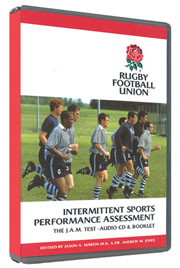
The J.A.M. Test uses a triangular course for walk-jog-run intervals
Test Purpose
The J.A.M. Test evaluates an individual's ability to repeatedly perform intervals over a prolonged period of time. This makes it particularly relevant for sports officials and players who must maintain intermittent high-intensity efforts throughout a match, such as rugby referees who need to keep pace with play while managing recovery between bursts of activity.
Equipment Required
To conduct the J.A.M. Intermittent Test, you need the following equipment: a flat, non-slip surface, marking cones, measuring tape, the JAM test audio CD (or equivalent audio file), a CD player or portable speaker, and recording sheets for documenting results.
Pre-Test Procedures
Before conducting the test, explain the test procedures thoroughly to participants. Perform health risk screening and obtain informed consent. Prepare recording forms and document basic information including age, height, body weight, gender, and test conditions. Measure and mark out the triangular test area using cones according to the official protocol. Allow participants adequate warm-up time and familiarization with the course layout. See more details of pre-test procedures.
Test Procedure
A full description of the test procedures is available with the audio CD and associated instruction booklet. Cones need to be set out in a triangular circuit, with sides of different lengths to create varied running distances. The test involves a series of walk–jog–run shuttles where participants loop around the triangle continuously.
The movement pattern follows a specific sequence: running, then walking, then jogging, in that order around the circuit. Approximately every 2 minutes, the run segment is replaced with a maximal 12-meter sprint bout to test high-intensity capacity. The test continues around the triangular circuit with participants keeping time with a series of audio signals. The time between beeps gets progressively shorter as the test advances, increasing the physiological demand. The test continues until participants can no longer maintain pace with the audio cues.
Scoring and Standards
Your J.A.M. Test score is the total time completed before you can no longer keep pace with the audio signals. The following standards apply:
- National RFU TJ Panel Minimum: 12 minutes
- Good intermittent fitness: 12-14 minutes
- Excellent intermittent fitness: 14-16 minutes
- Elite level: 16+ minutes
Target Population
This test was specifically developed for assessing the fitness of Rugby Football Union Referees, but would be suitable for other team sports such as football (soccer), rugby league, AFL (Australian Rules Football), field hockey, team handball, and basketball. The test is suitable for athletes of all competitive levels who have a reasonable fitness base.
Reliability Considerations
Test reliability depends on how strictly the test protocol is followed and the amount of familiarization participants have had with the test. Factors affecting reliability include consistent audio playback equipment, accurate course setup, standardized verbal instructions, and similar environmental conditions between test sessions. Practice effects can influence scores, so familiarization sessions are recommended before using the test for formal assessment.
Advantages
The J.A.M. Test offers several practical benefits: it is relatively easy to conduct once equipment is obtained, large groups can perform the test simultaneously with minimal cost per participant, the intermittent nature reflects actual match demands more accurately than continuous running tests, and the triangular course adds variety that can improve participant engagement compared to simple shuttle tests.
Disadvantages
There are limitations to consider when using this test. Practice and motivation levels can significantly influence the score attained. The determination of when a participant cannot keep time with the test can be somewhat subjective without strict criteria. As the test is usually conducted outdoors, environmental conditions including temperature, wind, and surface quality can affect results. The original audio CD may be difficult to obtain, though equivalent audio files can potentially be created.
Important Considerations
This test is a maximal effort assessment requiring a reasonable baseline level of fitness. It is not recommended for recreational athletes or individuals with health problems, injuries, or low fitness levels. Participants should obtain medical clearance before attempting this or any maximal exercise test. Adequate warm-up and cool-down protocols should be followed to minimize injury risk.
Frequently Asked Questions
What is a good score on the J.A.M. Test?
A minimum of 12 minutes is required to qualify for the National RFU Touch Judge Panel. Elite rugby referees typically achieve 14-16+ minutes. Scores above 15 minutes indicate excellent intermittent aerobic fitness suitable for high-level officiating or competitive team sport participation.
How is the J.A.M. Test different from the beep test?
The J.A.M. Test uses a triangular course with varied intensities (walk-jog-run) and includes sprint bouts every 2 minutes. This intermittent pattern better reflects the stop-start nature of rugby officiating compared to the continuous running of the standard 20-meter beep test, making it more sport-specific for referees and team sport athletes.
What equipment do I need for the J.A.M. Test?
You need a flat non-slip surface (grass or indoor court), marking cones to create the triangular course, measuring tape for accurate setup, the J.A.M. test audio file or CD for pacing signals, a speaker or CD player with adequate volume, and recording sheets for documenting participant results.
Can the J.A.M. Test be used for other sports besides rugby?
Yes, while developed for Rugby Union referees, the J.A.M. Test is suitable for any team sport athlete requiring intermittent fitness. This includes football (soccer), rugby league, Australian Rules Football, field hockey, team handball, and basketball players or officials who need to sustain repeated high-intensity efforts.
How often should I perform the J.A.M. Test?
For training monitoring purposes, perform the test every 4-6 weeks during pre-season preparation and every 8-12 weeks during the competitive season. This frequency allows adequate recovery between tests while providing meaningful data on fitness changes from training adaptations.
What factors affect J.A.M. Test reliability?
Test reliability depends on standardized administration procedures, participant motivation and effort, environmental conditions (temperature, humidity, wind, running surface), and prior test familiarization. Indoor testing or controlled environmental conditions can improve between-session consistency for longitudinal monitoring.
Is the J.A.M. Test suitable for fitness beginners?
The J.A.M. Test is a maximal effort test that requires a reasonable existing fitness base. It is not recommended for recreational athletes, individuals with health conditions or injuries, or those with low fitness levels. Medical clearance should be obtained before attempting this or any maximal exercise test.
References
- Weston, M., Castagna, C., Impellizzeri, F.M., Rampinini, E., & Breivik, S. (2010). "Ageing and physical match performance in English Premier League soccer referees." Journal of Science and Medicine in Sport, 13(1), 96-100.
- Krustrup, P., & Bangsbo, J. (2001). "Physiological demands of top-class soccer refereeing in relation to physical capacity: effect of intense intermittent exercise training." Journal of Sports Sciences, 19(11), 881-891.
- Castagna, C., Abt, G., & D'Ottavio, S. (2007). "Physiological aspects of soccer refereeing performance and training." Sports Medicine, 37(7), 625-646.
- Bangsbo, J., Iaia, F.M., & Krustrup, P. (2008). "The Yo-Yo intermittent recovery test: a useful tool for evaluation of physical performance in intermittent sports." Sports Medicine, 38(1), 37-51.
- Stolen, T., Chamari, K., Castagna, C., & Wisloff, U. (2005). "Physiology of soccer: an update." Sports Medicine, 35(6), 501-536.
- Helsen, W., & Bultynck, J.B. (2004). "Physical and perceptual-cognitive demands of top-class refereeing in association football." Journal of Sports Sciences, 22(2), 179-189.
- Rugby Football Union. (2020). "Referee Fitness Standards and Testing Protocols." RFU Technical Guidelines.
Similar Tests
- Referee Beep Test — a modified version of the standard 20m beep test adapted for the specific demands of Rugby League referees.
- Assistant Referee Intermittent Endurance Test (ARIET) — an intermittent yo-yo type test involving forwards and sideways running created specifically for football (soccer) assistant referees.
- Dynamic Yo-Yo Test — a modified yo-yo test designed specifically for football (soccer) referees.
Related Pages
- Fitness testing for field officials (umpires, referees)
- About Testing for Intermittent Sports
- The complete guide to the beep test for links to more information.
- About the Sport of Rugby Union.
 Any comments, suggestions, or corrections? Please let us know.