Juggling Coordination Test Calculator
Quick Answer
This calculator scores your Juggling Coordination Test performance, measuring hand-eye coordination and bilateral motor skills. Enter your hit count or duration to receive an instant performance rating.
- Scores performance from poor (<10 hits) to excellent (40+ hits)
- Measures hand-eye coordination and dexterity
- Applicable for athletes in racquet sports, ball sports, and combat sports
 Juggling Coordination Test
About the Juggling Coordination Test
The Juggling Coordination Test is a simple coordination and general motor skill test. Participants attempt to keep an object in the air, hitting it from hand-to-hand. This assessment measures hand-eye coordination, bilateral coordination, and dexterity—skills crucial for athletes in sports requiring quick reactions and precise object control.
Test Purpose: To measure hand-eye coordination and dexterity, providing insight into an athlete's ability to track moving objects and coordinate bilateral movements.
Equipment Required: An object to toss (something light such as a crumpled paper ball, shuttlecock, folded pair of socks, or similar), and a stopwatch timer for the timed variation.
Test Procedure
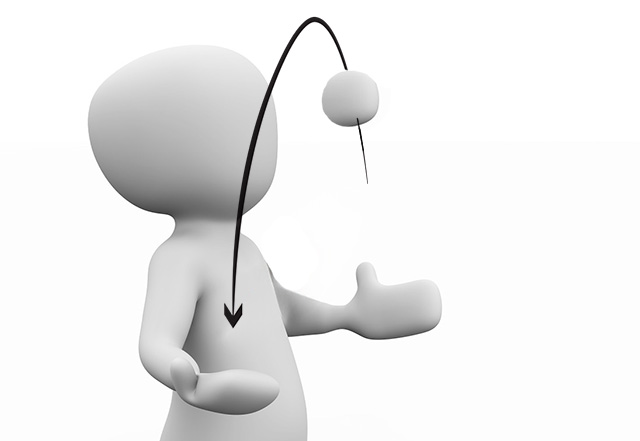
The participant stands comfortably with the object in the palm of one hand. When ready, they toss the object above the height of their head. As it comes down, they use the opposite hand to hit it back into the air. They continue this action hitting the object with alternate hands, keeping it in the air for a maximum of two minutes.
Variation: An alternative method is to use a ball and catch it as it reaches each hand rather than hitting it up. This catch variation may be more suitable for beginners or those testing with heavier objects.
Scoring the Juggling Coordination Test
Count the number of hits or throws before the object falls to the ground. Alternatively, time how long the participant can keep the object in the air. Use the calculator above to instantly convert your raw score into a performance rating.
| Rating | Number of Hits | Approximate Time |
|---|---|---|
| Poor | <10 | <15 seconds |
| Fair | 10-19 | 15-29 seconds |
| Good | 20-29 | 30-44 seconds |
| Very Good | 30-39 | 45-59 seconds |
| Excellent | >40 | 60+ seconds |
Sport-Specific Applications
Hand-eye coordination assessed by this test is essential across multiple sports:
- Racquet Sports (Tennis, Badminton, Table Tennis): Tracking and striking moving objects requires exceptional bilateral coordination
- Ball Sports (Basketball, Volleyball, Handball): Catching, passing, and shooting depend on precise hand-eye coordination
- Combat Sports (Boxing, MMA, Fencing): Defensive reactions and offensive timing require excellent coordination
- Baseball/Cricket: Batting and fielding demand rapid visual tracking and motor responses
- Goalkeeping (Soccer, Hockey, Lacrosse): Shot-stopping relies heavily on hand-eye coordination
How to Improve Your Coordination
Athletes can enhance their juggling coordination scores through targeted training:
- Progressive Object Training: Start with larger, slower objects and gradually decrease size and increase speed
- Bilateral Drills: Practice activities that require both hands equally, such as dribbling two basketballs simultaneously
- Visual Tracking Exercises: Use reaction balls and unpredictable bounce training to sharpen visual processing
- Sport-Specific Practice: Regular practice in your primary sport naturally develops relevant coordination pathways
- Juggling Practice: Traditional three-ball juggling is an excellent progression from this basic test
Test Considerations
Comments: This is not a commonly used standardized test, and as far as we know it has not been extensively tested for validity or reliability in peer-reviewed research. However, it serves as a practical field assessment for general motor coordination and is valuable for establishing baseline measurements and tracking improvement over time.
Frequently Asked Questions
What is a good score on the Juggling Coordination Test?
A score of 20-29 consecutive hits is considered good for the general population. Athletes typically achieve 30+ hits, with elite performers in sports requiring high hand-eye coordination often exceeding 40 consecutive hits.
Can I use any object for this test?
Use a lightweight object that's easy to hit but requires coordination to control. A crumpled paper ball, shuttlecock, or folded socks work well. Avoid heavy objects that could cause injury or very light items that are too difficult to control.
How often should I test my coordination?
For tracking improvement, test monthly while incorporating coordination training. During intensive training periods, weekly testing can help monitor progress. Ensure consistent testing conditions for accurate comparisons.
Is this test suitable for children?
Yes, this test is appropriate for children aged 6 and above. Younger children may benefit from using larger, slower-moving objects. The rating scale should be adjusted for age, as coordination develops significantly throughout childhood and adolescence.
Does hand dominance affect the test results?
Most people find the test slightly easier starting with their dominant hand, but since alternate hands are required, bilateral coordination is truly being assessed. Regular practice helps equalize performance between hands.
What other tests assess coordination?
Related coordination tests include the Stick Flip Test, Alternate Hand Wall Toss, and various catching and throwing assessments. For comprehensive coordination evaluation, consider using multiple tests that assess different aspects of motor control.
Can fatigue affect my coordination score?
Yes, both physical and mental fatigue can negatively impact coordination test performance. For accurate baseline measurements, test when well-rested. Testing under fatigue can be valuable for understanding how coordination degrades during competition or training.
References
- Schmidt, R.A., & Lee, T.D. (2019). "Motor Learning and Performance: From Principles to Application." Human Kinetics.
- Magill, R.A., & Anderson, D.I. (2017). "Motor Learning and Control: Concepts and Applications." McGraw-Hill Education.
- Gallahue, D.L., Ozmun, J.C., & Goodway, J.D. (2012). "Understanding Motor Development: Infants, Children, Adolescents, Adults." McGraw-Hill.
- Haywood, K.M., & Getchell, N. (2020). "Life Span Motor Development." Human Kinetics.
- Wood, R. (2024). "Coordination Testing in Sports." Topend Sports.
- Lemmink, K.A., Elferink-Gemser, M.T., & Visscher, C. (2004). "Evaluation of the reliability of two field hockey specific sprint and dribble tests." British Journal of Sports Medicine.
- Vestberg, T., Gustafson, R., Maurex, L., Ingvar, M., & Petrovic, P. (2012). "Executive functions predict the success of top-soccer players." PloS One.
Similar Tests
- Stick Flip Coordination Test — attempt to flip a stick using two other sticks.
- Alternate Hand Wall Toss Coordination Test — throw a ball against a wall from one hand in an underarm action, and attempt to catch it with the opposite hand.
Related Pages
 Any comments, suggestions, or corrections? Please let us know.