Stick Flip Coordination Test
The stick flip test is a coordination and general motor skill test. Participants attempt to flip a stick using two other sticks.
 Stick Flip Coordination Test
test purpose: to measure hand-eye coordination and dexterity.
equipment required: three sticks are required for each person being assessed. Each stick should be about 60 centimeters (~2 foot) long, two centimeters (~1 inch) in diameter and with tape or painted at one end.
procedure: there are two parts to this test, one with five attempts at a half flip, the other with five attempts at a full flip. Three practice attempts are allowed before each part.
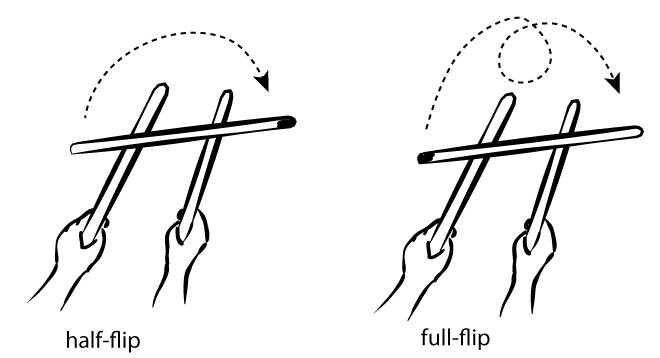
- Half-Flip: the subject holds a stick in each hand at waist level so that the sticks are horizontal. The assessor places the third stick across the two hand-held sticks. The subject then attempts to flip the balanced stick so that it turns one half of a rotation and lands back on the two hand‐held sticks. The subject should attempt five half-flips with one point scored for each successful attempt. The flip is unsuccessful if the stick is not flipped the half rotation or drops to the floor.
- Full-Flip: The starting position is the same as for the half-flip part of the test. In this second part, a full flip is attempted. The stick must go through a full rotation and land balanced across the other two sticks, with the same orientation as the starting position (using the painted end of the stick as a guide). Two points are awarded for each successful attempt.
scoring: One point is awarded for each successful half-flip, two points for each successful full-flip. Add up the scores for the two test parts and see the table below for a coordination rating. The maximum possible score is 15.
| rating | males (total points) | females (total points) |
|---|---|---|
| Excellent | 14–15 | 13–15 |
| Very Good | 11–13 | 10–12 |
| Fair | 5–10 | 4–9 |
| Poor | 3–4 | 2–3 |
| Very Poor | 0–2 | 0–1 |
reference: Corbin CB, Lindsey R (1994). Concepts of Fitness & Wellness. as cited in Jacaranda Outcomes 1 PDHPE Preliminary Course 5th Edition (published by Wiley), Chapter 5: Physical Fitness Training and Movement Efficiency.
Similar Tests
- Alternate Hand Wall Toss Coordination Test — throw a ball against a wall from one hand in an underarm action, and attempt to catch it with the opposite hand
- Juggling Coordination Test — keep an object in the air, hitting it from hand to hand.
Related Pages
- Other Coordination Tests
 Any comments, suggestions, or corrections? Please let us know.