Polar Fitness Test Calculator
Quick Answer
This calculator estimates your aerobic fitness level using the Polar OwnIndex methodology, providing a VO₂max estimate without requiring any exercise. Simply enter your resting heart rate and personal details for instant results.
- Calculates Polar OwnIndex score (25-95 scale) comparable to VO₂max
- Based on validated non-exercise fitness prediction research
- Ideal for athletes monitoring recovery, beginners establishing baseline, or anyone unable to perform maximal exercise testing
What is the Polar Fitness Test?
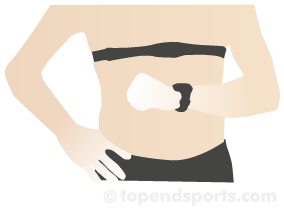
The Polar Fitness Test is a unique assessment that determines your cardiovascular fitness level without requiring any exercise. Originally developed by Polar Electro for use with their heart rate monitors, this test measures your aerobic fitness through analysis of heart rate variability (HRV) - the small beat-to-beat variations in your resting heart rhythm that reflect your autonomic nervous system function and cardiovascular health.
The test produces a score called the Polar OwnIndex, which is directly comparable to VO₂max (maximal oxygen uptake) - the gold standard measure of cardiorespiratory fitness. Scores typically range from 25 to 95 ml/kg/min, with higher values indicating superior aerobic capacity. Elite endurance athletes like marathon runners and professional cyclists often achieve scores above 70, while the average sedentary adult typically scores between 30-40.
How Does the Polar Fitness Test Work?
The Polar Fitness Test algorithm uses a combination of physiological variables to estimate your VO₂max without exercise. The calculation incorporates your resting heart rate, heart rate variability patterns, age, gender, height, weight, and self-reported physical activity level. Research has shown that these variables can predict maximal aerobic capacity with approximately 80-85% accuracy compared to laboratory treadmill testing.
The scientific basis relies on established relationships between cardiovascular function and fitness. Lower resting heart rates generally indicate a more efficient heart capable of pumping more blood per beat. Similarly, greater heart rate variability at rest suggests better autonomic nervous system balance and cardiovascular adaptability - both markers of superior aerobic fitness. When combined with anthropometric data and activity history, these measurements provide a reliable fitness estimate.
How to Use This Calculator
Follow these steps to accurately estimate your Polar OwnIndex fitness score:
- Measure Your Resting Heart Rate: Sit quietly for 5 minutes in a relaxed position before measuring. Early morning measurements before getting out of bed provide the most consistent results. You can use any heart rate monitor, fitness watch, or measure manually at your wrist or neck for 60 seconds.
- Enter Your Personal Data: Input your gender, age, height, and weight accurately. Use the unit toggle to switch between metric (kg/cm) and imperial (lbs/inches) as needed.
- Select Your Activity Level Honestly: Choose the option that best reflects your typical weekly exercise habits over the past 3 months. Overestimating activity level will inflate your score inaccurately.
- Review Your Results: Your Polar OwnIndex score will be displayed along with the equivalent VO₂max estimate, fitness classification, and sport-specific comparisons.
Understanding Your Results
Your Polar OwnIndex score corresponds to the following fitness classifications, adjusted for age and gender:
| Classification | Men (Age 20-39) | Women (Age 20-39) | Men (Age 40-59) | Women (Age 40-59) |
|---|---|---|---|---|
| Excellent | >52 | >45 | >45 | >38 |
| Good | 45-52 | 38-45 | 38-45 | 32-38 |
| Fair | 38-45 | 32-38 | 32-38 | 26-32 |
| Below Average | 32-38 | 26-32 | 26-32 | 22-26 |
| Poor | <32 | <26 | <26 | <22 |
For comprehensive VO₂max comparison data across different populations and sports, see our detailed VO₂max normative tables.
Sport-Specific Applications
Different sports require varying levels of aerobic fitness. Understanding where your Polar OwnIndex places you relative to sport-specific demands helps set appropriate training goals:
Endurance Sports (Marathon, Cycling, Triathlon)
Elite endurance athletes typically score 65-85 on the Polar OwnIndex. Professional cyclists and marathon runners often exceed 70, with some reaching 80+. Recreational competitors aiming for good performance should target scores above 50, while beginners can start competing with scores in the low 40s while building their aerobic base.
Team Sports (Soccer, Basketball, Hockey)
Team sport athletes need a balance of aerobic capacity and anaerobic power. Scores of 45-55 are typical for competitive players, with midfielders in soccer and guards in basketball often on the higher end due to their running demands. Position-specific variations exist - a goalkeeper may have a lower score than a midfielder while still being appropriately fit for their role.
Strength and Power Sports (Weightlifting, Sprinting)
Athletes in power-dominant sports may have lower Polar OwnIndex scores (35-45) as their training emphasizes different energy systems. However, maintaining a baseline aerobic fitness supports recovery between sets and competitions. A powerlifter doesn't need a marathoner's VO₂max, but adequate cardiovascular health remains important.
Factors Affecting Your Score
Several factors can influence your Polar Fitness Test results beyond your actual aerobic fitness:
- Caffeine and stimulants: Elevate resting heart rate and can lower your score. Test before consuming caffeine for accurate results.
- Hydration status: Dehydration increases heart rate. Ensure adequate hydration before testing.
- Sleep quality: Poor sleep increases resting heart rate and reduces heart rate variability. Test after normal sleep.
- Recent exercise: Intense training within 24 hours affects resting measurements. Allow recovery time for baseline testing.
- Stress and anxiety: Mental stress elevates heart rate and alters variability patterns.
- Medications: Beta-blockers and other cardiovascular medications directly affect heart rate measurements.
- Illness: Even minor infections can elevate resting heart rate significantly.
Improving Your Polar OwnIndex Score
To increase your Polar Fitness Test score, focus on systematic aerobic training:
For Beginners (Score <35)
Start with 150 minutes of moderate-intensity activity weekly, such as brisk walking, easy jogging, or cycling. Gradually increase duration before intensity. Expect improvements of 3-5 points over 8-12 weeks of consistent training.
For Intermediate Athletes (Score 35-50)
Incorporate interval training alongside steady-state cardio. Add two high-intensity sessions weekly while maintaining 3-4 moderate sessions. Hill training for runners or tempo rides for cyclists effectively build aerobic capacity at this stage.
For Advanced Athletes (Score >50)
Further improvements require periodized training with varied intensities and adequate recovery. Long aerobic sessions (60-90+ minutes) combined with threshold work and recovery periods optimize cardiovascular adaptations. At this level, improvements come more slowly - expect 1-2 point gains over months of dedicated training.
Test Protocols and Reliability
Test purpose: A simple assessment to calculate cardiovascular fitness level without exercise.
Equipment required: Polar heart rate monitor with Fitness Test function (for the original protocol), or any method to measure resting heart rate for this calculator. Also equipment to measure your height and bodyweight.
Procedure: In order to calculate your fitness level, you need to enter details of your gender, age, height, body weight, and level of physical activity. To achieve the most accurate resting heart rate measurement, relax in a lying or sitting position for at least 5 minutes. Avoid any disturbances such as talking during the measurement or surrounding noises.
Results: Your score (Polar OwnIndex) is comparable to VO₂max, typically ranging from 25 to 95. You can use the VO₂max normative tables for comparison with athletic populations.
Target population: A simple and safe test particularly suitable for those starting out or of low fitness level, the elderly, and for those unable to exercise due to musculoskeletal disorders or medical conditions that preclude maximal exercise testing.
Reliability: For maximal reliability of results it is recommended that you keep the testing place, time, body position, and testing environment the same each time the test is repeated. Conducting tests at the same time of day (preferably morning before breakfast) provides the most consistent comparative data.
Advantages: No specialized equipment beyond a heart rate monitor is required. You can get a measure of your fitness safely, without doing any exercise, conducted by yourself, and in only 5 minutes. The results are calculated automatically and provide immediate feedback.
Disadvantages: The results are partly based on your subjective self-assessed level of physical activity. This test cannot be as accurate as a laboratory-based maximal exercise test with direct gas analysis. Estimates may vary by ±5-10% from actual VO₂max values.
Scientific Validation
The non-exercise VO₂max prediction methodology has been validated in multiple peer-reviewed studies. Research published in the Medicine & Science in Sports & Exercise journal demonstrated correlation coefficients of 0.78-0.85 between predicted and measured VO₂max values across diverse populations. The accuracy is highest for healthy adults aged 20-65 who accurately report their physical activity levels.
The formula incorporates established physiological relationships: the inverse relationship between resting heart rate and aerobic capacity, the positive association between habitual physical activity and cardiovascular fitness, and the known effects of age, sex, and body composition on maximal oxygen uptake. While not a replacement for laboratory testing in clinical or elite athletic contexts, it provides a practical, accessible fitness assessment for the general population and recreational athletes.
Frequently Asked Questions
How accurate is the Polar Fitness Test?
The Polar Fitness Test correlates approximately 80-85% with laboratory VO₂max testing for healthy adults. The accuracy depends on honest self-assessment of physical activity level and correct resting heart rate measurement. While not as precise as maximal exercise testing, it provides a reliable estimate for tracking fitness changes over time and comparing against population norms.
What is a good Polar OwnIndex score for my age?
Good scores vary by age and gender. For men aged 20-39, scores above 45 are considered good and above 52 excellent. For women in the same age range, above 38 is good and above 45 is excellent. Elite endurance athletes typically score 60-85. See the classification table above for comprehensive age-adjusted standards.
Can I use this calculator without a Polar watch?
Yes, this calculator uses the same validated formula as the Polar device. You need to know your resting heart rate, which can be measured manually (count pulse for 60 seconds), with any heart rate monitor, smartwatch, or fitness tracker. The key is accurate resting measurement after 5+ minutes of quiet rest.
How often should I take the Polar Fitness Test?
For tracking fitness improvements, test every 2-4 weeks. Significant aerobic adaptations require at least 6-8 weeks of consistent training to manifest in test scores. Always test under the same conditions - same time of day, similar rest state, and consistent environment - for valid comparisons.
Why is my score lower than expected despite regular training?
Several factors can temporarily lower your score: recent intense exercise, poor sleep, dehydration, caffeine consumption, stress, or illness. Additionally, if you've just started training, cardiovascular adaptations take 6-12 weeks to fully develop. Ensure you're testing in optimal conditions and after adequate recovery.
How does the Polar OwnIndex relate to actual VO₂max?
The Polar OwnIndex is designed to directly approximate VO₂max in ml/kg/min. A score of 45 corresponds to an estimated VO₂max of approximately 45 ml/kg/min. While the correlation is strong (r=0.80-0.85), individual variation means your actual VO₂max measured in a laboratory may differ by ±5-10% from this estimate.
Is this test suitable for athletes?
Yes, athletes can use this test for convenient fitness monitoring between formal assessments. It's particularly useful for tracking recovery status - an elevated resting heart rate or lower-than-usual score may indicate incomplete recovery or overtraining. However, for performance-critical decisions, athletes should supplement with sport-specific field tests or laboratory assessments.
References
- Polar Electro. "Polar OwnIndex Fitness Test Methodology." Polar Research Documentation.
- Jackson, A.S., et al. (1990). "Prediction of functional aerobic capacity without exercise testing." Medicine & Science in Sports & Exercise, 22(6), 863-870.
- Jurca, R., et al. (2005). "Assessing cardiorespiratory fitness without performing exercise testing." American Journal of Preventive Medicine, 29(3), 185-193.
- Wier, L.T., et al. (1989). "A comparison of non-exercise methods for predicting VO2max." Medicine & Science in Sports & Exercise, 21(2), S79.
- Nes, B.M., et al. (2011). "Estimating VO2peak from a nonexercise prediction model: the HUNT Study, Norway." Medicine & Science in Sports & Exercise, 43(11), 2024-2030.
- American College of Sports Medicine. (2021). "ACSM's Guidelines for Exercise Testing and Prescription." 11th Edition. Wolters Kluwer.
- Plews, D.J., et al. (2013). "Heart rate variability and training intensity distribution in elite rowers." International Journal of Sports Physiology and Performance, 8(5), 497-506.
Similar Tests
- See also the Non-Exercise Fitness Test, another fitness test which does not require any exercise (uses a formula)
Related Pages
Polar BodyAge Assessment
Review of Polar's comprehensive fitness age evaluation system.
Read Review → Any comments, suggestions, or corrections? Please let us know.