Power Ball Overhead Throw Calculator (Backwards)
Quick Answer
This calculator evaluates your backwards overhead power ball throw distance against athletic standards and Army ACFT scoring. Enter your throw distance to get instant performance ratings and percentile rankings.
- Calculates: Performance rating against athletic population norms
- ACFT Scoring: Converts distance to Army Combat Fitness Test points (60-100)
- Ball Weights: Supports 2kg, 3kg, and 4.5kg (10lb) protocols
This test involves throwing a Power Ball (or medicine ball) for maximum distance. The Overhead Power Ball Throw was once part of the SPARQ assessment for basketball and soccer, and the protocol that they used is listed here. This test is also a part of the US Army Army Combat Fitness Test, called the Standing Power Throw, using a 10lb (4.5kg) medicine ball. There is a similar back throw test using a 8lb shot put.
How to Perform the Overhead Power Ball Throw Test
Purpose: This test measures core strength and total body explosive power, assessing your ability to generate and transfer force through the kinetic chain from your legs through your core to your upper body.
Equipment Required: 2-4.5 kg power ball or medicine ball (standard testing uses 3kg for males, 2kg for females/youth; Army ACFT uses 4.5kg/10lb), tape measure (minimum 15 meters), flat non-slip surface, clear open area for testing.
Pre-test: Explain the test procedures to the subject. Perform screening of health risks and obtain informed consent. Prepare forms and record basic information such as age, height, body weight, gender and test conditions. Check the weight of the ball. The start line should be clearly marked. Perform a standard warm-up including dynamic stretching and 2-3 practice throws at reduced intensity. See more details of pre-test procedures.
Power Ball Backwards Overhead Throw - Starting Position
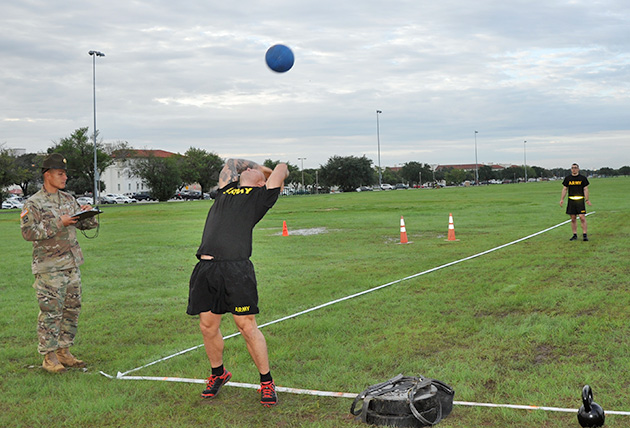
Procedure: The athlete starts by standing facing away from the direction they are going to throw, with their heels at the start line. The starting position is with the ball in both hands, held above the head, with arms extended. Keeping the arms extended, swing the ball down between your legs while flexing the knees. Then in one motion the ball is flung up and back over the head (optimally at about 45 degrees). Several practices may be required to get the best trajectory for maximum distance. The athlete is permitted to fall backward over the line after the ball is released. Three attempts are allowed.
Scoring: The distance from the starting line to where the ball first lands is recorded. The measurement is recorded to the nearest 0.1 meter (or nearest foot in imperial). The best result of three throws is recorded.
Pro Tip: The optimal release angle is approximately 45 degrees. Focus on generating power from your legs and hips, then transfer that force through your core to your arms. Think of it as an explosive "reverse" movement where you squat down and explode upward and backward in one fluid motion.
Performance Standards and Normative Data
Performance standards vary based on ball weight, gender, and testing population. The following normative data is based on research with athletic populations and official military standards.
Athletic Population Standards (3kg Ball)
| Rating | Male Distance | Female Distance | Percentile |
|---|---|---|---|
| Excellent | 14.0+ meters | 10.0+ meters | Top 10% |
| Good | 11.0-13.9 meters | 8.0-9.9 meters | Top 30% |
| Average | 8.5-10.9 meters | 6.5-7.9 meters | 40-60% |
| Below Average | 6.5-8.4 meters | 5.0-6.4 meters | Bottom 40% |
| Needs Improvement | <6.5 meters | <5.0 meters | Bottom 20% |
US Army ACFT Standing Power Throw Standards (10lb/4.5kg Ball)
| Score | Male Distance | Female Distance |
|---|---|---|
| 100 Points (Maximum) | 12.5+ meters | 8.4+ meters |
| 80 Points | ~9.5 meters | ~6.5 meters |
| 60 Points (Minimum Pass) | 6.0 meters | 4.0 meters |
| Below 60 (Fail) | <6.0 meters | <4.0 meters |
Notable Results and Records
Elite Performance: US Decathlete Bryan Clay achieved 77 ft 7 in (23.65 meters) in this test during a SPARQ testing exercise (published in SPARQ Magazine, Summer 2008). This extraordinary result demonstrates the explosive power potential of elite multi-event athletes.
Target Population: Basketball, soccer, and other sports in which total body power is important. The test is also a core component of the US Army Combat Fitness Test for assessing soldier readiness.
Sport-Specific Applications
The overhead power ball throw has direct applications across multiple sports where total body explosive power contributes to performance:
Basketball: The throwing motion correlates with rebounding power, outlet passes, and the ability to generate force during physical play under the basket. Guards benefit from improved passing distance and power.
Soccer/Football: The test was part of the SPARQ soccer assessment because it measures the explosive power needed for throw-ins, heading contests, and the physical duels common in the sport.
Combat Sports: Wrestlers, judoka, and MMA athletes benefit from total body power for takedowns, throws, and ground control. The movement pattern directly transfers to overhead throws and lifting opponents.
Military Applications: The Army uses this test to assess a soldier's ability to move equipment, assist fallen comrades, and execute explosive movements required in combat situations.
Advantages and Limitations
Advantages: This test is easy and quick to perform for an individual, with the equipment required relatively cheap. It provides a functional assessment of total body power that transfers well to athletic and military applications.
Disadvantages: Several people are needed to conduct this test smoothly: one to mark where the ball lands and take the measurement, another to check technique and another to collect and return the balls. If testing a large group of participants, it can be time consuming to put all of them through this test.
⚠️ Safety Note: Ensure the throwing area is clear of people and obstacles. The ball can travel significant distances and cause injury if it strikes someone. Mark throwing lanes clearly and maintain awareness of all personnel in the testing area.
How to Improve Your Overhead Power Ball Throw
Improving your overhead power ball throw requires developing explosive power throughout your kinetic chain. Focus on these training strategies:
Lower Body Power: Squat jumps, box jumps, power cleans, and kettlebell swings develop the leg drive essential for generating force from the ground up.
Core Strength: Medicine ball slams, Russian twists, hanging leg raises, and anti-rotation exercises build the core stability needed to transfer power efficiently.
Upper Body Development: Overhead press, push press, and medicine ball chest passes develop the shoulder and arm strength for the final phase of the throw.
Technique Work: Practice the throwing motion regularly with submaximal loads, focusing on the timing and sequencing of the hip extension, core engagement, and arm swing.
The Test in Action
- This test was once part of the SPARQ assessment for basketball and soccer
- This test is also a part of the US Army Army Combat Fitness Test (called the Standing Power Throw)
Frequently Asked Questions
What is a good overhead power ball throw distance?
For a 3kg ball, good distances are 11-14 meters for adult males and 8-10 meters for females. For the Army ACFT using a 10lb (4.5kg) ball, passing scores require 6.0 meters for males and 4.0 meters for females. Elite athletes with a 3kg ball can exceed 14 meters.
What ball weight should I use for testing?
Standard athletic testing uses a 3kg ball for adult males and 2kg for females and youth athletes. The US Army ACFT uses a standardized 10lb (4.5kg) medicine ball for all soldiers regardless of gender. Use consistent ball weight across testing sessions for valid comparisons.
How is the ACFT Standing Power Throw scored?
The ACFT Standing Power Throw is scored from 0-100 points based on distance thrown. Minimum passing score (60 points) requires 6.0m for males or 4.0m for females. Maximum score (100 points) requires 12.5m for males or 8.4m for females.
What muscles does this test measure?
The overhead power ball throw tests total body explosive power including the quadriceps, gluteus maximus, hamstrings (leg drive), rectus abdominis, obliques, erector spinae (core), and deltoids, pectoralis major, triceps (upper body). It specifically measures your ability to generate and transfer force through the kinetic chain.
How often should I test my power ball throw?
For tracking training adaptations, test every 4-6 weeks during training phases. For talent identification or team selection, testing at the start and end of training blocks is sufficient. Always allow 48-72 hours of recovery after heavy training before testing.
What is the optimal throwing angle?
Research indicates the optimal release angle for maximum distance is approximately 45 degrees. Athletes should practice to find their personal optimal angle, which may vary slightly based on individual biomechanics and strength characteristics.
Can I fall forward after releasing the ball?
Yes, the standard protocol allows athletes to fall backward over the start line after releasing the ball. In the ACFT, your feet can leave the ground during the throw, but if they touch or cross the fault line upon landing, the throw is a fault and does not count.
References
- US Army. (2022). "Army Combat Fitness Test Scoring Standards." Department of the Army.
- Stockbrugger, B.A., & Haennel, R.G. (2001). "Validity and reliability of a medicine ball explosive power test." Journal of Strength and Conditioning Research, 15(4), 431-438.
- Ikeda, Y., Kijima, K., Kawabata, K., Fuchimoto, T., & Ito, A. (2007). "Relationship between side medicine-ball throw performance and physical ability for male and female athletes." European Journal of Applied Physiology, 99(1), 47-55.
- Chelly, M.S., et al. (2010). "Effects of a back squat training program on leg power, jump, and sprint performances in junior soccer players." Journal of Strength and Conditioning Research, 24(8), 2241-2247.
- Ebben, W.P., et al. (2007). "The relationship between maximum squat strength and five, ten, and forty yard sprint times." Journal of Strength and Conditioning Research, 21(3), 739-744.
- SPARQ Magazine. (Summer 2008). "Bryan Clay SPARQ Testing Results." Nike SPARQ.
- National Strength and Conditioning Association. (2016). "Essentials of Strength Training and Conditioning." 4th Edition, Human Kinetics.
Similar Tests
- Kneeling Power Ball Overhead Throw (forwards)
- Medicine Ball standing overhead throw
- Powerball backwards overhead throw
- Shot put back throw
Related Pages
- Medicine and Power Ball Fitness Tests
- About the US Army Army Combat Fitness Test
- About Medicine/Power Balls
- The SPARQ rating system for basketball and soccer
- SPARQ fitness rating system
- Other speed and power tests
- Medicine balls for sale
 Any comments, suggestions, or corrections? Please let us know.