NAPFA Pull-Up Test Calculator
Quick Answer
This calculator determines your NAPFA pull-up test grade using Singapore's official National Physical Fitness Award standards. Enter your pull-up count, age, and gender to instantly see your grade and points.
- Scores pull-ups (males 16+) or incline pull-ups (females, males ≤15)
- Based on official NAPFA grading standards by age group
- Shows points toward Gold, Silver, or Bronze awards
What is the NAPFA Pull-Up Test?
The pull-up is a test of upper body strength used in Singapore's National Physical Fitness Award Scheme (NAPFA). This fitness assessment measures muscular strength, power, and endurance of the arms, shoulders, and back muscles. There are two versions of the test: full pull-ups for males aged over 15, and incline pull-ups for females and males aged 15 and under.
The NAPFA pull-up test is one of six stations in Singapore's national fitness testing program, which has been administered to students and National Service (NS) personnel since 1982. Achieving a good pull-up score is essential for earning the Gold, Silver, or Bronze NAPFA award, and for NS personnel, it directly impacts their IPPT (Individual Physical Proficiency Test) results.
How to Perform the NAPFA Pull-Up Test
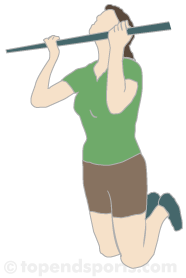 Proper Pull-Up Form
Full Pull-Up Procedure (Males 16+)
Test purpose: This test measures upper body strength and endurance, specifically targeting the latissimus dorsi, biceps, and forearm muscles.
Equipment required: Horizontal overhead bar at an adequate height so that participants can hang with arms fully extended and feet not touching the floor. See our guide to pull-up bars for equipment options.
Pre-test preparation: Explain the test procedures to the subject. Perform screening of health risks and obtain informed consent. Prepare forms and record basic information such as age, height, body weight, gender and test conditions. Measure and record the height of the bar. Perform a standard warm-up including arm circles, shoulder stretches, and a few practice hangs. See more details of pre-test procedures.
Procedure: Hang by your hands from an overhead bar, with either an overhand grip (palms facing away from body) or underhand grip (palms facing toward body). Pull yourself upwards until your chin reaches or passes above the bar, then lower your body again to a position with the arms fully extended. The feet must remain off the ground for the duration of the test. Each complete repetition counts as one pull-up.
Incline Pull-Up Procedure (Females & Males ≤15)
Procedure: Grip a bar that is approximately waist-high and hang below it. The arms should be straight, the torso and legs stiff and straight, with only your heels resting on the ground. Pull yourself towards the bar until your chest touches it, then lower yourself to the starting position. This modified version is similar to the modified pull-up test used in other fitness assessments.
Scoring: The maximum number of correctly completed pull-ups (or incline pull-ups) in 30 seconds is recorded. Partial repetitions do not count, and the body must return to full arm extension between each rep.
Understanding Your NAPFA Pull-Up Results
The NAPFA uses a standardized grading system that accounts for age and gender differences. Your pull-up count is converted to a grade (A through E) worth 1-5 points. These points combine with your scores from the other five NAPFA stations to determine your overall award level.
NAPFA Award Levels
- Gold Award: 21+ total points with at least 3 Grade A performances
- Silver Award: 15-20 total points with no failing grade
- Bronze Award: 6-14 total points
For National Service personnel, the NAPFA pull-up test is particularly important as it forms part of the IPPT assessment. Strong performance here can contribute to qualifying for NS fitness incentives and demonstrating combat readiness.
Sport-Specific Applications of Pull-Up Strength
Pull-up strength is valuable across many sports and athletic activities. Understanding where your NAPFA score places you can help guide your training priorities.
Climbing and Gymnastics
These sports require exceptional pulling strength. Climbers and gymnasts typically achieve Grade A scores easily, often completing 15-20+ pull-ups. The pulling motion directly transfers to climbing movements and gymnastics apparatus work like the rings and high bar.
Combat Sports and Martial Arts
Judo, wrestling, and Brazilian jiu-jitsu all rely heavily on grip strength and pulling power. Grapplers use the same muscles tested in pull-ups when executing throws, takedowns, and submission holds. A Grade B or higher indicates good foundational strength for these sports.
Swimming
The pulling phase of swimming strokes, particularly in freestyle and butterfly, engages the latissimus dorsi muscles tested by pull-ups. Competitive swimmers often use pull-up training to improve their stroke power and endurance.
Team Sports
While not directly transferable, upper body strength benefits sports like rugby, basketball (for rebounding), and volleyball (for blocking). Athletes in these sports should aim for at least Grade C to ensure adequate strength foundations.
How to Improve Your Pull-Up Performance
Whether you're preparing for NAPFA testing, IPPT, or general fitness improvement, these evidence-based strategies can help increase your pull-up count.
Pro Tip: Consistent practice is more effective than occasional intense sessions. Research by sports scientist Robert Wood indicates that 3-4 training sessions per week produces optimal strength gains while allowing adequate recovery between sessions.
Progressive Training Program
If you cannot complete any pull-ups: Start with dead hangs (simply hanging from the bar for time) to build grip strength, then progress to negative pull-ups (jump to the top position and lower yourself slowly). Australian pull-ups (incline rows) using a low bar are also excellent for building initial strength.
If you can complete 1-5 pull-ups: Use "greasing the groove" methodology—perform multiple sets throughout the day at about 50% of your maximum. For example, if your max is 4, do sets of 2 several times daily. Assisted pull-ups with resistance bands can also help build volume.
If you can complete 6-10 pull-ups: Focus on adding volume through multiple sets. A pyramid approach (1-2-3-4-3-2-1 reps with rest between) builds both strength and endurance. Begin incorporating weighted pull-ups with a dipping belt or weighted vest.
If you can complete 11+ pull-ups: Add resistance through weighted pull-ups to build maximum strength. Include variations like wide-grip, close-grip, and mixed-grip pull-ups to develop well-rounded pulling strength. Train for both strength (heavy weight, low reps) and endurance (bodyweight, high reps) on different days.
Grip Strength Development
Many athletes fail pull-up tests due to grip fatigue rather than back or arm weakness. Incorporate dead hangs, farmer's walks, and grip trainers into your routine. For NAPFA specifically, practicing with both overhand and underhand grips helps you determine which allows more repetitions.
Body Composition Considerations
Pull-ups become easier as body fat decreases because you're lifting less total mass. Athletes seeking to maximize their NAPFA score often focus on maintaining lean body mass while reducing excess weight through proper nutrition and cardiovascular training.
Frequently Asked Questions
What is a good NAPFA pull-up score?
A good NAPFA pull-up score depends on your age and gender. For males aged 18-24, Grade A (excellent) requires 12 or more full pull-ups, while Grade C (average) requires 6. For females in the same age group performing incline pull-ups, Grade A requires 20 or more, and Grade C requires 10.
Do I perform full pull-ups or incline pull-ups?
Males aged 16 and above perform full pull-ups from an overhead bar. Females of all ages and males aged 15 and below perform incline pull-ups from a waist-high bar. The calculator automatically determines your test type based on age and gender inputs.
How many pull-ups do I need for NAPFA Gold?
To achieve NAPFA Gold, you need at least 21 total points across all six stations with a minimum of three Grade A performances. For the pull-up station, Grade A for males 18-24 requires 12+ pull-ups. However, NAPFA Gold also depends on your performance in the other five stations.
Can I use any grip for the NAPFA pull-up test?
Yes, the NAPFA allows both overhand grip (palms facing away, also called "pull-up grip") and underhand grip (palms facing toward you, also called "chin-up grip"). Most people find the underhand grip slightly easier as it engages the biceps more directly. Choose whichever grip allows you to complete more repetitions.
How long do I have to complete the NAPFA pull-up test?
The NAPFA pull-up test has a time limit of 30 seconds. You must complete as many properly-executed pull-ups as possible within this time. Partial repetitions and those without full arm extension at the bottom do not count toward your score.
What muscles does the pull-up test measure?
The pull-up primarily tests the latissimus dorsi (back), biceps brachii (upper arm), brachialis, forearm flexors, and core stabilizers. It's a compound movement that assesses overall upper body pulling strength and muscular endurance.
How can I improve my pull-up count quickly?
The fastest way to improve is through frequent practice with sub-maximal sets ("greasing the groove"). Do 40-50% of your maximum several times throughout the day, every day. Also include negative pull-ups, lat pulldowns, and rows to build supporting strength. Most athletes can add 2-4 pull-ups within 4-6 weeks of dedicated training.
Similar Tests
- A general description of the pull up test procedure.
- Pull up procedure from the PFT
- Cadence Pull-Up Test — performed at a rate of 15 per minute
- Modified Pull-Up — with the body horizontal, grasp a bar set just out of reach, and pull up towards the bar.
- Horizontal Pull-Up Test — a variation of the hanging pull-up, made easier as the whole body weight does not need to be lifted.
- Flexed-arm hang — an isometric strength test
References
- Singapore Sports Council. (2024). "National Physical Fitness Award (NAPFA) Test Standards." Ministry of Education Singapore.
- Ronai, P., & Scibek, E. (2014). "The Pull-up." Strength and Conditioning Journal, 36(3), 88-90.
- Snarr, R. L., & Esco, M. R. (2014). "Electromyographical comparison of pull-up variations." Journal of Strength and Conditioning Research, 28(10), 2935-2942.
- Wood, R. J. (2005). "Fitness Testing for Athletes: Pull-Up Test Protocols." TopEndSports.
- Youdas, J. W., et al. (2010). "Surface electromyographic activation patterns and elbow joint motion during a pull-up, chin-up, or perfect-pullup rotational exercise." Journal of Strength and Conditioning Research, 24(12), 3404-3414.
- National Strength and Conditioning Association. (2016). "Essentials of Strength Training and Conditioning, 4th Edition." Human Kinetics.
Related Pages
- More about Singapore's National Physical Fitness Award Scheme (NAPFA).
- Where to buy pull-up or chin-up bars.
- POLL: Do you call it a chin-up or pull-up?
- Overhand or underhand - a description of each of the grip types
- Pull-up test norms
- World Records for Chin-Ups
 Any comments, suggestions, or corrections? Please let us know.