PFT Pull-Up Test Calculator
Quick Answer
This calculator determines your US Marine Corps PFT pull-up score using the official scoring system of 5 points per pull-up, with a maximum of 100 points for 20 pull-ups.
- Minimum to pass: 3 pull-ups (15 points)
- Maximum score: 20 pull-ups (100 points)
- Points per rep: 5 points for each completed pull-up
About the PFT Pull-Up Test
This test forms part of the US Marine Physical Fitness Test (PFT), performed by US Marine personnel every six months. The pull-up test measures upper body strength and muscular endurance, two critical components for military performance.
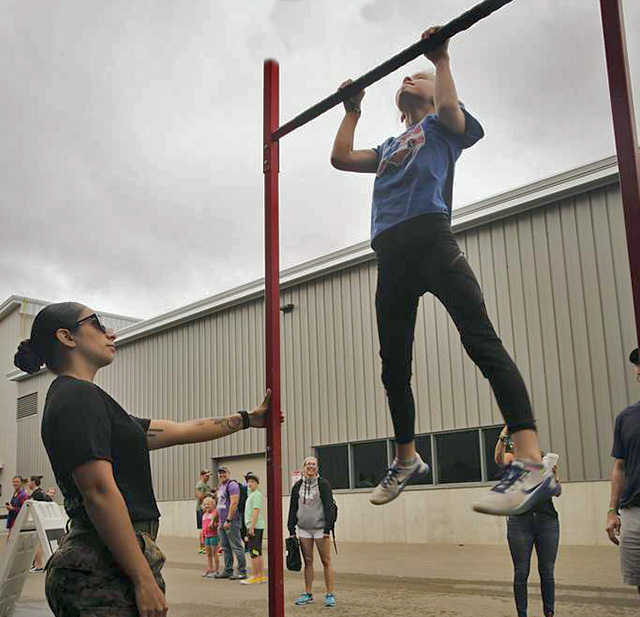
Pull-Up Test in progress
How to Use This Calculator
Using the PFT Pull-Up Calculator is straightforward:
- Enter your pull-up count - Input the total number of correctly performed pull-ups you completed during your test
- Click Calculate Score - The calculator instantly computes your PFT points
- Review your results - See your points total, percentile ranking, and performance category
- Use the recommendations - Get personalized guidance on improving your score
Pro Tip: Use the preset buttons to quickly see what score you'd achieve at different pull-up counts. This helps set training goals for your next PFT.
Test Purpose and Equipment
Test purpose: This test measures upper body strength and endurance, specifically targeting the latissimus dorsi, biceps, and forearm muscles essential for military tasks like climbing, pulling, and carrying equipment.
Equipment required: Horizontal overhead bar at an adequate height so that participants can hang from it with arms fully extended and feet not touching the floor. See our guide to pull-up bars for equipment options.
Pre-test procedures: Explain test procedures to the subject. Perform screening of health risks and obtain informed consent. Prepare forms and record basic information such as age, height, body weight, gender and test conditions. Measure and record the height of the bar. Perform a standard warm-up. See more details of pre-test procedures.
Official PFT Pull-Up Procedure
The pull-ups are performed starting from a dead hang (arms fully extended and locked), body motionless, feet off the floor. The grip can be either with both palms facing forward (overhand) or to the rear (underhand), though both palms must face the same direction.
From this starting position, a pull-up is performed without excessive body motion, and the body is lifted until the chin has cleared the top of the bar. The body is then lowered until arms are fully extended or locked out. One complete pull-up is counted when the Marine's arms are locked out. This procedure is repeated until the Marine has reached the maximum 20 complete pull-ups, or can no longer complete a pull-up.
Scoring and Point System
The PFT pull-up scoring is straightforward: 5 points for every correctly completed pull-up. At least three pull-ups are required to pass this portion of the test. The maximum score of 100 points is achieved at 20 pull-ups—additional pull-ups beyond 20 demonstrate excellent fitness but don't add to your score.
Key Scoring Facts
- Minimum passing: 3 pull-ups = 15 points
- Each pull-up: 5 points
- Maximum score: 20 pull-ups = 100 points
- Score caps at 20 pull-ups (no bonus for additional reps)
Technical Requirements and Rules
Understanding the official rules helps ensure your pull-ups count during the PFT:
- Grip changes are allowed during the exercise, as long as the Marine's feet do not touch the bar or ground, and hands do not touch the side bars of the pull-up bar
- Resting is allowed in the up or down position, but resting with the chin supported by the bar is not allowed
- Sweat shirts need to be removed so that the locking of the elbows can be observed by the scorer
- Leg position: Throughout the test, legs may be in a straight or bent position, but may not be raised above the waist
- Prohibited movements: Whipping, kicking, kipping of the body or legs, or any leg movement used to assist the pull-up is not allowed
"The pull-up test remains one of the most reliable measures of upper body strength-to-weight ratio, which directly correlates with military task performance in climbing, obstacle navigation, and combat situations."— Robert J. Wood, PhD, Founder of Topend Sports
Grip Types Explained
The terms chin-up and pull-up are often used interchangeably, though there are technical distinctions:
- Overhand grip (Pronated): Palms facing away from body - traditionally called a "pull-up"
- Underhand grip (Supinated): Palms facing toward body - traditionally called a "chin-up"
For the Marine Corps PFT, either grip is acceptable as long as both palms face the same direction. Most Marines find the underhand grip slightly easier due to greater bicep engagement.
How to Improve Your Pull-Up Score
Whether you're preparing for your first PFT or aiming to max out at 20 pull-ups, systematic training produces results:
For Beginners (0-5 pull-ups)
- Negative pull-ups (controlled lowering)
- Band-assisted pull-ups
- Lat pulldowns for strength building
- Dead hangs for grip strength
For Intermediate (6-12 pull-ups)
- Grease the groove (multiple sets daily)
- Weighted pull-ups with 10-25 lbs
- Varied grip widths and types
- Pyramid sets (1,2,3,4,5,4,3,2,1)
For Advanced (13-20+ pull-ups)
- Heavy weighted pull-ups (25-45 lbs)
- Muscle-ups and explosive variations
- One-arm progressions
- High-volume endurance training
Female Marines and Pull-Ups
Historically, female Marines performed the flexed-arm hang test as an alternative. However, female Marines now have the option to perform pull-ups for potentially higher scores. The scoring system is identical: 5 points per pull-up up to a maximum of 100 points for 20 pull-ups.
Frequently Asked Questions
How many pull-ups do I need to pass the Marine Corps PFT?
You need a minimum of 3 pull-ups to pass the pull-up portion of the US Marine Corps Physical Fitness Test. This earns you 15 points. However, for a competitive overall PFT score, most Marines aim for 15+ pull-ups (75+ points).
How many points is each pull-up worth on the PFT?
Each correctly performed pull-up is worth 5 points on the US Marine Corps PFT. The scoring is linear from 0 pull-ups (0 points) to 20 pull-ups (100 points maximum).
What happens if I do more than 20 pull-ups?
Pull-ups beyond 20 demonstrate excellent fitness and may earn recognition, but the PFT score caps at 100 points (20 pull-ups). Additional reps don't add to your official score but can be noted for fitness records.
Can I use an underhand (chin-up) grip on the PFT?
Yes, for the Marine Corps PFT, you can use either an overhand grip (palms facing away) or underhand grip (palms facing toward you). Both palms must face the same direction. Many find the underhand grip slightly easier due to bicep engagement.
What counts as a valid pull-up on the Marine PFT?
A valid PFT pull-up starts from a dead hang with arms fully extended, then you pull up until your chin clears the top of the bar, then lower back to full arm extension. No kipping, kicking, or using momentum is allowed.
How often is the PFT administered?
The US Marine Corps Physical Fitness Test is administered twice per year (every six months). Marines must pass to maintain fitness standards and may retake if they fail within a specified period.
Can I change my grip during the test?
Yes, grip changes are allowed during the PFT pull-up test, as long as your feet don't touch the bar or ground, and your hands don't touch the side bars. You can rest in the up or down position but cannot rest your chin on the bar.
References
- United States Marine Corps. (2024). "Physical Fitness Test (PFT) Order." MCO 6100.13A.
- Headquarters, US Marine Corps. (2023). "Marine Corps Physical Fitness Program." Marine Corps Order.
- Wood, R.J. (2005). "Pull-Up Test Protocols for Military Fitness Assessment." Topend Sports.
- American College of Sports Medicine. (2022). "ACSM's Guidelines for Exercise Testing and Prescription." 11th Edition.
- Vanderburgh, P.M. & Edmonds, T. (2018). "Pull-Up Performance Standards for Military Personnel." Military Medicine, 183(5-6), e289-e295.
Similar Tests
- General testing procedure for the Pull Up Test
- NAPFA pull up
- Cadence Pull-Up Test — at a rate of 15 per minute
- Horizontal Pull-Up Test — a variation of the hanging pull-up, made easier as the whole body weight does not need to be lifted
- Modified Pull-Up — with the body horizontal, grasp a bar set just out of reach, and pull up towards the bar
- Flexed arm hang
Related Pages
- PFT testing discussion and scoring.
- Where to buy pull-up or chin-up bars.
- POLL: Do you call it a chin-up or pull-up?
- Other strength tests
- All fitness test list
- World Records for Pull / Chin Ups
- Pull-up test norms
- Overhand or underhand - a description of each of the grip types
- Description of the chin up fitness exercise
 Any comments, suggestions, or corrections? Please let us know.