Boxing Punching Power Calculator
Quick Answer
This calculator analyzes your boxing punch power by processing force readings from 6 test punches. It calculates peak power, average power, and compares your results to athletic standards across weight classes.
- Based on the SPARQ Boxing test protocol using 100-lb heavy bag
- Measures punch force in PSI (pounds per square inch) or Newtons
- Provides percentile ranking compared to amateur and professional boxers
The Punching Power Test has been used as part of the SPARQ rating system for Boxers, and their protocol is listed here. This test was used in the 3rd season of the Contender TV series in the US to assess the fitness of the boxers. See also a description of how to measure punching speed. Note: we do not sell this equipment or provide testing of punching power.
How to Use This Calculator
Follow these steps to calculate and analyze your boxing punch power:
- Enter Your Body Weight - Input your current body weight in kilograms or pounds. This helps contextualize your power output relative to your mass.
- Select Your Weight Class - Choose your competitive weight class to enable accurate comparisons against other boxers in your division.
- Record Your Punch Forces - Enter the force reading from each of your 6 test punches. Use an instrumented heavy bag or force measurement device to capture these values in PSI or Newtons.
- Calculate Your Results - Click "Calculate Punch Power" to see your peak power, average power, consistency rating, and comparison to athletic standards.
- Review Training Recommendations - Based on your results, receive personalized suggestions to improve your punching power.
Pro Tip: For the most accurate results, ensure you're properly warmed up and throw each punch with maximum intent, just as you would in competition.
Test Purpose and Methodology
Test purpose: To measure maximal punching power and assess a boxer's ability to generate force through the kinetic chain from feet to fist.
Equipment required: Instrumented 100-pound heavy punching bag (see comments below), boxing gloves, and a force measurement system.
Pre-test: Explain the test procedures to the subject. Perform screening of health risks and obtain informed consent. Prepare forms and record basic information such as age, height, body weight, gender and test conditions. Perform a standard warm-up including shadow boxing and light bag work. See more details of pre-test procedures.
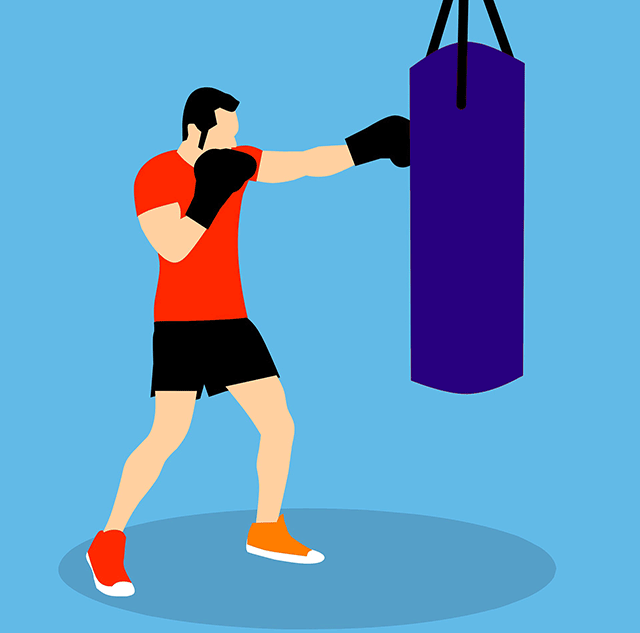
Procedure: A specially instrumented punching bag that can record the force of a hit is used. The athlete is allowed six maximal punches against the bag, with adequate rest between punches (typically 10-15 seconds). The peak and average punching power is recorded.
Scoring: The apparatus used by SPARQ measures peak and average punch power. Unit: Force/Surface Area → PSI (pounds per square inch). Some systems also measure in Newtons (N) for metric standardization.
Target population: Boxing and other combat sports including MMA, kickboxing, Muay Thai, and karate.
The Science Behind Punching Power
Punching power is the result of a complex kinetic chain that transfers force from the ground through the legs, hips, core, shoulders, and finally the fist. According to sports science research, effective punching power depends on several factors:
- Ground Reaction Force: Power generation starts from the feet pushing against the floor
- Hip Rotation: The hips contribute approximately 40% of total punch power
- Core Stability: A strong core transfers energy efficiently between lower and upper body
- Arm Extension Speed: Rapid extension of the arm adds final acceleration
- Timing and Coordination: Proper sequencing maximizes force delivery
Reference: Smith, M.S. et al. "Development of a boxing dynamometer and its punch force discrimination efficacy" Journal of Sports Sciences 18.6 (2000): 445.
Understanding Punch Power Standards
Punch power varies significantly based on weight class, experience, and technique. Here are general guidelines based on research and athletic testing data:
Note: These values represent approximate ranges for heavyweight boxers. Lighter weight classes will typically generate proportionally less absolute force but may have similar or higher power-to-weight ratios.
Equipment and Testing Considerations
Comments:
- A punching bag that measures punch power is difficult to find. A company called Adepta Sport Technologies once produced the "power pad" range of products that had a sensor embedded that was able to measure the PSI of your strike. The company does not seem to be around anymore.
- A new company (strike-research.org) producing a useful power/impact system StrikeMate, is worth checking out.
- If you have specific needs you may have to get something custom built.
- Some gyms now offer force plate systems and wearable sensors that can estimate punch power through acceleration measurements.
- For consistent results, always use the same equipment and testing conditions when tracking progress over time.
How to Improve Your Punching Power
Based on sports science research, here are evidence-based methods to increase your punching power:
Strength Training
- Compound Lifts: Squats, deadlifts, and bench press build foundational strength
- Explosive Movements: Power cleans, push press, and medicine ball throws
- Core Work: Rotational exercises, pallof press, and anti-rotation holds
Technical Development
- Hip Rotation: Focus on driving power from the hips
- Weight Transfer: Practice shifting weight into punches
- Relaxation: Stay loose until the moment of impact
Plyometric Training
- Medicine Ball Throws: Rotational throws, overhead slams
- Box Jumps: Develop lower body explosiveness
- Clap Push-ups: Upper body plyometrics
Frequently Asked Questions
How accurate is this punch power calculator?
This calculator provides analysis based on the force readings you input from your testing equipment. The accuracy of your results depends on the quality and calibration of your force measurement device. For standardized testing, use equipment validated against known force standards.
What's a good punching power score for my weight class?
Power output scales with body weight. Heavyweight boxers typically generate 500-700+ PSI at professional levels, while lighter weight classes like featherweight may see 300-450 PSI. The power-to-weight ratio is often more meaningful for comparing across divisions.
How often should I test my punch power?
Test every 4-6 weeks during training camps to track progress. More frequent testing may lead to inconsistent results due to fatigue or minor technique variations. Always test under similar conditions (same time of day, after similar warm-up, using same equipment).
Does punch speed affect power measurements?
Yes, power is a function of both force and velocity. A faster punch that connects with less mass can sometimes generate similar power readings to a slower, heavier punch. The SPARQ test measures the overall impact force, which combines these factors.
Why do I have inconsistent punch power readings?
Inconsistency often indicates technical issues rather than strength limitations. Focus on consistent foot positioning, hip rotation timing, and point of contact. Fatigue can also cause readings to drop, which is why the test uses only 6 punches with rest between each.
Can I use this calculator without specialized equipment?
This calculator requires actual force measurements from instrumented equipment. Without force sensors, you cannot accurately measure punch power in PSI or Newtons. Consider visiting a sports performance center or investing in equipment like StrikeMate for home testing.
How do glove weight and bag weight affect results?
Heavier gloves (16-18 oz) reduce punch speed but can increase impact absorption time. The standard 100-lb heavy bag provides consistent resistance. Using lighter bags may result in more bag movement and less accurate force transfer measurements.
References
- Smith, M.S., Dyson, R.J., Hale, T., & Janaway, L. (2000). "Development of a boxing dynamometer and its punch force discrimination efficacy." Journal of Sports Sciences, 18(6), 445-450.
- Loturco, I., Nakamura, F.Y., Artioli, G.G., et al. (2016). "Strength and power qualities are highly associated with punching impact in elite amateur boxers." Journal of Strength and Conditioning Research, 30(1), 109-116.
- Pierce, J.D., Reinbold, K.A., Lyngard, B.C., et al. (2006). "Direct measurement of punch force during six professional boxing matches." Journal of Quantitative Analysis in Sports, 2(2).
- Turner, A., Baker, E., & Miller, S. (2011). "Increasing the impact force of the rear hand punch." Strength & Conditioning Journal, 33(6), 2-9.
- Walilko, T.J., Viano, D.C., & Bir, C.A. (2005). "Biomechanics of the head for Olympic boxer punches to the face." British Journal of Sports Medicine, 39(10), 710-719.
Similar Tests
- Measure punching speed
- Quick Strike Test — punching bag test
Related Pages
- The SPARQ rating system for boxing
- About measuring punching speed
- About the SPARQ rating system
- See the list of anaerobic fitness tests
- Fitness testing for boxing
 Any comments, suggestions, or corrections? Please let us know.