Push-Up Beep Test Calculator
Quick Answer
The Push-Up Beep Test measures upper body muscular endurance at a standardized cadence of 25 push-ups per minute. This calculator scores your results against athletic norms used in NHL draft testing.
- Tests muscular endurance at controlled 25/min cadence
- Used in NHL Pre-Draft Combine assessments
- Scores compared to athletic population percentiles
The push-up beep test measures upper body strength and endurance. In this test, the maximum number of push-ups are performed at a rate of 25 push-ups per minute. The following information describes the procedures as once used for the NHL pre-draft testing combine (the test has since been replaced). There is a similar cadence push-up test used for the FitnessGram Program, the President's Challenge Fitness Awards and the Connecticut Physical Fitness Test.
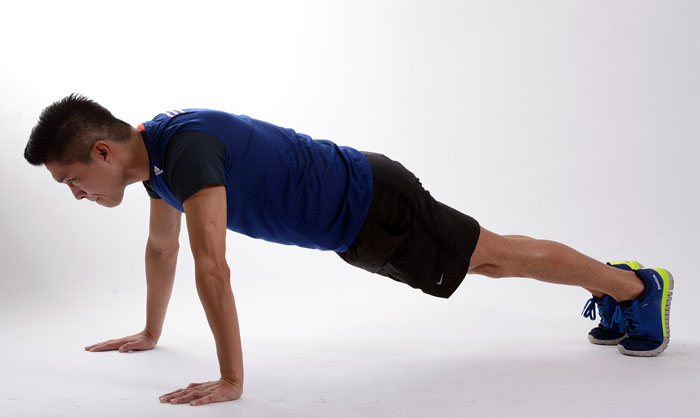
Proper push-up form: straight body line, hands under shoulders
How to Use This Calculator
Follow these steps to calculate your Push-Up Beep Test score and compare your results to athletic standards:
- Perform the Test: Complete as many push-ups as possible at the 25 per minute cadence (use our online push-up metronome set to 50 BPM)
- Enter Your Results: Input the number of correctly completed push-ups in the calculator above
- Select Your Gender: Choose male or female for accurate percentile comparison
- View Your Score: See your performance category, percentile ranking, and personalized training recommendations
Pro Tip: For the most accurate assessment, use the Advanced Options to include your body weight. This provides a relative strength score showing push-ups per kilogram of body weight, valuable for athletes monitoring training progress.
Test Equipment and Setup
Equipment required: Floor mat, method of indicating the desired pace of 25 per minute. Options include a stopwatch for manual calling at the set cadence, a metronome, or our free online push-up metronome. You can also create an audio track using the Team Beep Test software.
Pre-test procedures: Explain the test procedures to the subject. Perform screening of health risks and obtain informed consent. Prepare forms and record basic information such as age, height, body weight, gender and test conditions. Perform a standard warm-up. See more details of pre-test procedures.
Push-Up Beep Test Procedure
Starting Position: Athletes start in the up position, with hands positioned under the shoulders and fingers pointing forward, elbows fully straightened, body straight with feet together.
Movement Execution: For one complete repetition, the athlete lowers the torso so that the elbows reach a 90-degree angle, then returns to the starting position. All movements must be synchronized with the audio cadence.
Scoring: Record the number of correctly completed push-ups that were performed in time to the rhythm. Push-ups that break form or fall out of cadence are not counted.
Understanding Your Results
The Push-Up Beep Test scoring is based on normative data from athletic populations including professional and collegiate athletes. Your performance category indicates where you stand relative to trained athletes:
Elite (50+ male / 40+ female)
Professional athlete level performance. Exceptional upper body endurance suitable for NHL, professional football, and elite combat sports.
Excellent (40-49 male / 30-39 female)
Advanced athlete performance. Strong upper body endurance meeting standards for collegiate athletics and competitive sports.
Good (30-39 male / 20-29 female)
Well-trained athlete level. Solid foundation for most sports requiring upper body pushing strength and endurance.
Average (20-29 male / 12-19 female)
Recreational athlete performance. Adequate for general fitness but room for improvement for competitive athletics.
Sport-Specific Applications
The Push-Up Beep Test is particularly relevant for athletes in sports requiring sustained upper body power and endurance:
Ice Hockey: Hockey players need exceptional upper body endurance for checking, puck battles, and maintaining skating position. NHL combine testing historically used this protocol to assess prospect readiness.
Football: Linemen and linebackers benefit from the sustained pushing endurance measured by this test. The controlled cadence mirrors the repeated effort required throughout a game.
Combat Sports: Boxing, MMA, and wrestling all require sustained upper body muscular endurance. Athletes in these sports typically score in the excellent to elite categories.
CrossFit and Functional Fitness: The cadence push-up test correlates well with performance in workouts requiring high-volume push-up variations under fatigue.
How to Improve Your Score
Based on exercise science research, here are evidence-based strategies to improve your Push-Up Beep Test performance:
- Practice at Cadence: Train specifically at the 25 per minute cadence to develop the pacing and efficiency needed for the test
- Build Baseline Strength: Include bench press, dips, and varied push-up styles (diamond, wide, decline) in your training
- Develop Muscular Endurance: Perform high-rep push-up sets (3 sets of 50-70% max) several times per week
- Strengthen Your Core: A strong core maintains proper body position throughout the test, improving efficiency
- Use Progressive Overload: Gradually increase volume by adding 2-3 reps per week to your training sets
Variations and Related Tests
Cadence Push-Up Test: The cadence push-up test is very similar, though it uses a slower cadence and slightly different technique.
Cadence Bench Press Test: The NHL also uses the cadence Bench Press Test, which assesses a similar muscle group using external resistance.
Target Population: This test is part of the NHL pre-draft fitness assessment, though it would be suitable for any sports in which upper body strength and endurance are important.
Advantages: This test is easy and quick to perform, requires minimal equipment, and provides standardized comparison across athletes.
Testing Note: Participants should be instructed to spend as little time in the starting position beforehand in order to reduce fatigue and increase the number of repetitions. The test is also sometimes called the press-up test.
Frequently Asked Questions
What is a good score on the Push-Up Beep Test?
A good score for males is 30-40 push-ups at the 25 per minute cadence, placing you in the "Good" to "Excellent" categories. Females should aim for 20-30 push-ups. NHL draft prospects typically score 40-60+ push-ups. Elite athletes in sports requiring upper body endurance often exceed 50 push-ups.
How is the Push-Up Beep Test different from a regular push-up test?
The Push-Up Beep Test requires completing push-ups at a set cadence of 25 per minute (one push-up every 2.4 seconds). This controlled pace tests sustained muscular endurance rather than maximum speed, making results more standardized and comparable across athletes. Regular push-up tests often allow any pace.
What cadence is used for the NHL Push-Up Beep Test?
The NHL Pre-Draft Combine uses a cadence of 25 push-ups per minute. Athletes complete one full push-up cycle (down and up) every 2.4 seconds, synchronized to an audio beep. Set a metronome to 50 BPM where each click signals either the down or up movement.
How can I improve my Push-Up Beep Test score?
Practice push-ups at the specific 25/minute cadence using a metronome, build overall upper body strength with varied push-up styles (diamond, wide, decline), develop muscular endurance through high-rep training, and strengthen your core for better form maintenance. Most athletes can improve 5-10 reps within 4-6 weeks of dedicated training.
What muscles does the Push-Up Beep Test assess?
The Push-Up Beep Test primarily assesses strength endurance of the chest (pectoralis major), shoulders (anterior deltoids), triceps, and core stabilizers. It provides a comprehensive upper body pushing assessment that correlates with athletic performance in sports requiring sustained upper body effort.
Can I use this test for youth athletes?
Yes, the Push-Up Beep Test is suitable for athletes aged 12 and older. Youth athletes should focus on proper form and may need modified standards. The cadence remains the same, but expected scores will be lower for younger athletes who are still developing strength.
How often should I retest my Push-Up Beep Test score?
Retest every 4-6 weeks during training phases to track progress. Allow at least 48 hours of rest before testing. For competition preparation, final testing should occur 1-2 weeks before the event to allow recovery while confirming fitness levels.
References
- National Strength and Conditioning Association. (2016). "Essentials of Strength Training and Conditioning." 4th Edition. Human Kinetics.
- NHL Central Scouting. (2019). "NHL Combine Testing Protocols." National Hockey League.
- American College of Sports Medicine. (2022). "ACSM's Guidelines for Exercise Testing and Prescription." 11th Edition. Wolters Kluwer.
- Wood, R. (2008). "Fitness Testing for Athletes: A Comprehensive Guide." Topend Sports Research.
- Baumgartner, T.A., et al. (2007). "Measurement for Evaluation in Physical Education and Exercise Science." 8th Edition. McGraw-Hill.
- Cooper Institute. (2020). "FitnessGram/ActivityGram Test Administration Manual." Human Kinetics.
- Mayhew, J.L., et al. (1991). "Muscular Endurance Repetitions to Predict Bench Press Strength." Journal of Strength and Conditioning Research.
Similar Tests
- Cadence Push-Up Test at 20 per minute
- A similar test, the cadence Bench Press Test performed at 25 per minute at a set weight
- The general push-up test
- A Simple Push-Up Test that can be done at home
- Push-ups as performed in the US Army physical fitness test
- Push-ups as performed in the US Navy PRT
- Cadence Pull-Up Test — at a rate of 15 per minute
Related Pages
- Try our online push-up metronome where you can set any pace
- This test was once part of the NHL pre-draft testing combine
- The alternative test for the President's Challenge and FitnessGram is the pull-up
- World Records for Push Ups
- List of other strength tests
 Any comments, suggestions, or corrections? Please let us know.