Run-2 Cricket Running Speed Test Calculator
Quick Answer
The Run 2 Cricket Speed Test measures your ability to sprint between wickets carrying a bat, including a 180-degree turn. Use this calculator to compare your time against professional cricket standards.
- Professional male average: 6.10 ± 0.16 seconds
- Professional female average: 6.79-6.93 seconds
- Total distance: 35.36 meters (2 × 17.68m crease-to-crease)
Running speed, acceleration, and agility are very important physical attributes for cricket players, particularly for moving between the wickets and when fielding. The Run 2 Speed Test is a cricket fitness test that assesses both speed and agility in a very specific cricket situation (there is also a similar run-a-three cricket test). The Run 2 Test involves sprinting over the actual pitch distance twice, carrying a bat and incorporating one 180 degree turn. This test not only assesses cricket specific running speed, but also technique on the turn and the ability to run with the bat in hand.
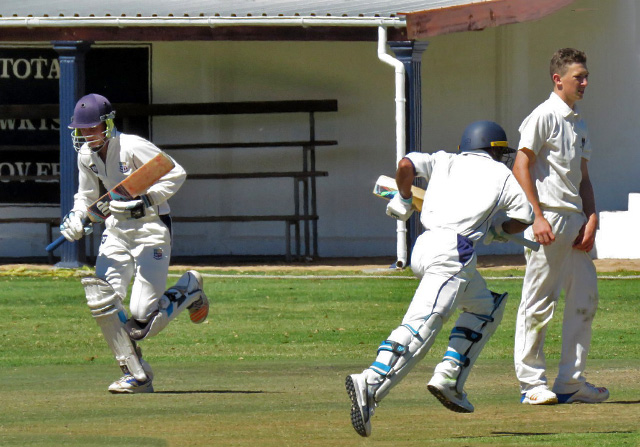 running between wickets in a cricket match
Test purpose: The aim of this test is to assess a player's ability to run quickly between the wickets within a match.
Equipment required: timing gates or stopwatch, non-slip running surface (preferably a cricket pitch), tape for marking the ground and cone markers.
Pre-test: Explain the test procedures to the subject. Perform screening of health risks and obtain informed consent. Prepare forms and record basic information such as age, height, body weight, gender, test conditions including the running surface. Measure and mark out the test area. Perform an appropriate warm-up. Set up and test the timing gates. See more details of pre-test procedures.
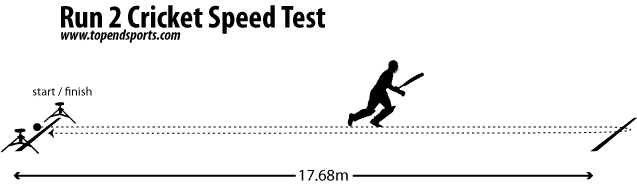
Test setup: If the test is not performed on a cricket pitch, then lines marking the creases need to be made 58 feet or 17.68 meters apart. If using timing gates, they are set up at the line of the popping (batting) crease at each end. Set the timing gates low so that a sliding bat will activate the timer.
Procedure: The run 2 test involves sprinting the length of the cricket pitch, turning and returning to the starting position. The players carry their cricket bat, but do not wear pads and helmet. The starting position is with the foot behind the starting line with the bat in hand. At the turn, players should reach out and slide the bat over the crease mark, then slide the bat ahead of them at the finish as they would in a match. The test should be performed with the bat in the dominant hand, and also the non-preferred hand (and therefore turning off each the left and right foot).
Results: Record the total time to the nearest 0.01 seconds. Two trials are allowed with the bat in each hand, and the fastest times recorded. A group of international male English cricketers recorded an average time of 6.10 ± 0.16 seconds in 2020 (Ahmun et al. 2020). Results for professional (P) and non-professional (NP) female cricketers (Brazier et al. 2024) were: seam-bowlers 6.93 ± 0.20 (P) and 7.04 ± 0.19 (NP) seconds, and non seam-bowlers 6.79 ± 0.30 (P) and 7.01 ± 0.31 (NP) seconds. The results for the non-dominant hand was between 0.06 and 0.12 seconds slower on average.
Target population: cricket players of all levels.
Variations:
- You could also measure and compare to the running speed for run-a-three, and also a straight 17.68m quick single.
- Wearing pads and helmet can add to the cricket specificity of this test.
Comments:
- The distance from stumps to stumps is 22 yards / 66 feet / 20.12m, with the popping crease at each end 4 feet (1.22m) from the stumps. Therefore, from crease to crease is 66 - (2 x 4) = 58 feet, or 17.68 meters.
- The run 2 test has at some stage been part of the English and Wales Cricket Board regional profiling assessment.
Understanding Your Run 2 Test Results
Your Run 2 time reflects your cricket-specific running ability, combining pure speed with turning technique and bat handling. Times are influenced by several factors including acceleration ability, deceleration and turning efficiency, and coordination while carrying equipment.
Interpreting Your Performance Level:
- Elite (Top 10%): Male <5.95s, Female <6.60s - International/professional standard
- Good (Top 30%): Male 5.95-6.15s, Female 6.60-6.90s - First-class/professional level
- Average: Male 6.15-6.40s, Female 6.90-7.15s - Club/county standard
- Below Average: Male >6.40s, Female >7.15s - Development needed
How to Improve Your Run 2 Time
Improving your Run 2 performance requires focused training on several key areas:
Sprint Training: Short sprints of 15-20 meters with maximum acceleration develop the explosive power needed for quick singles and twos. Include both standing starts and rolling starts to replicate match situations.
Turning Technique: Practice the deceleration and turn at the crease. Efficient turning involves lowering your center of gravity, planting the outside foot firmly, and driving explosively out of the turn. The bat slide should be automatic and not slow your momentum.
Bat Handling: Run regularly with your bat in training to develop coordination and reduce any time lost through awkward handling. Practice with both hands to minimize the performance difference between dominant and non-dominant sides.
Agility Drills: Include change-of-direction drills such as the 5-0-5 test, pro agility shuttle, and T-test to develop the neuromuscular coordination required for quick turns.
Frequently Asked Questions
What is a good Run 2 cricket test time?
For professional male cricketers, a good Run 2 time is around 6.10 seconds or faster, with elite performers achieving times under 6.00 seconds. Professional female cricketers typically record times between 6.79-6.93 seconds depending on playing position.
How do you perform the Run 2 cricket test?
Start behind the crease line with bat in hand, sprint 17.68 meters to the far crease sliding your bat over the line, perform a 180-degree turn, then sprint back to the start and slide your bat over the finish line. Time begins when you cross the start and ends when the bat crosses the finish.
Why is the Run 2 test important for cricket?
The Run 2 test directly replicates match conditions for running between wickets. It assesses not just speed, but also turning technique, bat handling, and the ability to accelerate after a turn - all critical skills for converting singles into twos during a match.
Should I test with both dominant and non-dominant hand?
Yes, testing with both hands is recommended. Research shows the non-dominant hand typically produces times 0.06-0.12 seconds slower. Identifying this difference helps target training to improve your weaker side for more consistent match performance.
What equipment is needed for the Run 2 test?
You need timing gates or a stopwatch, a non-slip surface (preferably an actual cricket pitch), tape or markers to indicate the crease lines 17.68 meters apart, and a standard cricket bat. Timing gates positioned low at crease height provide the most accurate results.
How can I improve my Run 2 test time?
Focus on sprint training for acceleration, practice efficient turning technique at the crease, develop bat handling coordination through regular practice, and include agility drills in your training program. Working on both sides equally will help minimize the dominant/non-dominant time difference.
What is the exact distance for the Run 2 cricket test?
The total distance is 35.36 meters (2 × 17.68m). Each leg is 17.68 meters, which is the distance between popping creases. This equals 58 feet, derived from the 66-foot pitch length minus 4 feet at each end for the crease-to-stumps distance.
References
- Ahmun R, Scott P, Jones TW and Tallent, J. Sprint acceleration mechanical profiling of international cricketers. International Journal of Sports Science & Coaching 2020; 15: 745-752.
- Brazier TA, Tallent J, Patterson SD, Howe LP, Callaghan SJ. The physical profile of female cricketers: An investigation between playing standard and position. PLoS One. 2024 Jun 10;19(6).
- Houghton, L. A. (2010). Running between the Wickets in Cricket: What is the Fastest Technique? International Journal of Sports Science & Coaching, 5(1), 101–107.
- Johnstone JA, Ford PA. Physiologic profile of professional cricketers. Journal of Strength and Conditioning Research. 2010;24(11):2900-2907.
- Petersen CJ, Pyne DB, Dawson BT, et al. Movement patterns in cricket vary by both position and game format. Journal of Sports Sciences. 2010;28(1):45-52.
- Duffield R, Drinkwater EJ. Time-motion analysis of Test and One-Day international cricket centuries. Journal of Sports Sciences. 2008;26(5):457-464.
- England and Wales Cricket Board. Regional Profiling Assessment Guidelines. ECB Performance Programme. 2020.
Similar Tests
- Run-a-Three — a cricket speed and agility test, involving sprinting over a cricket pitch distance three times while carrying a bat.
- 5-0-5 Agility Test — run 5m and back, testing 180 degree turning ability.
- Straight 17.68m Sprint — running speed test over the length of a standard cricket wicket.
Related Pages
- More about fitness testing for cricket
- General information about Sprint or Speed Testing
- Training for speed
- Warming up for sprint testing
- Other anaerobic tests and about anaerobic testing
- Fitness for Cricket
- We have listed some suggested tests for testing cricket players.
- Cricket Training Programs
- Fitness Components for Cricket
- Discussion about Who Is The Fittest Cricket Player Ever?
 Any comments, suggestions, or corrections? Please let us know.