Run-a-Three Cricket Fitness Test Calculator
Quick Answer
The Run-a-Three is a cricket-specific fitness test that measures speed and agility by sprinting 53.04 meters (three pitch lengths) with two 180-degree turns while carrying a bat. This calculator analyzes your performance against cricket-specific standards.
- Elite male cricketers typically complete the test in under 9.0 seconds
- Assesses both straight-line speed and turning ability
- Validated by Cricket Australia and sports science research
Running speed, acceleration, and agility are very important physical attributes for cricket players, particularly for moving between the wickets and when fielding. The Run-a-Three Test is a cricket fitness test that assesses both speed and agility in a very specific cricket situation (see also the similar Run 2 Cricket Test). The run-a-three involves sprinting over the actual pitch distance three times, carrying a bat and incorporating two 180 degree turns. This test not only assesses speed, but also technique on the turn and running the bat in at the end.
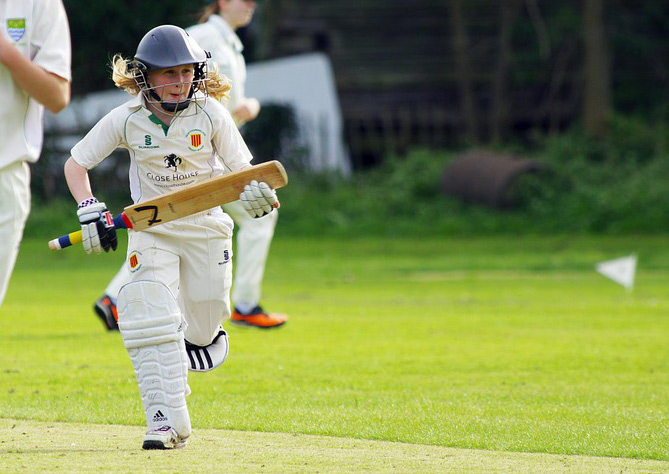 running between wickets in a cricket match
Test Purpose
The aim of this test is to determine the running speed up and down the cricket pitch while wearing cricket equipment. The Run-a-Three specifically measures acceleration, maximum running speed, 180-degree turning ability, and bat grounding technique in a cricket-specific context.
Equipment Required
To conduct the Run-a-Three test, you need: timing gates or stopwatch, non-slip running surface, tape for marking the ground and cone markers.
Pre-Test Procedures
Explain the test procedures to the subject. Perform screening of health risks and obtain informed consent. Prepare forms and record basic information such as age, height, body weight, gender, test conditions including the running surface. Measure and mark out the test area. Perform an appropriate warm-up. Set up and test the timing gates. See more details of pre-test procedures.
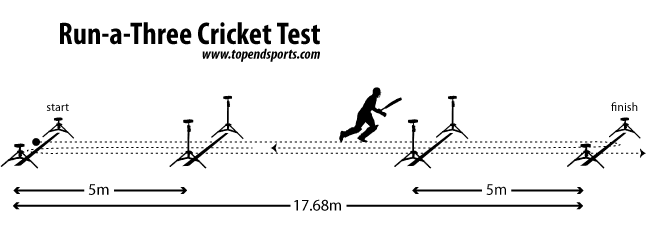
Test Setup
If the test is not performed on a cricket pitch, then lines marking the creases need to be made 17.68 meters apart. If using timing gates, they are set up at the line of the popping (batting) crease at each end, and also 5 meters before each crease. Set the center timing gates at a height of 1.2 m to be activated with the torso, and at each end the timing gates are to be lowered to a height of 0.06 m so that a sliding bat would break the beam.
Test Procedure
The run-a-three test involves three repeated maximal sprint trials to be performed over the same distance as between the batting creases on a cricket pitch (58 feet or 17.68 meters). The players carry their cricket bat (and can also be wearing cricket kit such as pads and helmet). They start running from one end, run to the other crease where they turn and run back to the starting line, turn again then run through the final line. The starting position is with the foot over the starting line with the bat in hand. Players should slide the bat over the crease mark at each end when turning and at the finish.
Recording Results
Three trials are allowed. Record the time for each straight run (58 feet / 17.68m), and total time for the run-a-three. Turning time for the changes of direction between runs 1–2, and 2–3 can also be recorded (timed from when the subject passes through the timing gate 5 m away from the crease, until they return through the same timing gate).
Target Population
This test is designed for cricket players of all levels, from recreational club players to elite international athletes. It is particularly relevant for batsmen who need to run between wickets quickly and for all players in fielding positions.
Test Variations
You could also measure running speed for run-a-two, and also a straight 17.68m quick single. Some protocols include wearing full batting gear (pads, gloves, helmet) for maximum specificity.
Important Considerations
- The participants are required to keep the bat in their dominant hand throughout the test.
- If timing gates are not available, use a stopwatch to record the time from start to finish.
- Wearing pads and helmet adds to the cricket specificity of this test.
- The distance from stumps to stumps is 22 yards / 66 feet / 20.12m, with the popping crease at each end 4 feet (1.22m) from the stumps. Therefore, from crease to crease is 66 - (2 x 4) = 58 feet, or 17.68 meters.
Understanding Your Results
The Run-a-Three test provides valuable insights into cricket-specific fitness. A total time under 9 seconds indicates elite-level speed and agility, while times over 11 seconds suggest room for improvement. The individual split times can identify specific weaknesses—if turn times are slow relative to straight running, technique work is needed; if straight running is slow, sprint training should be prioritized.
How to Improve Your Run-a-Three Time
To improve your Run-a-Three performance, focus on several key areas. Sprint training with short-distance intervals (20-40m) will develop acceleration. Practice efficient turning technique by lowering your center of gravity and using your outside foot to push off. Work on bat grounding mechanics to minimize time at the crease. Plyometric exercises like box jumps and bounding will develop explosive power for quick direction changes.
Frequently Asked Questions
What is a good Run-a-Three time for cricket?
For elite male cricketers, an excellent Run-a-Three time is under 9.0 seconds. Club level players typically achieve 9.5-10.5 seconds. Female players generally have times 0.5-1.0 seconds slower at equivalent levels. Professional players like international representatives consistently achieve times around 8.5-9.0 seconds.
How far is the Run-a-Three cricket test?
The Run-a-Three test covers 53.04 meters total (3 x 17.68 meters). The pitch distance from crease to crease is 17.68 meters (58 feet), which is derived from the 22-yard wicket minus the two popping creases (each 4 feet from the stumps).
What equipment is needed for the Run-a-Three test?
You need timing gates or a stopwatch, a non-slip running surface (cricket pitch or equivalent), tape for marking creases, cone markers, and a cricket bat. Optionally, players can wear pads and helmet for added test specificity that replicates match conditions.
How do I improve my Run-a-Three time?
Focus on sprint training for acceleration, practice efficient turning technique with your outside foot, work on bat grounding mechanics, and develop explosive power through plyometrics. Regular practice on an actual cricket pitch is essential for developing sport-specific movement patterns.
Why do I need to carry a bat during the test?
Carrying the bat adds cricket-specific demands to the test. Players must ground the bat behind the crease line at each turn and at the finish, which is the legal requirement during actual match play for completing a run. This tests both speed and technique under realistic conditions.
How many trials should be performed?
Three trials are typically allowed for the Run-a-Three test. The best time is recorded as the final result. Adequate recovery of 2-3 minutes should be given between attempts to ensure maximal effort and accurate assessment of peak performance capability.
How does the Run-a-Three compare to the Run-a-Two test?
The Run-a-Three covers 53.04m with two turns, while the Run-a-Two covers 35.36m with one turn. The Run-a-Three is more demanding and provides additional data on fatigue resistance and repeated turning ability. Both tests are commonly used in cricket fitness assessments.
References
- Bourdon P., Savage B. and Done R. (2000). "Protocols for the Assessment of Cricket Players." Physiological Tests for Elite Athletes, Australian Sports Commission.
- Lockie, R.G., Callaghan, S.J., & Jeffriess, M.D. (2013). "Analysis of Specific Speed Testing for Cricketers." Journal of Strength and Conditioning Research, 27(11), 2981-2988.
- Houghton, L.A. (2010). "Running between the Wickets in Cricket: What is the Fastest Technique?" International Journal of Sports Science & Coaching, 5(1), 101-107.
- Petersen, C.J., Pyne, D.B., Portus, M.R., & Dawson, B. (2009). "Validity and Reliability of GPS Units to Monitor Cricket-Specific Movement Patterns." International Journal of Sports Physiology and Performance, 4(3), 381-393.
- Duffield, R., & Drinkwater, E.J. (2008). "Time-Motion Analysis of Test and One-Day International Cricket Centuries." Journal of Sports Sciences, 26(5), 457-464.
- Noakes, T.D., & Durandt, J.J. (2000). "Physiological Requirements of Cricket." Journal of Sports Sciences, 18(12), 919-929.
- Stretch, R.A., Bartlett, R., & Davids, K. (2000). "A Review of Batting in Men's Cricket." Journal of Sports Sciences, 18(12), 931-949.
Similar Tests
- Run 2 Cricket Running Speed Test — a cricket speed and agility test, involving sprinting the length of a cricket pitch twice.
- 5-0-5 Agility Test — run 5m and back, testing 180 degree turning ability.
- Straight 17.68m Sprint — running speed test over the length of a standard cricket wicket.
Related Pages
- More about fitness testing for cricket
- General information about Sprint or Speed Testing
- Training for speed
- Warming up for sprint testing
- Other anaerobic tests and about anaerobic testing
- Fitness for Cricket
- We have listed some suggested tests for testing cricket players.
- Cricket Training Programs
- Fitness Components for Cricket
- Discussion about Who Is The Fittest Cricket Player Ever?
 Any comments, suggestions, or corrections? Please let us know.