VAMEVAL Test Calculator
Quick Answer
This calculator determines your Maximal Aerobic Speed (MAS) and estimates VO₂max from your VAMEVAL test results. Enter your final completed stage to instantly see your aerobic fitness level and personalized training zones.
- Uses the validated Cazorla & Léger formula (1993): VO₂max = 3.5 × MAS
- Provides training pace zones based on your MAS
- Includes fitness ratings compared to athletic populations
The VAMEVAL (VAM-Eval) Test is a running test which can be used to calculate the maximal aerobic speed (Cazorla and Leger, 1993). The test involves running around a track, increasing the pace every minute. The maximal aerobic speed (or maximal running speed) is defined as the slowest speed at which you reach VO2max. This speed is used to help set an appropriate running pace in training programs.
How to Use This Calculator
Using this VAMEVAL calculator is straightforward and takes less than a minute once you have completed the test. Follow these steps to determine your maximal aerobic speed and estimated VO₂max:
- Complete the VAMEVAL test following the standard protocol on a 200m or 400m track with markers every 20 meters.
- Note your final stage - this is the last complete minute you achieved before dropping out or failing to keep pace with the audio signals.
- Select your stage using either the dropdown menu or by clicking the corresponding stage button in the calculator above.
- Click "Calculate Results" to instantly see your MAS, estimated VO₂max, fitness rating, and recommended training zones.
The calculator provides training pace zones based on your MAS, which you can use to structure interval sessions, tempo runs, and recovery workouts. These zones follow established sports science guidelines for aerobic development.
VAMEVAL Test Protocol
Test purpose: The purpose of this test is to calculate the maximal aerobic speed.
Equipment required: 200m or 400m circular track, stopwatch, marker cones, VAMEVAL audio track, recording sheets.
Pre-test: Explain the test procedures to the subject. Perform screening of health risks and obtain informed consent. Prepare forms and record basic information such as age, height, body weight, gender, test conditions. Measure and mark out the course using cones. Perform a thorough warm-up. See more details of pre-test procedures.
Test setup: The test can be completed on a 200m or 400m oval or round track. You can create a 200m circle using a tape measure from a central point (radius 31.85m). Place cones every 20 meters around the track. You can start one player on each cone (up to 10 players at once on a 200m track).
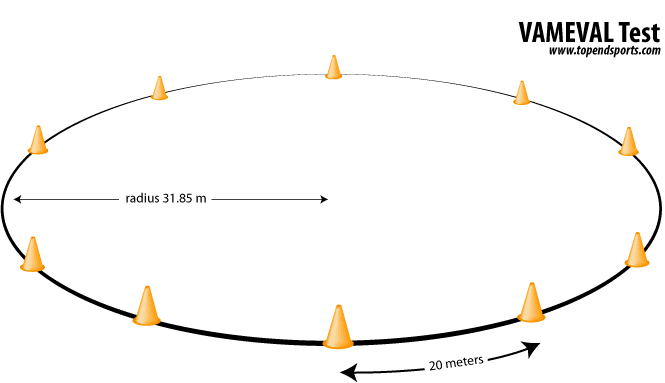
Procedure: The participants run around a track with markers placed every 20 meters. The test begins at 8km/hr and the pace increases by 0.5km/hr every minute. Each player must maintain the correct speed as indicated by the audio recording, so that they are in line with a marker cone when each pacing signal sounds. If a player is one meter or more behind the required pace, they receive a warning. If they are more than two meters behind, they have reached the end of the test and their result is recorded.
Scoring: The maximal aerobic speed (VMA) of the last shuttle achieved is recorded. The maximal oxygen consumption (VO₂max) is estimated by the formula: VO₂max (ml/min/kg) = 3.5 × VMA (km/h).
Variations: The starting speed can vary depending on the fitness of the subject group. Guessogo et al. (2018) have proposed a reduced area version conducted on a 20m square area, which may be useful if the larger space is not available. You can also conduct this test on a treadmill, where the gradient should be set at 1% to simulate flat outdoor running.
Advantages: Groups of athletes can be tested at once, and it is a very cheap and simple test to perform. As the test is conducted on a circular running track, all the athletes will be in view throughout the test.
Understanding Your Results
Your VAMEVAL test results provide valuable information about your aerobic fitness that can guide your training program:
Maximal Aerobic Speed (MAS)
MAS represents the minimum running speed at which you achieve your maximum oxygen uptake (VO₂max). This is a crucial metric for endurance athletes because it provides a practical, pace-based measure of aerobic capacity that can be directly applied to training prescription. A higher MAS indicates greater aerobic power and the ability to sustain faster running speeds.
Estimated VO₂max
The calculator estimates your VO₂max using the formula: VO₂max = 3.5 × MAS. While this estimation has been validated in athletic populations, direct laboratory testing provides the most accurate VO₂max measurement. However, for practical training purposes, this estimate is highly useful and correlates well with measured values.
Fitness Rating Categories
Your results are compared to normative data for athletic populations:
- Elite: MAS ≥20 km/h (VO₂max ≥70 ml/kg/min) - Professional endurance athletes
- Excellent: MAS 18-20 km/h (VO₂max 63-70) - Competitive club athletes
- Good: MAS 16-18 km/h (VO₂max 56-63) - Regular trained athletes
- Average: MAS 14-16 km/h (VO₂max 49-56) - Recreationally active individuals
- Below Average: MAS 12-14 km/h (VO₂max 42-49) - Occasionally active
- Poor: MAS <12 km/h (VO₂max <42) - Sedentary individuals
Training Applications
Once you know your MAS, you can structure training sessions using percentage-based zones:
- Recovery runs (60-70% MAS): Easy aerobic sessions that promote recovery and build aerobic base without excessive stress.
- Aerobic base (70-80% MAS): Steady-state runs that develop cardiovascular efficiency and fat oxidation capacity.
- Tempo runs (80-90% MAS): Sustained efforts at lactate threshold that improve lactate clearance and race pace endurance.
- VO₂max intervals (95-105% MAS): High-intensity intervals that maximize oxygen uptake and aerobic power development.
- Anaerobic capacity (>105% MAS): Short, supramaximal efforts that develop speed endurance and anaerobic power.
Sport-Specific Applications
The VAMEVAL test and MAS concept are widely used across various sports:
Soccer and Team Sports
Many professional soccer clubs use the VAMEVAL test during preseason to establish baseline fitness and prescribe individual training intensities. Players typically achieve MAS values of 15-18 km/h, with midfielders often recording the highest values due to their high-volume running demands.
Distance Running
Competitive distance runners use MAS to structure interval training. For example, 1000m intervals at 100% MAS with 2-minute recoveries effectively develop VO₂max, while shorter 200-400m repetitions at 110-120% MAS build speed endurance.
Rugby and Football
Rugby and American football programs use VAMEVAL results to ensure players meet position-specific aerobic standards. Backs typically require higher MAS values (16-19 km/h) than forwards (14-17 km/h) due to differing match demands.
Cycling and Triathlon
While the test is running-specific, the VO₂max estimate provides useful cross-sport comparisons. Triathletes can use their running MAS alongside cycling power data to identify limiters and balance their training.
How to Improve Your VAMEVAL Score
Improving your maximal aerobic speed requires a systematic approach combining different training methods:
High-Intensity Interval Training
Perform 2-3 sessions per week of intervals at 90-105% of your current MAS. Effective protocols include 30/30s (30 seconds at 100-105% MAS, 30 seconds recovery), 1000m repetitions at MAS, or hill repeats that elevate heart rate to maximum.
Tempo Runs
Weekly tempo runs at 85-90% MAS improve lactate threshold and running economy. Start with 20 minutes and progressively extend to 40-50 minutes as fitness improves.
Aerobic Base Building
Maintain a foundation of easy running at 60-75% MAS. This builds capillary density, mitochondrial function, and fat oxidation capacity that supports higher-intensity work.
Progressive Overload
Increase training volume by no more than 10% per week. Allow 6-12 weeks of consistent training before retesting to see measurable improvements in MAS.
Frequently Asked Questions
What is the VAMEVAL test?
The VAMEVAL (VAM-Eval) test is a maximal running test conducted on a circular track that measures maximal aerobic speed (MAS). Athletes run around cones placed every 20 meters while following audio signals, with speed increasing by 0.5 km/h every minute starting at 8 km/h. It was developed by Cazorla and Léger in 1993.
How is VO₂max calculated from the VAMEVAL test?
VO₂max is estimated using the formula: VO₂max (ml/min/kg) = 3.5 × MAS (km/h), where MAS is the maximal aerobic speed achieved in the final completed stage. For example, a MAS of 16 km/h gives an estimated VO₂max of 56 ml/kg/min.
What is a good maximal aerobic speed?
For recreational athletes, a MAS of 14-16 km/h is considered good. Competitive endurance athletes typically achieve 17-19 km/h, while elite professional athletes may reach 20-22+ km/h. Values vary by sport, age, and gender.
How does the VAMEVAL test differ from the beep test?
The VAMEVAL test is conducted continuously around a circular track (200m or 400m), while the beep test involves 20m shuttle runs with direction changes. The VAMEVAL has smaller speed increments (0.5 km/h vs 0.5-1 km/h) and starts at a slower pace (8 km/h vs typically 8.5 km/h). The circular format eliminates deceleration and acceleration demands.
How can I improve my VAMEVAL test score?
Improve your MAS through interval training at 90-105% of current MAS, tempo runs at 80-90% MAS, and consistent aerobic base training. Include 2-3 high-intensity sessions per week while maintaining easy running volume. Most athletes see significant improvements over 6-12 weeks of structured training.
How often should I perform the VAMEVAL test?
Test every 6-12 weeks to track progress, or at key points in your training cycle such as preseason, mid-season, and post-season. More frequent testing doesn't allow enough time for measurable adaptations and adds unnecessary fatigue.
Can I do the VAMEVAL test on a treadmill?
Yes, the VAMEVAL test can be performed on a treadmill. Set the gradient to 1% to simulate the energy cost of outdoor running against air resistance. Manually increase the speed by 0.5 km/h each minute following the standard protocol.
References
- Cazorla, G., & Léger, L.A. (1993). "Comment évaluer et développer vos capacités aérobies? Epreuves de course navette et épreuve VAM-Eval." Eds AREAPS.
- Guessogo, W.R., et al. (2018). "The 20 m² VAMEVAL Test: A Reduced Space Approach to Determine the Maximum Oxygen Consumption of Young Cameroonians." International Journal of Sports Science and Physical Education, 3(2), 27-31.
- Billat, V., & Koralsztein, J.P. (1996). "Significance of the velocity at VO2max and time to exhaustion at this velocity." Sports Medicine, 22(2), 90-108.
- Léger, L., & Boucher, R. (1980). "An indirect continuous running multistage field test: the Université de Montréal track test." Canadian Journal of Applied Sport Sciences, 5(2), 77-84.
- Dupont, G., et al. (2004). "Relationship between oxygen uptake kinetics and performance in repeated running sprints." European Journal of Applied Physiology, 91(4), 382-388.
- Buchheit, M., & Laursen, P.B. (2013). "High-intensity interval training, solutions to the programming puzzle." Sports Medicine, 43(5), 313-338.
- Midgley, A.W., McNaughton, L.R., & Wilkinson, M. (2006). "Is there an optimal training intensity for enhancing the maximal oxygen uptake of distance runners?" Sports Medicine, 36(2), 117-132.
Similar Tests
- University of Montreal Track Test — the original beep test, though run continuously around a track.
Related Pages
- About measuring Maximal Aerobic Speed (MAS)
- General Walk or Run Test
- Other aerobic tests
- All fitness test list
 Any comments, suggestions, or corrections? Please let us know.