Waist to Hip Ratio (WHR) Calculator
Quick Answer
The Waist to Hip Ratio (WHR) is calculated by dividing your waist circumference by your hip circumference. This measure indicates body fat distribution and is a key indicator of cardiovascular disease risk.
- Formula: WHR = Waist ÷ Hip circumference
- Healthy range: Below 0.90 for men, below 0.80 for women
- Athletic application: Monitors body composition changes during training cycles
The waist to hip ratio is the ratio of waist circumference to the hip circumference, a simple calculation of the measurements of the waist girth divided by the hip girth. This test has been shown to be related to the risk of coronary heart disease. The basis of this measure as a coronary disease risk factor is the assumption that fat stored around the waist poses a greater risk to health than fat stored elsewhere in the body.
Test Procedure
Purpose: To determine the ratio of waist circumference to the hip circumference, as this has been shown to be related to the risk of coronary heart disease.
Equipment required: Tape measure
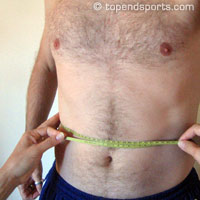
Procedure: A simple calculation of the measurements of the waist girth divided by the hip girth. Waist to Hip Ratio (WHR) = Gw / Gh, where Gw = waist girth, Gh = hip girth. It does not matter which units of measurement you use, as long as it is the same for each measure.
Scoring and Classification
The table below gives general guidelines for acceptable levels for hip to waist ratio. Acceptable values are excellent and good. You can use any units for the measurements (e.g., cm or inches), as it is only the ratio that is important.
| Classification | Male | Female |
|---|---|---|
| Extreme | > 1.00 | > 0.90 |
| High | 0.95 - 1.00 | 0.85 - 0.90 |
| Average | 0.90 - 0.95 | 0.80 - 0.85 |
| Good | 0.85 - 0.90 | 0.75 - 0.80 |
| Excellent | < 0.85 | < 0.75 |
The Science Behind WHR
The waist to hip ratio serves as a valuable indicator of visceral fat distribution. Research has consistently shown that individuals with higher WHR values have increased risk for cardiovascular disease, type 2 diabetes, and metabolic syndrome. This is because abdominal fat (apple-shaped body distribution) is more metabolically active and produces hormones and inflammatory substances that negatively affect health.
For athletes, WHR provides insight into body composition that complements other measures like body mass index (BMI). Unlike BMI, which only considers total body weight relative to height, WHR specifically addresses where fat is distributed, making it particularly valuable for athletes who may have higher muscle mass.
Sport-Specific Applications
Different sports have varying optimal WHR ranges based on performance demands:
Endurance Sports (Marathon, Cycling, Triathlon): Athletes typically have lower WHR values (males: 0.78-0.85, females: 0.70-0.78) due to reduced body fat from high training volumes.
Power Sports (Weightlifting, Football, Wrestling): Athletes may have slightly higher WHR values (males: 0.85-0.92, females: 0.75-0.82) due to greater muscle mass around the core.
Team Sports (Basketball, Soccer, Hockey): Position-specific variations exist, with WHR values typically ranging from 0.82-0.90 for males and 0.72-0.80 for females.
How to Improve Your WHR
If your WHR falls outside the healthy range, several evidence-based strategies can help:
- Cardiovascular exercise: Regular aerobic training helps reduce visceral fat and waist circumference
- Strength training: Building muscle increases metabolic rate and improves body composition
- Dietary modifications: Reducing processed foods and increasing protein intake supports fat loss
- Stress management: Chronic stress increases cortisol, which promotes abdominal fat storage
- Adequate sleep: Poor sleep is associated with increased waist circumference
Target population: This measure is often used to determine the coronary artery disease risk factor associated with obesity.
Advantages: The WHR is a simple measure that can be taken at home by anyone to monitor their own body composition levels.
Frequently Asked Questions
What is a healthy waist to hip ratio?
For men, a healthy WHR is below 0.90, with excellent being below 0.85. For women, a healthy WHR is below 0.80, with excellent being below 0.75. Higher ratios indicate greater abdominal fat and increased health risks.
How do you calculate waist to hip ratio?
Waist to hip ratio is calculated by dividing your waist circumference by your hip circumference. For example, if your waist measures 80 cm and your hips measure 100 cm, your WHR is 80 ÷ 100 = 0.80.
Why is waist to hip ratio important for athletes?
WHR helps athletes monitor body fat distribution, which affects performance, movement efficiency, and injury risk. Different sports have optimal WHR ranges based on the demands of the activity.
Is waist to hip ratio better than BMI?
WHR is often considered more useful than BMI for assessing health risks because it measures fat distribution rather than just overall weight. Central obesity (high WHR) is a stronger predictor of cardiovascular disease than BMI alone.
How often should I measure my waist to hip ratio?
Athletes should measure WHR monthly during training phases and weekly during body composition change periods. For general health monitoring, measuring every 1-3 months is sufficient.
What affects waist to hip ratio?
WHR is influenced by genetics, diet, exercise habits, hormones, and age. Regular cardiovascular exercise and strength training can help reduce waist circumference and improve WHR.
Where exactly should I measure waist and hip circumference?
Measure waist at the narrowest point between ribs and iliac crest (usually at the navel level). Measure hips at the widest point around the buttocks. Use a flexible tape measure and ensure it's level around your body.
References
- World Health Organization. (2011). "Waist Circumference and Waist-Hip Ratio: Report of a WHO Expert Consultation." WHO Technical Report Series.
- Yusuf, S., et al. (2005). "Obesity and the Risk of Myocardial Infarction in 27,000 Participants from 52 Countries: A Case-Control Study." The Lancet, 366(9497), 1640-1649.
- Lear, S.A., et al. (2010). "Ethnic Variation in Fat and Lean Body Mass and the Association with Insulin Resistance." Journal of Clinical Endocrinology & Metabolism, 95(4), 1761-1768.
- de Koning, L., et al. (2007). "Waist Circumference and Waist-to-Hip Ratio as Predictors of Cardiovascular Events: Meta-Regression Analysis of Prospective Studies." European Heart Journal, 28(7), 850-856.
- Price, G.M., et al. (2006). "Weight, Shape, and Mortality Risk in Older Persons: Elevated Waist-Hip Ratio, Not High Body Mass Index, Is Associated with a Greater Risk of Death." American Journal of Clinical Nutrition, 84(2), 449-460.
- Norton, K. & Olds, T. (1996). "Anthropometrica: A Textbook of Body Measurement for Sports and Health Courses." UNSW Press.
- American College of Sports Medicine. (2021). "ACSM's Guidelines for Exercise Testing and Prescription." Lippincott Williams & Wilkins. 11th Edition.
Similar Tests
- General procedures for girth measurements, plus waist girth and hip girth procedure
- Adiposity Index — another measure of body composition using the hip circumference and height
- Waist to Height Ratio — a simple body composition measure.
- Body Mass Index (BMI) — calculated by taking a person's weight and dividing by their height squared.
- Body Roundness Index (BRI) — a measure of body shape and fat distribution based on height and waist circumference.
Related Pages
- Other body composition tests and anthropometrical tests
- About measuring body composition
- Using girth measures to calculate percent body fat
- Using MyoTape for girth measurement.
 Any comments, suggestions, or corrections? Please let us know.