Ankle Girth Calculator
Quick Answer
This calculator measures your ankle circumference and compares it to population norms, helping athletes track swelling, determine brace sizing, and assess lower body frame size.
- Average male ankle girth: 8.73 inches (22.17 cm)
- Average female ankle girth: 8.08 inches (20.53 cm)
- Clinically significant swelling: 1 cm or more difference between ankles
How to Measure Ankle Girth Accurately
Girths are circumference measures taken at standard anatomical sites around the body. The ankle girth measurement is taken at the level of the narrowest point of the ankle, typically just above the ankle bone (malleolus). This measurement is widely used by physical therapists, athletic trainers, and sports medicine professionals to assess ankle swelling, track recovery from injuries, and determine appropriate support equipment sizing.
Purpose: To measure the circumference of the ankle as one of the many measurements of body size, track swelling from injuries, and assess lower body frame size.
Equipment required: Flexible metal tape measure and pen suitable for marking the skin. If a plastic or cloth tape is used, it should be checked regularly against a metal tape as they may stretch over time.
Pre-test: Explain the test procedures to the subject. Prepare forms and record basic information such as age, height, body weight, gender. See more details of pre-test procedures.
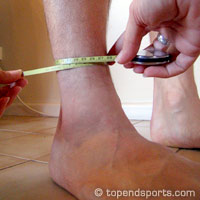
Measurement Procedure
Step 1: Have the subject stand with feet flat on the ground, or sit with the leg extended if standing is difficult.
Step 2: Locate the narrowest point of the ankle, typically just above the medial and lateral malleoli (ankle bones). The minimal girth point is not always obvious, and the tape may need to be moved up and down to find the point of least circumference.
Step 3: Wrap the tape measure horizontally around the ankle at this point. Ensure the tape is not too tight or too loose, is lying flat on the skin, and is horizontal.
Step 4: Record the measurement to the nearest 0.1 cm or 1/16 inch.
Pro Tip: It may help to have the subject stand on a box to make the measurement easier. For athletes tracking swelling, always measure at the same time of day (preferably morning before training) for consistent results.
Understanding Average Ankle Size
Based on comprehensive US anthropometric data, the average ankle circumference varies by gender. According to research measuring 1,774 men and 2,208 women, the average male ankle size is 8.73 inches (22.17 cm), while the average female ankle size is 8.08 inches (20.53 cm). These values represent the 50th percentile, meaning half the population has smaller ankles and half has larger.
Ankle circumference varies considerably within the population due to differences in bone structure, body composition, and genetics. For men, ankle measurements range from 7.61 inches at the 1st percentile to 9.90 inches at the 99th percentile—a difference of 2.29 inches. Women show a similar range from 7.08 to 9.31 inches. Professional football players from a Turkish study showed an average ankle measurement of 9.04 inches (22.97 cm), reflecting their larger overall frame sizes.
Sport-Specific Applications of Ankle Girth Measurement
Ankle girth measurements serve multiple purposes across different sports and athletic contexts:
Injury Assessment and Rehabilitation
Physical therapists and athletic trainers use ankle girth measurements to quantify swelling (edema) following ankle sprains, fractures, or surgery. The figure-of-eight measurement method has been validated with an intraclass correlation coefficient of 0.99, making it highly reliable for clinical use. A difference of 1 cm or more between the injured and uninjured ankle is considered clinically significant and indicates meaningful swelling.
Equipment Sizing
Accurate ankle measurements are essential for proper fitting of ankle braces, compression sleeves, and athletic tape. Improperly sized equipment can compromise support and potentially increase injury risk. Most manufacturers provide sizing charts based on ankle circumference, making this measurement critical for athletes requiring ankle support.
Body Composition Assessment
Unlike wrist circumference, which is commonly used to assess upper body frame size, ankle girth can provide insights into lower body frame size. Some individuals have different upper and lower body frame sizes—a phenomenon particularly common in athletes with sport-specific training adaptations. Combining ankle and wrist measurements provides a more complete picture of overall skeletal frame.
Training Monitoring
Regular ankle girth measurements can help coaches and athletes monitor for overtraining-related inflammation or detect early signs of injury before symptoms become apparent. Girth measurements combined with skinfold measurements can give a clearer picture of changes in tissue composition and distribution of muscle and fat.
Reliability and Accuracy
Reliability: The ankle girth measurement has demonstrated excellent inter-rater and intra-rater reliability in research settings, with ICC values consistently above 0.95. Factors that may affect reliability include changes to the testing personnel, constant and even tension on the tape, and correct landmarking (finding the correct anatomical site for measurement).
Advantages: Low costs involved in the testing procedure, ease of self-testing, and no special equipment beyond a tape measure.
Limitations: Unlike volumetric water displacement methods (the gold standard for limb volume measurement), tape measurements may not capture localized swelling as accurately. However, the figure-of-eight method provides a practical and reliable alternative for most clinical and athletic applications.
Frequently Asked Questions
What is the average ankle circumference for men and women?
The average ankle circumference for men is 8.73 inches (22.17 cm) and for women is 8.08 inches (20.53 cm), based on US anthropometric data. Individual variation is significant, with normal ranges spanning approximately 7.5 to 10 inches depending on frame size and body composition.
How do I know if my ankle is swollen?
Compare your injured ankle to your uninjured ankle using the calculator above. A difference of 1 cm (0.4 inches) or more is considered clinically significant swelling. Also look for visual puffiness, difficulty wearing shoes, and reduced range of motion.
What ankle brace size should I get?
Use the Brace Sizing tab in the calculator above. Generally, ankles measuring 19-22 cm (7.5-8.7 inches) are size Small, 21-24 cm (8.3-9.4 inches) are Medium, and 24-27 cm (9.4-10.6 inches) are Large. When between sizes, choose the larger size for comfort.
Can ankle size indicate lower body frame size?
Yes, ankle circumference can indicate lower body frame size similar to how wrist circumference indicates upper body frame size. Some individuals have different upper and lower body frames, particularly athletes who have developed sport-specific adaptations.
How often should I measure ankle girth when tracking an injury?
For acute injuries, measure daily at the same time (morning is ideal). For chronic conditions or rehabilitation tracking, weekly measurements are typically sufficient. Always measure both ankles for comparison and document your progress.
Why do athletes have different ankle sizes?
Ankle size varies based on genetics, bone structure, body composition, and sport-specific adaptations. Power athletes typically have larger ankle circumferences due to increased bone density and muscle mass in the lower leg. Professional football players average 9.04 inches compared to the general population average of 8.4 inches.
What is the figure-of-eight ankle measurement method?
The figure-of-eight method involves wrapping tape in a specific pattern around the ankle and foot to capture more comprehensive volume. It has excellent reliability (ICC 0.99) and is commonly used in clinical settings for measuring ankle edema. The standard minimal girth method used in this calculator is simpler and effective for most applications.
References
- Gordon, C.C., et al. (1988). "1988 Anthropometric Survey of U.S. Army Personnel." U.S. Army Natick Research, Development and Engineering Center.
- Tatro-Adams, D., McGann, S.F., & Carbone, W. (1995). "Reliability of the Figure-of-Eight Method of Ankle Measurement." Journal of Orthopaedic & Sports Physical Therapy, 22(4), 161-163.
- Rohner-Spengler, M., Mannion, A.F., & Babst, R. (2007). "Reliability and minimal detectable change for the figure-of-eight-20 method of measurement of ankle edema." Journal of Orthopaedic & Sports Physical Therapy, 37(4), 199-205.
- Petersen, E.J., et al. (1999). "Reliability of water volumetry and the figure of eight method on subjects with ankle joint swelling." Journal of Orthopaedic & Sports Physical Therapy, 29(10), 609-615.
- Wilmore, J.H., & Costill, D.L. (2004). Physiology of Sport and Exercise. Human Kinetics.
- Marfell-Jones, M., et al. (2006). International Standards for Anthropometric Assessment. ISAK.
- Liehr, P., et al. (1992). "Measurement of ankle edema." Clinical Nursing Research, 1(2), 134-142.
Similar Tests
Related Pages
Girth Measurements
General description of taking girth measurements, and links to other girth measurement sites.
Learn More →MyoTape for Girth Measurement
Using the MyoTape self-measuring tape for accurate circumference measurements.
Learn More →Body Size Testing
A discussion about body size testing and its applications in sports science.
Learn More →Anthropometry Tests
Complete list of anthropometric tests and measurements used in fitness testing.
Learn More →Videos of Anthropometric Tests
Watch instructional videos demonstrating proper measurement techniques.
Watch Videos → Any comments, suggestions, or corrections? Please let us know.