Wrist Girth Calculator
Quick Answer
This wrist girth calculator determines your body frame size and calculates your ideal body proportions based on wrist circumference measurement. Simply enter your wrist measurement, height, and gender for instant results.
- Determines body frame size (small, medium, large) using standardized tables
- Calculates ideal body proportions using the McCallum formula for athletes
- Based on validated methodology from Metropolitan Life Insurance Company
How to Measure Your Wrist Girth
Wrist girth measurement is a circumference measure taken around the wrist at the narrowest point, just distal to the styloid processes. This measurement is particularly valuable because the wrist contains minimal fat and muscle tissue, making it an excellent indicator of skeletal frame size. Athletes and coaches use wrist girth to assess body structure and set realistic training goals.
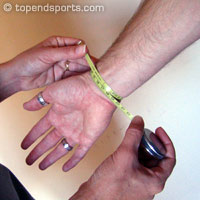
Measurement Procedure
Follow these steps for accurate wrist girth measurement:
- Position your arm: Extend your right arm horizontally with your hand relaxed and fingers slightly spread
- Locate the measurement site: Find the narrowest point of your wrist, just distal (toward the hand) from the styloid processes - the bony protrusions on each side of your wrist
- Apply the tape: Wrap a flexible tape measure around your wrist at this location, ensuring it lies flat against the skin. See more details of pre-test procedures
- Record the measurement: The tape should be snug but not compressing the tissue. Move the tape slightly to confirm you have captured the minimum circumference
Pro Tip: For consistency, always measure on the right arm at the same time of day. Using a flexible metal tape ensures accuracy, as cloth or plastic tapes may stretch over time.
Equipment Required
You will need a flexible metal tape measure and optionally a pen suitable for marking the skin. If using a plastic or cloth tape, check it regularly against a metal tape as these materials may stretch over time. The MyoTape is also an excellent tool for taking girth measurements consistently.
Understanding Body Frame Size
Body frame size categorizes your skeletal structure as small, medium, or large based on the ratio of your height to wrist circumference. This classification, developed by the Metropolitan Life Insurance Company in the 1940s, helps determine appropriate weight ranges and realistic fitness goals for individuals with different bone structures.
Small Frame
Characterized by lighter bone structure. Athletes with small frames may excel in endurance sports and weight-class competitions.
Medium Frame
The most common frame size. Provides good versatility for various sports and training adaptations.
Large Frame
Indicates heavier bone structure. Athletes may have advantages in strength and power sports requiring greater mass.
Body Frame Size Reference Tables
The following tables show the wrist circumference ranges for determining body frame size based on gender and height:
Female Body Frame Size (by Wrist Circumference)
| Height | Small Frame | Medium Frame | Large Frame |
|---|---|---|---|
| Under 5'2" (157 cm) | < 5.5" (14 cm) | 5.5" - 5.75" (14-14.6 cm) | > 5.75" (14.6 cm) |
| 5'2" - 5'5" (157-165 cm) | < 6" (15.2 cm) | 6" - 6.25" (15.2-15.9 cm) | > 6.25" (15.9 cm) |
| Over 5'5" (165 cm) | < 6.25" (15.9 cm) | 6.25" - 6.5" (15.9-16.5 cm) | > 6.5" (16.5 cm) |
Male Body Frame Size (by Wrist Circumference)
| Height | Small Frame | Medium Frame | Large Frame |
|---|---|---|---|
| Over 5'5" (165 cm) | 5.5" - 6.5" (14-16.5 cm) | 6.5" - 7.5" (16.5-19 cm) | > 7.5" (19 cm) |
The McCallum Formula for Ideal Body Proportions
John McCallum, a prominent fitness writer of the 1960s and 1970s, developed a formula for calculating ideal body proportions based on wrist circumference. His "Keys to Progress" column in Strength & Health magazine popularized this method among natural athletes and bodybuilders seeking realistic, achievable physique goals.
The McCallum formula uses wrist girth as the foundation measurement because wrist size strongly correlates with overall skeletal structure. Unlike other body measurements that can change significantly with training, wrist circumference remains relatively constant, making it an ideal baseline for proportional calculations.
McCallum's Proportional Relationships
| Body Part | Formula | Example (17 cm wrist) |
|---|---|---|
| Chest | Wrist × 6.5 | 110.5 cm |
| Hips | Chest × 0.85 | 93.9 cm |
| Waist | Chest × 0.70 | 77.4 cm |
| Thigh | Chest × 0.53 | 58.6 cm |
| Neck | Chest × 0.37 | 40.9 cm |
| Upper Arm (Biceps) | Chest × 0.36 | 39.8 cm |
| Calf | Chest × 0.34 | 37.6 cm |
| Forearm | Chest × 0.29 | 32.0 cm |
Sport-Specific Applications of Wrist Girth Measurement
Wrist girth measurements have practical applications across many sports where body composition and frame size influence performance:
Strength and Power Sports
In weightlifting, powerlifting, and strongman competitions, athletes with larger wrist circumferences typically have greater potential for muscle mass development. Coaches use frame size assessment to set realistic strength goals and predict competitive weight classes.
Combat Sports and Weight-Class Athletics
Wrestlers, boxers, and martial artists use body frame analysis to determine optimal competition weight classes. A larger-framed athlete may perform better at a higher weight class, while smaller-framed competitors can cut weight more effectively.
Endurance Sports
Distance runners, cyclists, and triathletes often have smaller frame sizes, which correlates with lower body mass and improved power-to-weight ratios. Frame size assessment helps these athletes understand their genetic advantages.
Team Sports
Position-specific requirements in football, rugby, and basketball often align with frame size. Linemen and forwards benefit from larger frames, while smaller-framed athletes may excel in speed and agility positions.
Average Wrist Size Data
Understanding where your wrist measurement falls compared to population averages can provide additional context for your body frame assessment:
| Population | Average Wrist Circumference |
|---|---|
| Adult Males (general) | 17-18 cm (6.7-7.1 inches) |
| Adult Females (general) | 15-16 cm (5.9-6.3 inches) |
| Male Athletes | 17.5-19 cm (6.9-7.5 inches) |
| Female Athletes | 15.5-17 cm (6.1-6.7 inches) |
| Large-framed Males | >19 cm (>7.5 inches) |
| Small-framed Males | <16.5 cm (<6.5 inches) |
Reliability and Limitations
Factors that may affect the reliability of wrist girth measurement include changes in testing personnel, inconsistent tape tension, and incorrect landmarking. To maximize accuracy:
- Use the same measurement technique and equipment consistently
- Measure at the same time of day (minimal fluid retention)
- Ensure proper anatomical landmark identification
- Apply consistent, moderate tape tension
⚠️ Important: While wrist girth provides valuable information about skeletal structure, it should be combined with other anthropometric measurements like skinfold measurements for a complete picture of body composition. Individual variation exists, and these formulas provide guidelines rather than absolute targets.
Frequently Asked Questions
How do I measure my wrist girth accurately?
Measure at the narrowest point of your wrist, just distal to the styloid processes (the bony bumps). Use a flexible tape measure, keeping it snug but not compressing the tissue. The measurement is typically taken on the right arm for consistency. Move the tape slightly around the area to confirm you've found the minimum circumference.
What is a normal wrist circumference for adults?
The average wrist circumference is approximately 17-18 cm (6.7-7.1 inches) for adult males and 15-16 cm (5.9-6.3 inches) for adult females. However, these values vary based on height, ethnicity, and overall body frame. Athletes often have slightly larger wrist measurements due to bone density from training.
Can I change my body frame size through exercise?
Body frame size, as determined by wrist circumference, is largely genetic and cannot be significantly changed through exercise. Wrist bones are primarily determined by skeletal structure. However, you can optimize your physique within your frame size through proper training and nutrition.
How accurate is the McCallum formula for women?
The McCallum formula was originally developed for male bodybuilders and may not be directly applicable to women. Female athletes should use these proportions as general guidelines and may need to adjust expectations, particularly for measurements like chest, waist, and thigh that differ between genders.
Why is wrist measurement used instead of other body parts?
Wrist circumference is preferred because wrists contain minimal subcutaneous fat and muscle tissue. This makes the measurement a more accurate reflection of underlying bone structure compared to other sites that can vary significantly with body composition changes.
Should I measure before or after training?
For the most consistent results, measure your wrist at the same time each day, preferably in the morning before exercise. While wrist circumference doesn't change significantly with training like other body parts might, maintaining consistent measurement conditions improves reliability.
How does body frame size affect ideal body weight?
Body frame size helps adjust ideal weight calculations. Larger-framed individuals naturally carry more skeletal mass and can support more muscle tissue, resulting in higher healthy weights. BMI calculations alone don't account for frame size, which is why frame assessment provides valuable additional context.
References
- Metropolitan Life Insurance Company. (1983). "Metropolitan Height and Weight Tables." Statistical Bulletin, 64(1), 2-9.
- McCallum, J. (1968). "Keys to Progress: The Science of Proportional Development." Strength & Health.
- International Society for the Advancement of Kinanthropometry (ISAK). (2001). International Standards for Anthropometric Assessment.
- Frisancho, A.R. (2008). Anthropometric Standards: An Interactive Nutritional Reference of Body Size and Body Composition for Children and Adults. University of Michigan Press.
- Heyward, V.H., & Wagner, D.R. (2004). Applied Body Composition Assessment. Human Kinetics.
- Norton, K., & Olds, T. (1996). Anthropometrica: A Textbook of Body Measurement for Sports and Health Courses. UNSW Press.
- CDC National Health Statistics Reports. (2021). "Anthropometric Reference Data for Children and Adults: United States, 2015-2018."
Similar Tests
Related Pages
Girth Measurements
General description of taking girth measurements, and links to other girth measures.
Learn More →MyoTape for Girth Measurement
Using MyoTape for consistent and accurate girth measurements.
Learn More →Anthropometry Videos
Watch video demonstrations of anthropometric testing techniques.
Watch Videos → Any comments, suggestions, or corrections? Please let us know.