Forearm Girth Calculator
Quick Answer
This calculator measures your forearm circumference and compares it to athletic standards from research data. Enter your forearm girth to see where you rank among different populations and get training recommendations.
- Calculates percentile ranking within gender-specific populations
- Based on U.S. Army Anthropometric Survey (ANSUR) research data
- Includes Grecian Ideal proportions for bodybuilding aesthetics
Forearm girth measurement is a circumference measure taken at standard anatomical sites around the body. The forearm girth measurement is a measure of the forearm at the level of the greatest circumference. This measurement is valuable for athletes, coaches, and fitness professionals assessing upper limb muscular development and tracking changes from training programs. See the list of girth measurement locations for other anthropometric assessments.
How to Use This Forearm Girth Calculator
Follow these steps to accurately measure and analyze your forearm circumference:
Step 1: Gather Your Equipment - You will need a flexible metal tape measure and optionally a pen suitable for marking the skin. If using a plastic or cloth tape, check it regularly against a metal tape as these materials may stretch over time.
Step 2: Pre-Test Preparation - Explain the test procedures to the subject. Prepare forms and record basic information such as age, height, body weight, and gender. See more details of pre-test procedures.
Step 3: Position Your Arm - Hold your arm extended with the palm facing upward. The arm should be relaxed, not flexed. This measurement is typically taken on the right side of the body for standardization, though you can measure both sides to check for asymmetry.
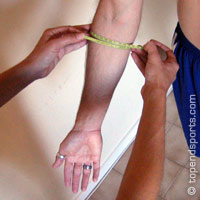
Step 4: Locate the Measurement Point - Find the largest circumference of your forearm. Move the tape up and down along the forearm to identify the point of maximum circumference, which is usually found closer to the elbow, approximately one-third of the way from the elbow toward the wrist.
Step 5: Take the Measurement - Wrap the tape measure around your forearm at the widest point. Ensure the tape is snug but not tight, lying flat on the skin without compressing the tissue. The tape should be horizontal and not angled.
Step 6: Enter Your Data - Input your forearm measurement in the calculator above. For additional analysis, enter your wrist circumference to calculate your Grecian Ideal ratio and select your gender and activity level for accurate population comparisons.
Pro Tip: For reliable tracking over time, take measurements at the same time of day, preferably in the morning before training. Take 2-3 measurements and use the average for best accuracy.
What is Forearm Girth and Why Measure It?
Forearm girth refers to the circumference measurement of your forearm at its widest point, typically measured with a flexible tape measure. This anthropometric measurement provides valuable data about the underlying musculature and adipose tissue distribution in the lower arm.
Purpose of Forearm Girth Measurement: The primary purpose is to assess the circumference of the forearm as a measure of the underlying musculature and adipose tissue. When combined with skinfold measurements, girth measurements provide a clearer picture of changes in tissue composition and distribution of muscle and fat.
Why Athletes Should Track Forearm Measurements
Grip Strength Indicator
Research shows a strong correlation (r = 0.64-0.77) between forearm circumference and grip strength. Larger forearms typically indicate greater grip capacity.
Training Progress
Tracking forearm girth over time helps athletes monitor hypertrophy from grip and forearm training programs, with measurable changes possible within 8-12 weeks.
Sport Performance
Forearm development is critical in climbing, wrestling, judo, baseball, tennis, and weightlifting. Optimal forearm size varies by sport and position.
Average Forearm Circumference by Population
Based on data from the U.S. Army Anthropometric Survey (ANSUR) and sports science research, here are the reference ranges for forearm circumference:
| Population | Male (cm) | Male (inches) | Female (cm) | Female (inches) |
|---|---|---|---|---|
| General Population | 26-30 | 10.2-11.8 | 22-26 | 8.7-10.2 |
| Recreational Athletes | 29-33 | 11.4-13.0 | 25-28 | 9.8-11.0 |
| Competitive Athletes | 32-36 | 12.6-14.2 | 27-30 | 10.6-11.8 |
| Elite Grip Athletes | 35+ | 13.8+ | 29+ | 11.4+ |
These ranges represent typical values; individual variation depends on genetics, training history, body composition, and overall body size. Taller individuals with larger frames naturally have bigger forearms.
The Science Behind Forearm Measurements
Forearm Anatomy and Muscle Groups
The forearm consists of two long bones (radius and ulna) connected by an interosseous membrane, with muscles divided into two compartments:
Anterior Compartment (Flexors): Three layers of muscles responsible for wrist flexion, finger flexion, and forearm pronation. These muscles create the bulk of the forearm when well-developed.
Posterior Compartment (Extensors): Muscles responsible for wrist extension, finger extension, and forearm supination. Development here contributes to forearm width and grip endurance.
Correlation with Grip Strength
Research from the Journal of Physical Therapy Science and multiple anthropometric studies confirms that forearm circumference significantly predicts grip strength. According to research compiled by Robert J. Wood, PhD in Exercise Physiology from the University of Western Australia and founder of Topend Sports, hand length, age, and forearm girth circumference together predict approximately 44% of hand grip strength variation.
A study on elite Indian athletes found forearm circumference showed strong positive correlations with handgrip strength (r = 0.641 for right hand, r = 0.666 for left hand), making it a useful proxy measurement for grip capability assessment.
The Grecian Ideal Formula
The Grecian Ideal, developed by bodybuilding pioneer Eugen Sandow in the late 19th century, provides proportional targets based on fixed skeletal measurements:
Ideal Forearm = Wrist Circumference × 1.88
This formula was derived from Sandow's measurements of classical Greek and Roman sculptures, which were celebrated for their portrayal of the ideal male physique. Legendary bodybuilders like Steve Reeves, Frank Zane, and Arnold Schwarzenegger used these proportions as targets.
For example, with a 17 cm (6.7 inch) wrist, the Grecian Ideal forearm would be approximately 32 cm (12.6 inches).
Sport-Specific Forearm Requirements
Grip-Intensive Sports
Rock Climbing: Research shows higher climbing skills are associated with larger forearm girth. Climbers benefit from high forearm-to-body-weight ratios rather than absolute size, with elite climbers showing significantly greater forearm circumference compared to non-climbing athletes.
Wrestling and Judo: Grip fighting is fundamental to these sports. Studies report that elite judo athletes require well-developed forearms (32-36 cm in males) for effective grip fighting. Bilateral differences greater than 2 cm may lead to decreased grip strength in the weaker hand.
Weightlifting and Powerlifting: Sufficient forearm development is necessary to maintain grip during heavy deadlifts, rows, and pulling movements. Grip often becomes the limiting factor before target muscles fatigue.
Racquet and Ball Sports
Tennis and Badminton: Forearm strength contributes to racquet control, serve velocity, and injury prevention. Research on badminton players found correlations between forearm circumference and grip strength essential for performance.
Baseball: Pitchers generate velocity and control through forearm strength and endurance. Position players benefit from grip strength for batting and catching.
Team Sports
Basketball: Research on junior basketball players indicates forearm fatigue affects grip strength and passing accuracy. Well-developed forearms help maintain ball control during competition.
Football: Linemen and receivers benefit from grip strength for blocking and catching, with forearm development supporting these demands.
How to Improve Your Forearm Size
Research confirms that consistent grip training can increase forearm circumference measurably within 8-12 weeks. Here are evidence-based approaches:
Effective Forearm Exercises
Wrist Curls (Flexors): Perform with palms up, curling a barbell or dumbbells through full range of motion. Target 3-4 sets of 12-15 reps.
Reverse Wrist Curls (Extensors): Perform with palms down to balance forearm development. Use lighter weight than standard wrist curls.
Hammer Curls: Neutral grip position targets the brachioradialis, adding overall forearm thickness.
Farmer's Carries: Hold heavy dumbbells or kettlebells and walk for distance or time. Develops raw grip strength and forearm endurance.
Dead Hangs: Hang from a pull-up bar for time to stretch and strengthen forearm muscles under load.
Gripper Training: Progressive resistance grip trainers allow systematic overload for forearm hypertrophy.
Training Recommendations
For forearm development, train 3-4 times per week with progressive overload. Forearms recover relatively quickly due to their daily use, allowing higher training frequency than other muscle groups.
Measurement Reliability and Considerations
Reliability Factors: Factors that may affect reliability include changes to the testing personnel, constant and even tension on the tape, and correct landmarking (finding the correct anatomical site for measurement).
Advantages: This test requires low costs and minimal equipment, making it accessible for regular monitoring.
Comments: Remove clothing from the site to ensure the measuring tape is positioned correctly and that the correct circumference is determined. For longitudinal tracking, standardize the time of day and conditions of measurement.
Asymmetry Considerations: Some asymmetry between dominant and non-dominant forearms is normal, typically 0.5-2 cm difference. The dominant forearm is usually larger due to preferential use. Differences greater than 2 cm may warrant attention to balanced training.
Frequently Asked Questions
What is a good forearm circumference for men?
The average male forearm circumference is 28-30 cm (11-12 inches) in the general population. Athletic males typically measure 31-34 cm (12.2-13.4 inches), while elite grip athletes may exceed 35 cm (13.8 inches). Your ideal measurement depends on your wrist size and overall frame.
How accurate is this forearm girth calculator?
The percentile rankings are based on large-scale research data including the U.S. Army Anthropometric Survey. Accuracy depends on correct measurement technique. For best results, take 2-3 measurements and average them, measure at the same time of day, and ensure consistent tape tension.
Does forearm size affect grip strength?
Yes, research shows a strong positive correlation between forearm circumference and grip strength. Studies report correlation coefficients of 0.64-0.77, meaning larger forearms generally indicate greater grip capacity. However, muscle quality and neural factors also contribute to strength.
Should I measure flexed or relaxed forearm?
Standard anthropometric protocol measures the forearm in a relaxed state with the palm facing upward. While flexed measurements may show larger values, relaxed measurements provide more consistent and reproducible data for tracking progress over time.
How long does it take to increase forearm size?
Research indicates measurable increases in forearm circumference within 8-12 weeks of consistent, progressive training. Gains of 0.5-1 cm are realistic in this timeframe for beginners. Genetics, training intensity, and nutrition all influence the rate of hypertrophy.
Why is one forearm bigger than the other?
Asymmetry of 0.5-2 cm between dominant and non-dominant forearms is normal. This occurs due to preferential use in daily activities and sports. If the difference exceeds 2 cm, consider incorporating unilateral training to address imbalances.
What is the ideal forearm to wrist ratio?
The Grecian Ideal suggests forearm circumference should be approximately 1.88 times wrist circumference for aesthetically proportioned development. This ratio, derived from classical sculpture measurements, has been used as a target by bodybuilders for over a century.
⚠️ Disclaimer: This calculator provides estimates for educational and athletic training purposes only. Results are based on population data and may not reflect individual circumstances. Always consult with a qualified fitness professional or healthcare provider before making training decisions based on these calculations.
References
- Gordon, C.C., et al. (2012). "2012 Anthropometric Survey of U.S. Army Personnel: Methods and Summary Statistics." U.S. Army Natick Soldier Research.
- Abe, T., et al. (2016). "Forearm muscle quality as a better indicator of physical performance than handgrip strength in older male ground golf players." Journal of Musculoskeletal and Neuronal Interactions, 16(4):296-301.
- Visnapuu, M. & Jürimäe, T. (2007). "Handgrip strength and hand dimensions in young handball and basketball players." Journal of Strength and Conditioning Research, 21(3):923-929.
- Bohannon, R.W. (2015). "Grip Strength: An Indispensable Biomarker For Older Adults." Clinical Interventions in Aging, 10:1681-1693.
- Leong, D.P., et al. (2015). "Prognostic value of grip strength: findings from the Prospective Urban Rural Epidemiology (PURE) study." The Lancet, 386(9990):266-273.
- Norton, K. & Olds, T. (2017). "Anthropometrica: A textbook of body measurement for sports and health courses." UNSW Press.
- McCallum, J. (1968). "Keys to Progress." Ironman Magazine. John McCallum's formula for ideal body proportions.
- Fry, A.C. & Kraemer, W.J. (1997). "Resistance Exercise Overtraining and Overreaching." Sports Medicine, 23(2):106-129.
Similar Tests
Related Pages
Girth Measurements
Complete guide to taking circumference measurements at various body sites.
Learn More → Any comments, suggestions, or corrections? Please let us know.