500m Rowing Ergo Test Calculator
Quick Answer
This calculator analyzes your 500m rowing ergometer test performance, providing instant ratings based on eTID protocol standards. The 500m ergo test measures total body anaerobic power and is designed to exhaust all anaerobic energy pathways.
- Uses standardized eTID protocol drag factors (90 female, 100 male)
- Calculates power output, speed, and percentile ranking
- Provides sport-specific performance categories for rowers
This is a fitness test specific for rowers. The 500m Rowing Ergo Test is part of the eTID Talent Identification Testing Program for rowing, and their protocol is listed here. There is also a 5000m and 2000m ergo test.
Test Purpose
The aim of this test is to measure total body anaerobic power. The test is designed to completely exhaust all anaerobic energy production pathways, making it an excellent assessment of short-duration, high-intensity rowing capacity.
Equipment Required
Concept IID rowing ergometer (or equivalent). A specific drag factor needs to be set (see comments below).
Pre-Test Procedures
Explain the test procedures to the subject. Perform screening of health risks and obtain informed consent. Prepare forms and record basic information such as age, height, body weight, gender and test conditions. Check and calibrate the equipment as required. Perform a standard warm-up. See more details of pre-test procedures.
Test Procedure
Ensure the correct drag factor is set correctly with the preferred display option selected on screen (see comments below). Sit ready to start the 500m test. The aim of the test is to cover the 500m in the shortest possible time, and you should be exhausted at the completion of the 500m trial. Experience has shown that better scores are achieved with an even split (same time for the first 250 as for the second 250m) rather than starting conservatively and then coming home strong, or going out too fast and not being able to complete the distance.
Scoring
Record the time taken to complete the 500m in minutes and seconds and the average stroke rate.
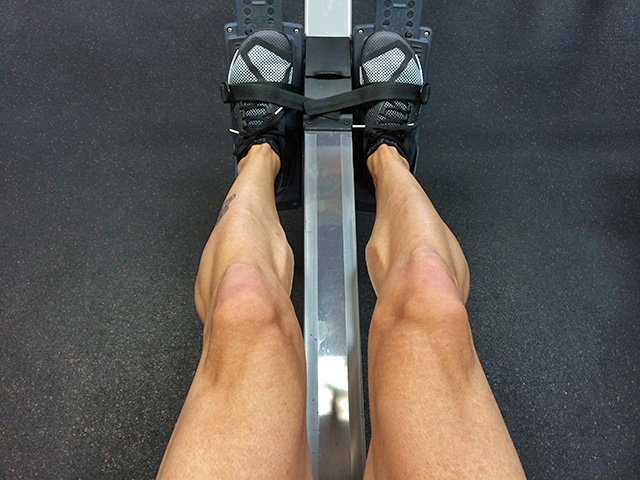
Rowing ergometer - the primary equipment for the 500m test
Target Population
This test is primarily designed for competitive rowers and athletes involved in rowing-based training. It is also used for talent identification in rowing programs and for CrossFit athletes who need to assess their anaerobic rowing capacity.
Test Comments and Considerations
- Drag factors should be set at 90 for females and 100 for males. Drag factors can be checked on the Concept IID rowing ergometer by following the menu prompts on the PM3/4 interface. The drag factor display will appear in the lower right display window. When the drag factor display is present, participants are to row lightly and adjust the damper setting to select the correct drag factor. Check with local staff to ensure the drag factor is set for the particular ergometer you are using.
- Strong verbal encouragement will help the subject achieve their maximal score.
- Ensure adequate warm-up of 5-10 minutes at low intensity before attempting the test.
- Allow full recovery (at least 48 hours) between maximal test attempts.
Understanding Your 500m Rowing Test Results
Your 500m rowing time is influenced by several factors including technique, power output, stroke efficiency, and anaerobic capacity. The calculator above provides multiple metrics to help you understand your performance:
Power Output (Watts): Calculated using the standard Concept 2 formula, this represents the average power you sustained throughout the test. Higher power output generally correlates with faster times.
Percentile Ranking: This shows where your performance falls compared to other athletes of the same gender. A 75th percentile means you performed better than 75% of comparable athletes.
Performance Category: Based on eTID and competitive rowing standards, your time is classified into categories ranging from Elite to Beginner, helping you understand your current fitness level relative to rowing-specific benchmarks.
Improving Your 500m Rowing Time
To improve your 500m ergo time, focus on these key areas:
- Anaerobic Interval Training: Perform 250m repeats at race pace with 2-3 minutes recovery
- Power Development: Include strength training for legs, core, and pulling muscles
- Technique Refinement: Work on catch timing, drive sequence, and recovery efficiency
- Pacing Strategy: Practice maintaining even splits (same time for first and second 250m)
- Stroke Rate Management: Find your optimal stroke rate for sustainable power output
The Test in Action
- This test is part of the eTID Talent Identification Testing Program for rowing.
Frequently Asked Questions
What is a good 500m rowing time?
A good 500m rowing time varies by gender and training level. For trained male rowers, sub-1:25 is excellent, while sub-1:35 is good. For female rowers, sub-1:35 is excellent and sub-1:50 is good. Elite competitive rowers can achieve times under 1:15 (male) and 1:25 (female).
What does the 500m rowing test measure?
The 500m rowing ergometer test measures total body anaerobic power. The test is designed to exhaust all anaerobic energy production pathways and is specific to rowing performance assessment. It primarily tests your phosphagen and glycolytic energy systems.
What drag factor should I use for the 500m rowing test?
According to the eTID protocol, drag factors should be set at 90 for females and 100 for males on the Concept II rowing ergometer. The drag factor can be adjusted using the damper setting while checking the PM3/4 interface display.
How do I pace my 500m rowing test?
Research shows better scores are achieved with even pacing — aim for the same time in the first 250m as the second 250m. Starting conservatively or going out too fast typically results in slower overall times than maintaining consistent effort throughout.
How often should I test my 500m rowing time?
For training monitoring, test every 4-6 weeks during the training phase. Allow adequate recovery (at least 48 hours) before testing. Avoid testing during periods of high training load or when fatigued to get accurate performance measurements.
How does the 500m test compare to the 2000m test?
The 500m test primarily measures anaerobic power (lasting 60-120 seconds), while the 2000m test (6-8 minutes) assesses aerobic capacity with anaerobic contribution. The 500m is better for assessing sprint capability, while the 2000m is the standard race distance and measures overall rowing fitness.
Can I use this test for CrossFit training?
Yes, the 500m rowing test is commonly used in CrossFit to benchmark anaerobic rowing capacity. Many CrossFit workouts include 500m rowing efforts, making this test highly relevant for tracking fitness improvements and predicting workout performance.
References
- Concept2. (2024). "Indoor Rower Training Guide." Concept2 Inc., Morrisville, VT.
- Lawton, T.W., Cronin, J.B., & McGuigan, M.R. (2011). "Strength Testing and Training of Rowers: A Review." Sports Medicine, 41(5), 413-432.
- Australian Institute of Sport. (2022). "Physiological Tests for Elite Athletes." Human Kinetics.
- Smith, T.B., & Hopkins, W.G. (2012). "Variability and Predictability of Finals Times of Elite Rowers." Medicine & Science in Sports & Exercise, 44(11), 2029-2036.
- Riechman, S.E., Zoeller, R.F., Balasekaran, G., Goss, F.L., & Robertson, R.J. (2002). "Prediction of 2000m Indoor Rowing Performance Using 30s Wingate Test Parameters." Journal of Sports Sciences, 20(9), 681-687.
- Rowing Australia. (2023). "eTID Talent Identification Testing Protocol." Rowing Australia Ltd.
- Ingham, S.A., Whyte, G.P., Jones, K., & Nevill, A.M. (2002). "Determinants of 2,000m Rowing Ergometer Performance in Elite Rowers." European Journal of Applied Physiology, 88(3), 243-246.
Similar Tests
- 2000m (2km) rowing ergometer test — aim to cover the 2km in the shortest possible time.
- 5km Rowing Ergometer Test — aim to cover the 5000m in the shortest possible time.
- Rowing Beep Test — incremental test performed on a rowing ergometer
Related Pages
- Fitness testing for rowers
- Rowing Ergometers for Fitness Testing
- About the eTID Talent Identification Testing Program.
- ETID Fitness Testing for Rowing
- About the sport of rowing, which includes indoor rowing competitions
- See the list of anaerobic capacity tests
 Any comments, suggestions, or corrections? Please let us know.